Ten States Could Catch the Aurora Tonight in the Wake of Saturday's Rare G3 Storm
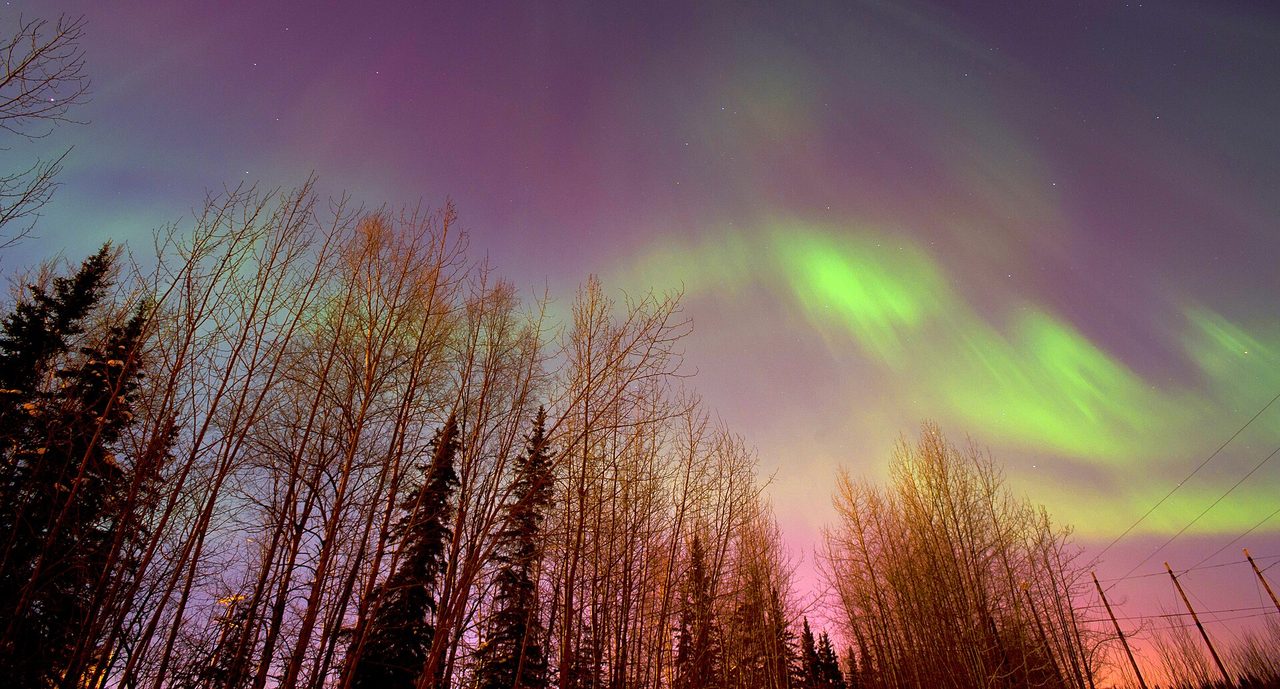
Photo: Justin Connaher / Public domain · via Wikimedia Commons
Ten States Could Catch the Aurora Tonight in the Wake of Saturday's Rare G3 Storm
Ten states sit inside tonight's window
NOAA's latest forecast puts the aurora over ten northern states on Monday night: northern Washington, northern Idaho, most of Montana, essentially all of North Dakota, much of Minnesota, northern Wisconsin and Michigan's Upper Peninsula, plus the far northern stretches of South Dakota and Wyoming. Alaska, as usual, carries a "high" likelihood across most of the state.
A Kp of five, but no storm is declared
Forecasters put the planetary Kp index at five out of nine for Monday night, enough for the lights to look brighter and more active than usual and to reach somewhat farther south. NOAA's three-day discussion stops short of calling a geomagnetic storm for Monday itself; the only storm-level activity it flags is mild G1 conditions early on Tuesday morning.
Saturday's G3 storm is the source of the glow
Monday's display is the tail of a much bigger event. A coronal mass ejection struck Earth's magnetic field on October 10, and geomagnetic conditions climbed to G3 — "Strong" — from about 17:58 UTC. G3 sits four steps up NOAA's five-level scale and is genuinely rare. Forbes reported that the night produced G4-class displays forecasters had not expected, seen on the northern horizon from Germany, France, the U.K. and Scandinavia as well as from northern U.S. states and Canada.
Three eruptions in three days set it up
The chain starts on October 6, when sunspot region AR4549 unleashed an M1.4-class flare that launched an almost full-halo coronal mass ejection clocked at roughly 560 km/s, followed hours later by an M1.8 flare from the same region. An M6.7 flare followed on October 8. The eruptions left the Sun on October 7 and 8 and reached Earth around October 10. NOAA forecast G1 to G2 storming for October 11–12; the U.K. Met Office called G1 (Kp5) likely, G2 (Kp6) possible, and an isolated G3 (Kp7) a slight chance.
Your zip code decides your odds
Over the weekend, outlets mapped out as many as 28 states across the storm tiers. G1 covers Alaska and 11 northern-tier states — Washington, Idaho, Montana, North Dakota, South Dakota, Minnesota, Wisconsin, Michigan, Maine, Vermont and New Hampshire. G2 pushes the auroral oval into Oregon, Wyoming, Nebraska, Iowa, Illinois, Indiana, Ohio, Colorado, Pennsylvania and New York. A less likely G3 would reach Kansas, Missouri, Kentucky, West Virginia, Virginia and Maryland. With activity easing on Monday, the focus returns to the Canadian border states.
The 10 p.m. to 2 a.m. rule still holds
NOAA's viewing window is 10 p.m. to 2 a.m. local time, when the aurora is typically most active. Go as far north and as far from city light as you can, pick a high spot with an unobstructed northern sky, and give your eyes at least 20 minutes to adjust. If all you see is a pale gray arc, point a phone north in night mode — cameras pick up green and magenta tones the eye misses. The new moon on October 10 keeps moonlight out of the way.
A faint encore before it fades
Beyond Monday, NOAA's three-day forecast shows only a mild G1 spike early Tuesday morning, after which activity is expected to contract sharply, leaving a low likelihood over mainland Canada and part of Alaska. Visibility still hinges on cloud cover, light pollution and the orientation of the interplanetary magnetic field.
The real stakes are grids and satellites
For most people the storm is a photo opportunity, but operators watch a different list of impacts. At G2, high-latitude power systems see voltage alarms, satellite operators adjust orientation and refresh orbital-decay predictions, and high-frequency radio fades at high latitudes. G3 adds voltage corrections, spacecraft surface charging and degraded GPS. In February 2022, a comparatively mild storm left about 38 of 49 freshly launched Starlink satellites to re-enter before they could climb to a safe orbit. No grid advisory has been issued for Monday night.
Sources
- Yahoo Travel: Northern Lights Forecast: Aurora Could Be Visible From These 10 States Monday
- Forbes: Northern Lights Could Return Sunday To 28 States After Epic Displays
- Geo.tv: Geomagnetic storm Aurora visibility Northern US: Forecast, states, viewing tips
- Rustourism News: Northern Lights Alert After Strong Geomagnetic Storm
- People: How to Watch the Northern Lights from 28 States This Weekend