Hera Reaches the Crime Scene: Europe's Probe Goes to Weigh What NASA Hit
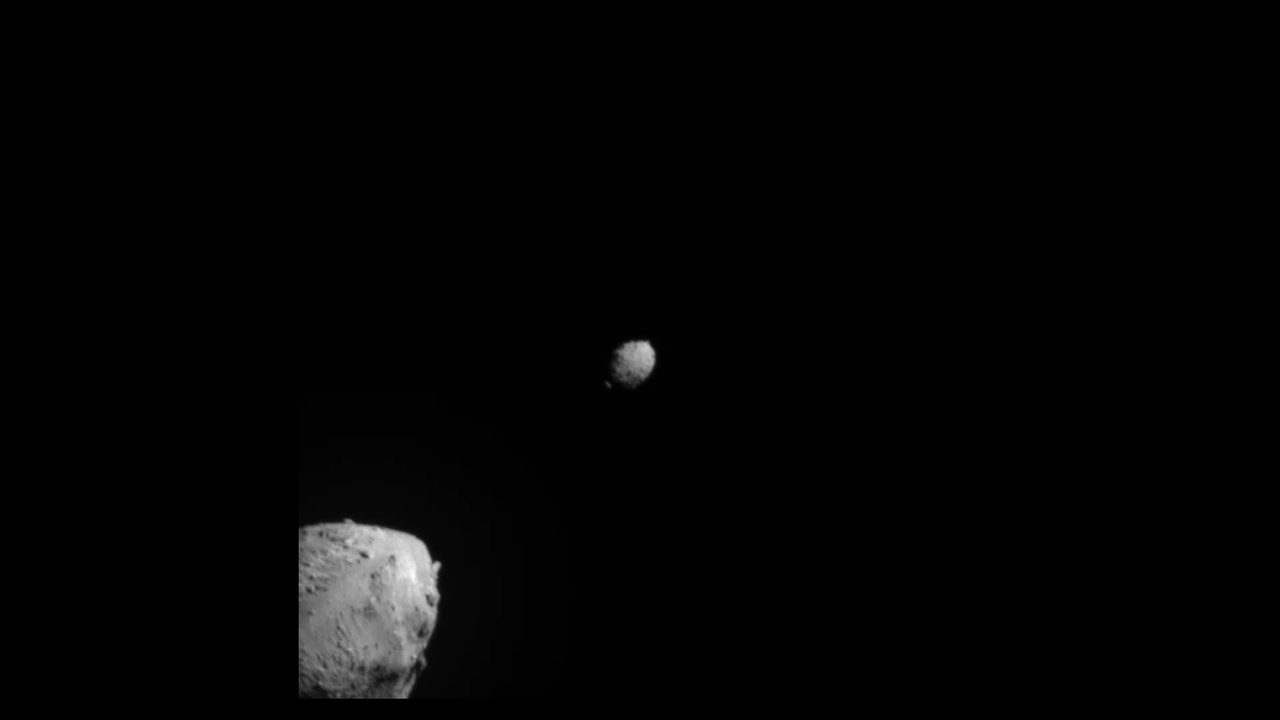
Photo: NASA/Johns Hopkins APL / Public domain · via Wikimedia Commons
Hera Reaches the Crime Scene: Europe's Probe Goes to Weigh What NASA Hit
Hera arrives at Didymos this month
The European Space Agency's Hera spacecraft is closing on the binary asteroid 65803 Didymos and its moon Dimorphos — the rock NASA's DART spacecraft struck on 26 September 2022 in the first live test of planetary defence. Hera is not there to admire the work. It is there to measure it.
Three burns brake a 12 km/s approach
Hera launched on 7 October 2024 on a Falcon 9 from Cape Canaveral, lifting off just ahead of Hurricane Milton. The 1,128-kilogram spacecraft has spent two years coasting and is still moving more than 12 kilometres per second relative to Earth. On 15 October it fires its thrusters for 93 minutes; a second burn follows on 22 October, then three smaller trims, shaving off several hundred metres per second. Flight dynamics teams at ESA's operations centre in Darmstadt, more than 50 mathematicians, physicists and engineers with roughly 10 on shift at a time, are running the sequence.
November: 30 kilometres out, then one
By early November the probe should be within 30 kilometres of the two bodies, beginning early science; by December it moves to 10 kilometres, 4 kilometres, and finally 1 kilometre. ESA said in October 2025 that arrival would come a month earlier than originally planned. About six months of close survey follows.
A 160-metre rubble pile beside a 780-metre rock
Didymos is roughly 780 metres across; Dimorphos is about 160 metres, with estimates ranging from 151 to 177 metres, and a mass near 5 billion kilograms — about the scale of the Great Pyramid. Both are loose rubble piles. Before impact, Dimorphos circled Didymos every 11 hours and 55 minutes at a distance of about 1.1 kilometres. This is the first binary asteroid ever studied up close.
DART beat its own success threshold 25-fold
The impact shortened Dimorphos's orbit by about 33 minutes, against a pre-defined success threshold of 73 seconds; NASA's Jet Propulsion Laboratory later reported 33 minutes 15 seconds. The orbital velocity changed by just 2.7 millimetres per second. Ejecta flying off the surface acted as an afterburner, pushing the momentum enhancement factor, beta, to about 3.6 instead of 1. DART displaced more than a million kilograms of material, and the debris tail stretched at least 30,000 kilometres.
ESA calls it a crime scene investigation
Patrick Michel of France's CNRS, the mission's principal investigator, puts it plainly: "Hera wants to be the detective, like Inspector Colombo, going back to the crash scene." Angela Stickle of Johns Hopkins University's Applied Physics Laboratory, who worked on both missions, says a lot of material was kicked up and "we probably left a pretty significant mark on Dimorphos." Mission manager Ian Carnelli frames the goal as turning kinetic impact from an experiment into a reliable, repeatable technique.
Nobody knows how big the crater is
Four years on, the crater's size is still unknown, as is whether the impact rearranged the moon's boulders. There are hints Dimorphos is tumbling, and that material may have moved between it and Didymos. Hera will map the whole moon at a few metres' resolution and the impact zone at 10 centimetres, while radio science weighs the moon precisely — which is how beta finally gets pinned down.
Two CubeSats will look inside an asteroid
In January 2027, Hera releases two hitchhiking CubeSats. Milani, built with Italian, Czech and Finnish contributions, studies surface composition and dust around both bodies. Juventas, from GomSpace and GMV, carries JuRa, a 60-megahertz radar able to see 100 metres or more below the surface — the first direct look at an asteroid's interior. Both are due to operate from late January to late March 2027 and will attempt landings at the end.
The punch also nudged a solar orbit
New work shows the effect reached beyond the pair. Ejecta carried momentum away from the system, shifting its 770-day orbit around the Sun by about 0.15 seconds — a velocity change of some 11.7 microns per second. It is the first time humans have measurably altered a celestial body's path around the Sun, and a reminder that microns per second compound into hit or miss.
Next: mass, landings and a software sandbox
Hera's primary mission ends around mid-2027. ESA then plans to let European teams test autonomy software aboard the spacecraft, 150 million kilometres from Earth, with half of its dual-core processor held back as a sandbox. DART cost $325 million. Asteroid 2024 YR4 briefly hit level 3 on the Torino scale in January 2025, with about a 1% chance of striking Earth in December 2032, before observations cleared it; NASA's NEO Surveyor telescope is in development. Hera's job is to convert one spectacular crash into numbers a planetary defence manual can use.
Sources
- Space.com: Four years ago, NASA punched an asteroid. Europe Hera probe arrives this month
- heise online: ESA probe Hera to arrive at Didymos
- EarthSky: Hera mission hits the brakes to arrive at asteroid
- ESA: Destination sighted: Hera first glimpse of Didymos
- Universe Today: ESA Hera Mission Targets Binary Asteroid Pair in November