Sickle Cell Gene Therapy Works. Getting It Is the Hard Part
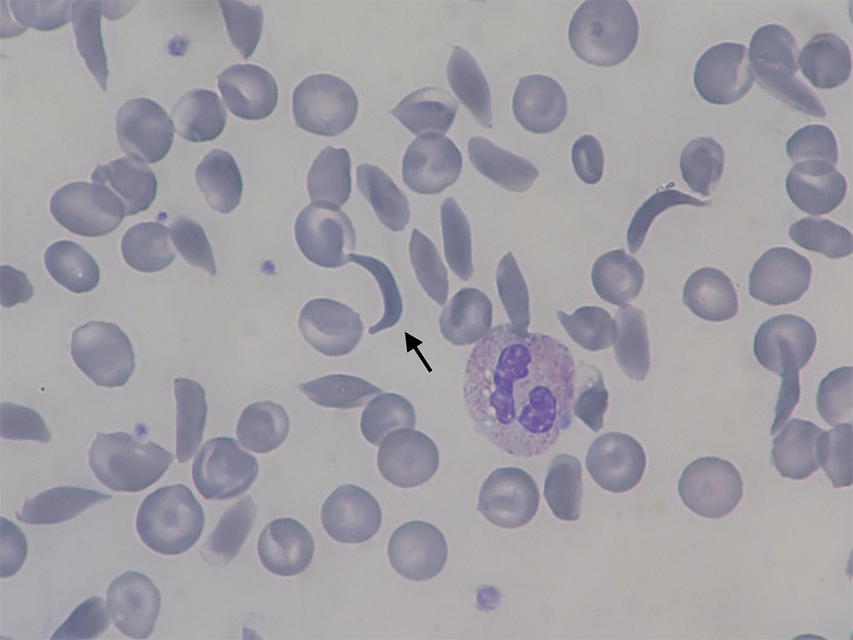
Photo: Paulo Henrique Orlandi Mourao / CC BY-SA 4.0 · via Wikimedia Commons
Sickle Cell Gene Therapy Works. Getting It Is the Hard Part
Editing a patient's own stem cells
Sickle cell disease comes from a single mutation in the beta-globin gene: red blood cells stiffen into crescents, jam blood vessels and trigger pain crises that last hours to weeks, along with stroke and organ damage. About 100,000 people in the United States have the disease, and more than 90% of them are Black. On Dec. 8, 2023, the FDA approved Casgevy and Lyfgenia for severe cases — the first treatments aimed at the root cause. Casgevy uses CRISPR to edit a patient's own blood stem cells, switching off BCL11A, the gene that silences fetal hemoglobin; Lyfgenia uses a lentiviral vector to deliver a modified hemoglobin gene. Both require cell collection, lab modification, myeloablative chemotherapy and reinfusion. Patients become their own donors.
Only a few hundred patients treated
Uptake has been painfully slow. Two years after approval, roughly 165 patients had received the two therapies combined in 2025, including Casgevy's beta-thalassemia indication, MedPage Today reported. Vertex's 2025 annual filing put it at about 300 people who started Casgevy treatment globally, 147 who completed a first cell collection and just 64 who received an infusion. Lyfgenia's developer reported 115 U.S. patients treated since 2023 and another 216 in preparation, according to Total News.
29 of 30 went a year without a crisis
The results themselves are strong. In the pivotal Casgevy trial, 44 patients were infused with a median follow-up of 19.3 months; of 30 evaluable patients, 29 — about 97% — had no severe vaso-occlusive crises for at least 12 consecutive months, after averaging about 3.9 crises a year. The U.S. label cites a 93.5% response rate in 31 patients. Clinicians still call it life-changing for a subset of patients, not for all of them.
A $2.2 million list price
Cost is the first wall. Casgevy's U.S. wholesale acquisition cost is $2.2 million per patient; Lyfgenia's is $3.1 million. Independent health-technology assessments put the cost-effective range for a high-income system at $1.35 million to $2.05 million — meaning both launched above it, before conditioning, hospitalization and long-term monitoring are counted.
Medicaid is paying for outcomes
The official answer is payment innovation. In 2024 CMS launched its Cell and Gene Therapy Access Model, negotiating outcome-based agreements with manufacturers on behalf of states: full payment only if the therapy works. Congressional records show 32 states, plus the District of Columbia and Puerto Rico, participating — about 84% of Medicaid beneficiaries living with sickle cell disease. Medicaid covers both therapies in participating states, MedPage Today reported, though the support services covered vary by state.
Private patients may owe $40,000
For commercially insured patients, out-of-pocket costs may reach $40,000, MedPage Today reported. Indirect costs bite too: NIH researchers estimate patients lose about $700,000 in lifetime earnings to the disease, and one study found travel, lodging and time off work weigh most heavily on patients far from a treatment center. The Patient Access Act, cited by AJMC, would let manufacturers cover travel, lodging and caregiver costs.
Just over 75 treatment centers
Geography is the second wall. The therapy requires transplant-grade facilities. As of July 1, 2026, Vertex reported more than 75 activated U.S. authorized treatment centers. CNBC quoted experts describing a mismatch between patients and providers, with some patients driving up to three hours for sickle cell expertise; MDNewsline reported that some states have no center at all and send patients across state lines.
Chemotherapy first, fertility at risk
The treatment itself is punishing. Patients may need repeated hospital apheresis collections, then myeloablative chemotherapy that can impair fertility — centers offer preservation options — with infection and bleeding risks during recovery. There are procedural exclusions, too: labels state there are no data for HIV-positive patients and that they "will not be accepted for these treatments," and payers often mirror trial criteria. As one clinician put it, the therapy is resource-heavy and not every center can offer it.
The FDA has lowered the age to two
Regulators are widening the door. Casgevy's EU authorization is conditional, for patients 12 and older with no matched donor; on July 1, 2026, the FDA extended both U.S. indications down to age 2 after a 53-day review, adding roughly 5,500 eligible U.S. patients overnight. Casgevy is now approved in 39 countries, and Germany agreed to reimburse it in May.
Where the burden is heaviest
The patients with the greatest need are not in the United States. Nigeria sees about 150,000 babies born with sickle cell disease each year, and more than a quarter of Nigerians carry the gene — over 40 million healthy carriers. Of the more than 7 million people with the disease worldwide, more than three-quarters live in sub-Saharan Africa, where up to 90% of untreated affected children die before age five. Against those budgets, $2.2 million a dose is not a price point.
India is building its own version
India's reported indigenous CRISPR candidate, BIRSA 101, is estimated at 5 million rupees — about a 97% cut from the 200 million to 250 million rupees per course charged abroad, though still far beyond most affected families. India is also a co-founder of the new global partnership.
A partnership, and a payment fight
On Sept. 23, 2026, Nigeria launched OneSCD at the 81st UN General Assembly, co-founded with India, Uganda, Jamaica and St. Kitts and Nevis, with support from St. Jude Children's Research Hospital. Nigeria's health minister said a child's chance of survival should not depend on where they are born. Back in Washington, Yale researchers have documented design and implementation gaps in the CMS model. Payment and capacity, not the science, will decide how far this cure travels.
Sources
- CNBC: Sickle cell gene therapies offer new hope, accessing them is hard
- MedPage Today: Improving Survival for Adults With Sickle Cell Disease
- Total News: Gene therapies for sickle cell disease provide new promise, but access is challenging
- Zfort: FDA Approval, Price and Access in 2026
- Alpha Briefing: The First Drug That Edits Your DNA Is Finally Selling