Earth's oldest life story is written in stone — and it's being stepped on
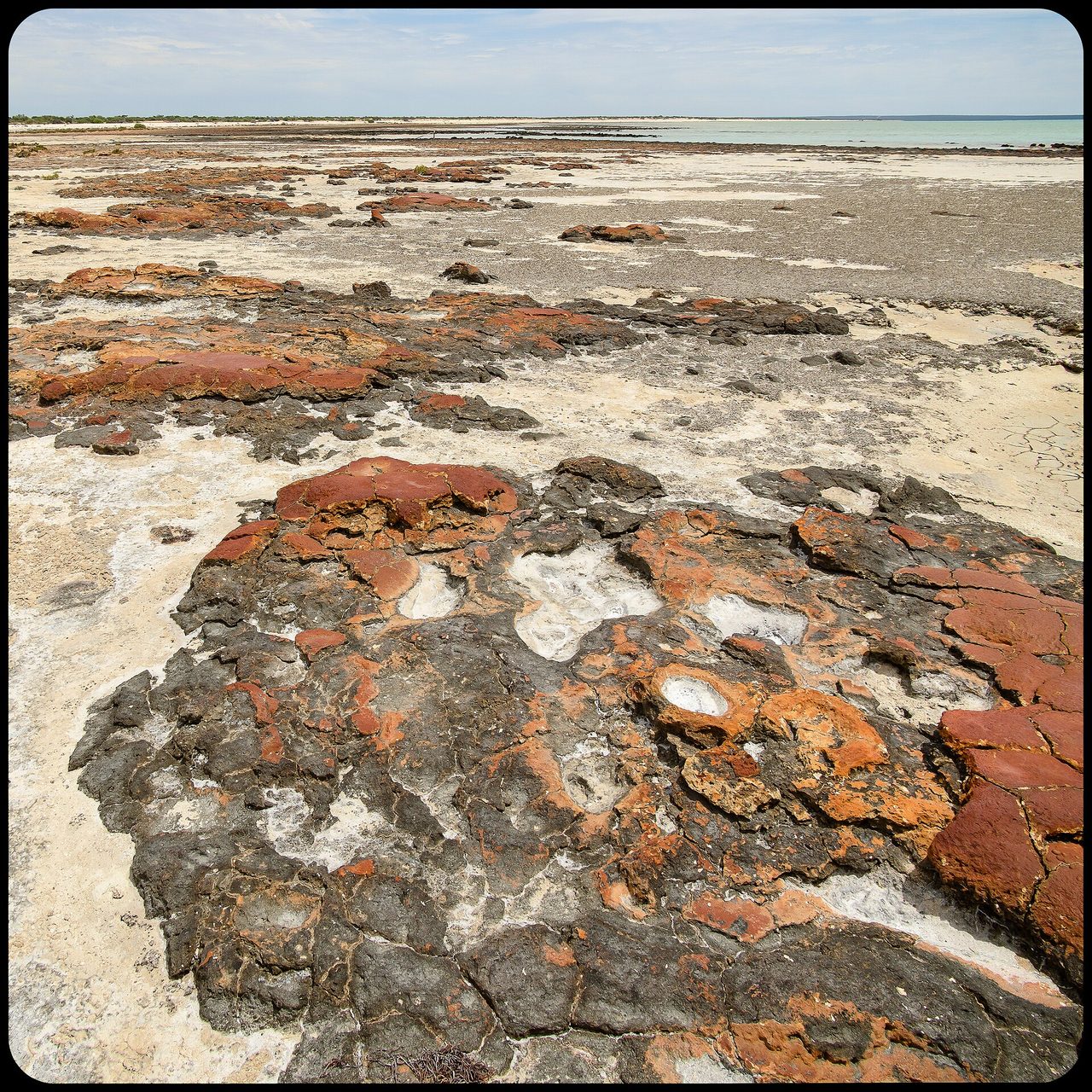
Photo: Ben Cordia / CC BY-SA 4.0 · via Wikimedia Commons
Earth's oldest life story is written in stone — and it's being stepped on
Microbialites: the first visible page of life
Long before bones or shells, life left its earliest visible marks in stone. These fossils are microbialites: structures built when microbial communities trap sediment, bind it, and precipitate minerals into layers or clotted masses. In a piece published on October 15, The Conversation sorts them into three fabrics — laminated stromatolites, clotted thrombolites, and dense, unlayered leiolites. The oldest examples are about 3.5 billion years old.
One region holds 3.5 billion years of archive
Western Australia's record is unusually complete: fossils nearly 3.5 billion years old in the Pilbara, and living microbialites inside the UNESCO World Heritage area of Shark Bay. About 750 kilometres northeast of Shark Bay, red hills that were a shallow sea some 3.4 billion years ago hold kilometres of fossil stromatolites. Geyserite in the Dresser Formation, dated to roughly 3.48 billion years, pushed the earliest evidence of life on land back by hundreds of millions of years, and the Strelley Pool Chert stromatolites are about 3.43 billion years old. The word "stromatolite" means "layered rock" in Greek.
Why Shark Bay's salt saves them
Hamelin Pool is shallow and evaporates quickly, and a sandbar restricts the flow of ocean water in, leaving the water roughly twice as saline as normal seawater. Few organisms tolerate that, which shields the microbialites from competitors and grazers. Living microbialites there have been described as a "Rosetta Stone" for reading their fossil relatives — samples collected at Shark Bay helped researchers isolate a member of the Asgard archaea, a group considered close to the ancestors of eukaryotes.
The official verdict: the outlook is poor
In the protection system, these rocks sit under "geoheritage." Australia's 2021 State of the Environment report concluded that "the overall outlook for geoheritage is poor," blaming the absence of national frameworks, focus and resourcing. Little has changed since, the article's authors write.
Fifty years of work, one review
A review of 50 years of microbialite research in Western Australia, published in the journal Alcheringa, notes that the state's record spans at least one — and possibly two — of Earth's five mass extinctions. Sudden increases in microbialites often coincided with, or slightly preceded, major ecological disruption, which makes them potential early indicators of environmental stress.
They put oxygen in the sky, then lost ground
Microbialites occupy the ancestral niche of the metabolisms that first released oxygen, pushing coastal waters and eventually the early atmosphere from a reduced to an oxidised state. Cyanobacteria may have appeared around 2.9 billion years ago and produced oxygen for hundreds of millions of years before the Great Oxidation Event of 2.4 to 2.3 billion years ago. Stromatolites thrived from roughly 2.8 billion to 1 billion years ago, then their diversity and fossil abundance plunged; living stromatolites survive today only in scattered locales.
Damage that outlasts the people who cause it
Living microbialites are highly sensitive to disturbance and grow extremely slowly: physical damage can take decades or centuries to repair, if it heals at all. Shifting water quality, climate change and rising visitation all add pressure. Fossil sites are vulnerable too — tourism, inappropriate collecting and even scientific sampling can damage or diminish them.
The incidents already on record
In May 2024, dozens of aurora chasers trampled 2,000-year-old thrombolites in a restricted area at Lake Clifton. At sites such as Lake Clifton and Shark Bay, the article says, some events may already have caused irreparable damage.
What is at stake
Detecting life in ancient rock gets harder with age: according to Carnegie Science research, rocks from the past 500 million years retain strong biotic signals, about two-thirds of samples aged 500 million to 2.5 billion years still show signatures, and just 47% of rocks older than 2.5 billion years retain detectable evidence of life. Collecting is prohibited at the roughly 3.4-billion-year-old Strelley Pool Chert in the Pilbara, and Shark Bay's living sites are fully protected — yet geoheritage remains under-resourced at both state and federal level.
What happens next
A new boardwalk is planned for Lake Clifton's ancient thrombolites, and Shark Bay World Heritage Area guides ask visitors to stay on paths and in viewing areas. Researchers argue that without a national framework and funding, such piecemeal measures will not secure a 3.5-billion-year archive.
Sources
- The Conversation: Earth oldest evidence of life is written in stone – but it is at risk of disappearing
- isacnet: Earth Oldest Evidence of Life Is Disappearing Fast (2026)
- inkl.com: Earth oldest evidence of life is written in stone (The Conversation)
- ABC News: Ancient thrombolite damage in southern WA
- RAC Horizons: A new boardwalk is on the way for Lake Clifton ancient thrombolites