The Leap Second Is Dead. Time Now Drifts by the Hour
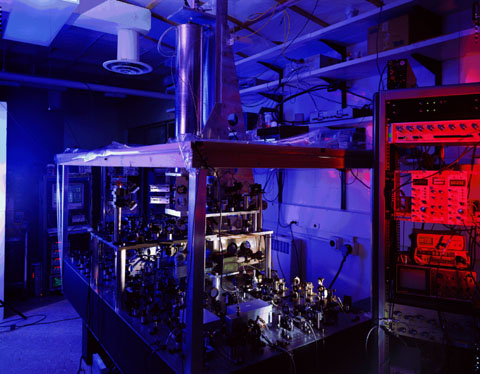
Photo: NIST / Public domain · via Wikimedia Commons
The Leap Second Is Dead. Time Now Drifts by the Hour
Versailles Retires a Half-Century Patch
Delegates from the 69 member states of the International Bureau of Weights and Measures voted on Thursday, 15 October, at the 28th General Conference on Weights and Measures in Versailles to stop inserting leap seconds into Coordinated Universal Time. The resolution passed by majority, not unanimity. "Continuous UTC" takes effect on 20 May 2027.
A Second That Kept Civil Time Honest
UTC is not one clock but a weighted average of hundreds of atomic clocks, so its second is exact. Earth's rotation is not: tides slow the planet over centuries, while winds, ocean currents, meltwater and the churn of the core make individual days longer or shorter than 86,400 seconds. Since 1972 the rule was to keep UTC within 0.9 seconds of UT1, the timescale that follows the planet, inserting a second at the end of June or December whenever the gap approached that limit — producing a minute with 61 seconds.
Twenty-Seven Seconds in Five Decades
The patch was applied 27 times between 1972 and 2016, most recently on 31 December 2016, usually at the last minute of a June or December day.
Then the Planet Began to Speed Up
Earth has been spinning faster in recent years. In 2020, 28 days came in under 86,400 seconds, and on 29 June 2022 the planet finished a rotation 1.59 milliseconds short of a standard day — the shortest on record. That raised the prospect of the first negative leap second, with clocks skipping from 23:59:58 to 00:00:00. Patrizia Tavella, who heads BIPM's time department, told Scientific American that waiting for the original 2035 deadline carried a "30 percent risk" of needing one; some published work suggests it could be required as early as 2029. Scientific American reported that engineers describe the scenario as a "mini Y2K".
The Minute That Broke Servers
The 2012 insertion knocked out services at Reddit, LinkedIn and Mozilla; 2015 and 2016 also produced failures, largely because so much software assumes every minute has 60 seconds.
Industry Had Argued for Years
Meta, Google, Microsoft and Amazon all backed abolition. "After 30 years of debates, we are ready," Noël Dimarcq, president of BIPM's Consultative Committee for Time and Frequency, said before the vote.
An Hour of Slack, Not a Second
Resolution 5 raises the permitted difference between UTC and UT1 from 0.9 seconds to 3,600 seconds — one hour. The hour is a ceiling, not a scheduled jump: no clocks will move on 20 May 2027, and the resolution sets no procedure for adding a leap hour. The date was chosen as World Metrology Day, the anniversary of the 1875 Metre Convention that created BIPM.
Navigation Was Already Outside UTC
America's GPS keeps its own continuous timescale and never inserted leap seconds; Russia's GLONASS did build them into its operations; astronomers work in UT1 and apply separate corrections. Setnam Shemar of the UK's National Physical Laboratory said UT1 will keep being monitored and its offset from UTC will keep being published through established international services.
On Your Phone, Nothing Happens
For most people 20 May 2027 will pass unmarked: phones, laptops and radio-controlled clocks need no adjustment and will not gain or lose an hour. What changes is the rule underneath — the code branches written for a 61-second minute can be retired.
The Next Adjustment Is a Millennium Away
Shemar told the Daily Mail that at least 1,000 years should pass before an hour needs adding; The Verge puts the figure at around 3,000. Whenever it comes, the world gains a 25th hour.
The Handover Has Begun
BIPM, the International Earth Rotation and Reference Systems Service and national labs such as NIST will run the transition. IERS keeps watching the planet and publishing the UT1–UTC difference; it simply stops issuing leap-second bulletins. A timetable first set for 2035 was pulled forward to 2027, because timekeepers did not want a negative leap second to arrive first.
Sources
- CNN
- Scientific American
- New Scientist
- Smithsonian Magazine
- The Verge