Kilauea Fires 720-Foot Fountains in Episode 55, Then Stops in Six Hours
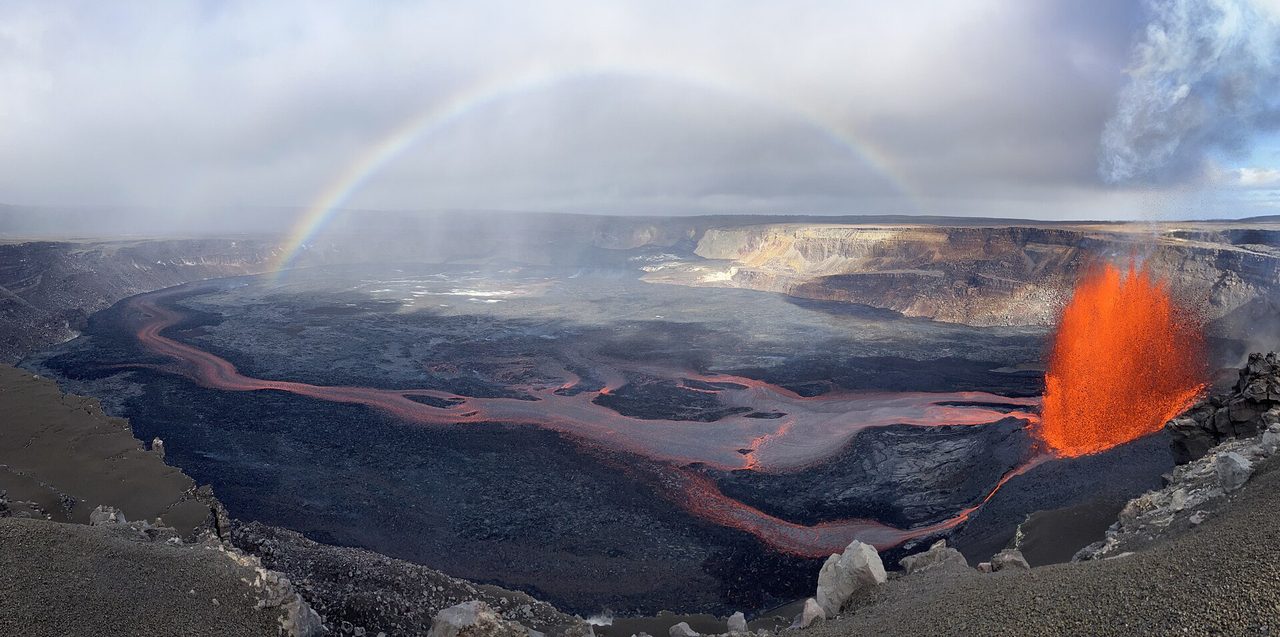
Photo: USGS/M. Zoeller / Public domain · via Wikimedia Commons
Kilauea Fires 720-Foot Fountains in Episode 55, Then Stops in Six Hours
Two months of quiet end at 3:19 a.m.
Kilauea's 55th lava-fountaining episode began at 3:19 a.m. HST on Saturday, October 17, from the north vent inside Halemaʻumaʻu crater at the volcano's summit, according to the USGS Hawaiian Volcano Observatory (Big Island Video News, Big Island Now). It broke a pause that FOX Weather called an unusually long two-month stretch. Episode 54 had ended on the evening of August 25, and in between, the vents showed only glow, steam and occasional spattering. KHON2 reported that as of October 13 it had been 49 days since a fountaining episode — the longest gap since the current eruptive cycle began on December 23, 2024.
This episode ran higher than the four before it. Scientists measured a maximum fountain height of about 720 feet (220 meters), compared with roughly 500 feet (150 meters) for episodes 51 through 54 (Big Island Video News). A USGS notice at 4:21 a.m. put the north vent fountain at about 250 feet (80 meters) high and at least as wide, feeding a broad sheet of lava onto the crater floor (FOX Weather).
All the lava stayed inside the crater
Fountaining stopped abruptly at 9:03 a.m. after about six hours of continuous activity (Big Island Video News). The observatory's preliminary estimate put the volume of lava erupted at about 9 million cubic yards (7 million cubic meters). Every vent and lava flow remained confined to Halemaʻumaʻu crater inside Hawaiʻi Volcanoes National Park (Big Island Video News, Star-Advertiser).
The plume of volcanic gas and tephra climbed to about 25,000 feet (7,000 meters) above sea level before dropping rapidly below 20,000 feet. Radar showed significant tephra in the plume only up to 8,000 feet, with winds from the north-northeast carrying gas and volcanic material toward the south-southwest (Star-Advertiser). Tephra fall was expected southwest of the vents inside the park's closed area, and traces of fine ash and Pele's hair were possible in Pāhala and other communities in Kaʻū (Big Island Video News).
Watch, then advisory: the alert level comes down
Kilauea sat at a Volcano Alert Level of WATCH with an Aviation Color Code of ORANGE during the episode. Once it ended, USGS lowered the alert level to ADVISORY and the aviation code to YELLOW (Big Island Video News, KITV). Officials warned that volcanic gas can stay hazardous downwind even after fountaining stops: sulfur dioxide reacts in the atmosphere to form vog, which can cause respiratory and other health problems, and lava in the crater and along the southwest side of the summit caldera may stay hot and creep slowly for days (KITV). The observatory and the national park stayed in contact on eruptive hazards during the episode. In its post-episode report, HVO attributed the trigger to the previous days of vigorous overflows that purged older degassed magma and let more water-rich magma into the conduit (Big Island Video News).
New magma pathways killed the forecast
Why the delay? The summit plumbing had changed. According to the observatory's Volcano Watch column, six new fissure vents opened along the western wall of Halemaʻumaʻu between September 14 and 16, after the Uēkahuna tiltmeter measured roughly 13 microradians of ground tilt — a sign of a repressurizing magma reservoir (Big Island Video News, Kauai Now). Then a shallow intrusion on September 30–October 1 cracked the caldera floor between Uēkahuna and Wahinekapu, also known as Steaming Bluff (Aloha State Daily).
Because inflation and deflation turned irregular, the observatory stopped issuing forecast windows for the next fountain in late September, saying the timing could no longer be modeled. Conditions remained favorable for another fountaining episode, but also for a change in eruptive activity or a halt, HVO said (Big Island Now, West Hawaii Today, Nature World News).
Trails shut, but the park stays open
Hawaiʻi Volcanoes National Park bore the most immediate effects. It closed the Keanakākoʻi viewing area on October 1 after the intrusion and nearly 100 small earthquakes — the strongest a magnitude 3.4 at 9:52 p.m. on September 30 — noting that the nearest parking sits about a mile from the overlooks, making a quick evacuation difficult. On October 7 the park closed Halemaʻumaʻu Trail and part of Byron Ledge Trail, a combined 1.3 miles (National Park Service, Big Island Video News). The restrictions cover specific trails and overlooks, not the park as a whole (i-journey, Beat of Hawaii), and visitors are told to stay out of closed areas and away from cliff edges that can collapse without warning.
For residents, the practical hazards are gas and particles. Between episodes, sulfur dioxide emissions from the summit typically range from 1,000 to 5,000 tonnes per day, forming vog downwind; people with asthma or heart and lung conditions, young children and older adults are most sensitive, and households on rainwater catchment should watch for falling ash (Nature World News, HVERI). The eruption also draws crowds: one report put visitation to the park at 1.8 million in 2025, and the park service has said visits surge during eruptive episodes (The Daily Beast, New York Post).
The next episode has no timetable
With the alert level and aviation code lowered, the eruption that began on December 23, 2024, continues. Historically, individual episodes last less than 12 hours and are separated by pauses of two weeks or more — but that pattern no longer holds: HVO says another fountaining episode, another intrusion, or a full stop are all possible (Nature World News, Volcano Guide). For anyone planning a Big Island trip, the park and local outlets give the same advice — check the observatory's and the park's latest notices on the day you travel.
Sources
- FOX Weather: VIDEO: Kilauea spews sheets of lava during 55th eruptive episode
- Big Island Video News: Episode 55 Ends After 6 Hours Of Lava Fountaining
- Big Island Now: Episode 55 of ongoing Kīlauea eruption lasted less than 6 hours on Saturday morning
- Star-Advertiser: Lava fountaining returns to Kilauea's Halemaumau crater
- KITV: Kīlauea's episode 55 ends after six hours of spectacular lava fountains