Japan's MMX Probe Lifts Off Tuesday to Bring Phobos Samples Home
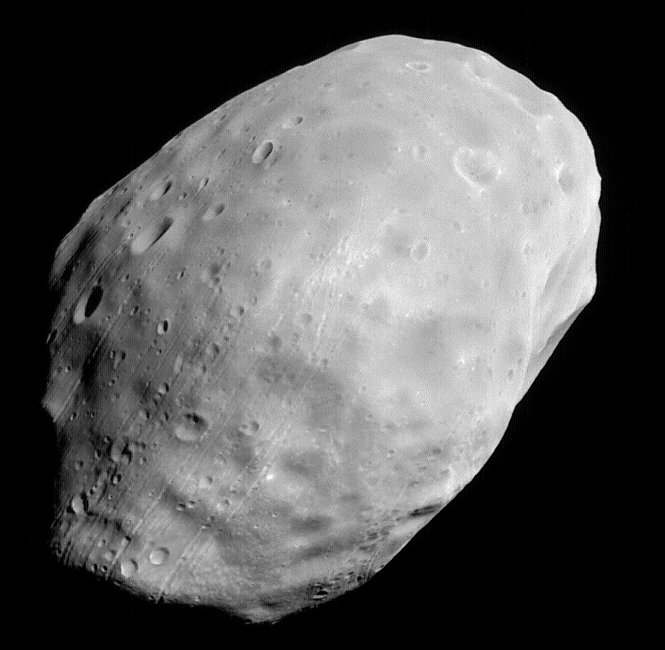
Photo: NASA/JPL/Malin Space Science Systems(public domain) · via Wikimedia Commons
Japan's MMX Probe Lifts Off Tuesday to Bring Phobos Samples Home
Japan launches its first round trip to the Martian system
The Japan Aerospace Exploration Agency (JAXA) is set to launch its Martian Moons eXploration (MMX) spacecraft early Tuesday from the Tanegashima Space Center in Kagoshima Prefecture. If it works, MMX will be the first mission ever to land on a Martian moon and bring material back from the Martian system.
Liftoff set for 4:41 a.m. Japan time
JAXA has fixed the launch for 4:41:03 a.m. JST on Oct. 20 — 3:41 p.m. EDT Oct. 19, or 19:41:03 UTC — on H3 Flight No. 10 in the H3-24L configuration, from the Yoshinobu Launch Complex. The probe reached Tanegashima on March 31, 2026. Backup opportunities open Oct. 21 and run into early November. The mission was originally meant to fly in 2024 and slipped because of H3 rocket problems.
At least 10 grams of Phobos regolith
MMX consists of three modules — propulsion, exploration and return — with a launch mass of about 4,480 kilograms. It should arrive at Mars in August 2027, fly alongside Phobos for up to three years, and take its sample no earlier than December 2028. The target is at least 10 grams (0.35 ounces) of surface material. Only the return module travels home, carrying the sample in a capsule that will parachute into Australia in 2031. It is Japan's first probe toward Mars in 28 years.
Two theories, one oddly shaped moon
Phobos, about 11 kilometres in mean radius, circles Mars at only some 6,000 kilometres from the planet's surface — closer than any other moon in the solar system. Scientists still cannot say whether Phobos and the smaller Deimos are captured asteroids or debris flung out by a giant impact on Mars. Settling that question is JAXA's first scientific goal.
The sample may hold clues to Martian water
The second goal points at Mars itself. Today the planet is cold and thin-aired, but early Mars had a thick atmosphere and liquid water on its surface. Researchers suspect some of the material Mars lost ended up on Phobos, recorded in its regolith. A tiny laser built at Fraunhofer IOF in Jena will fly on MMX to help analyse the sample's composition.
A 25-kilogram rover goes down first
Before the main spacecraft touches down, a 25-kilogram rover will drop onto the surface. Named IDEFIX, after the dog in the Asterix comics, it was built jointly by France's CNES and Germany's DLR. It is microwave-oven sized — 231 by 376 by 415 millimetres — crawls at about one millimetre per second and is designed to work for 100 days, dropping from a height of 40 to 100 metres in early 2029 to test how firm the regolith is for the lander.
Seven instruments and two 8K cameras
MMX carries seven science instruments, among them the French-built MIRS near-infrared spectrometer and the NASA-backed MEGANE gamma-ray and neutron spectrometer, plus a lidar, a dust monitor and a mass spectrometer. Two ultra-high-definition cameras developed with Japan's public broadcaster NHK will film Mars and its moons in 8K for the first time.
Four agencies and about 20 institutions
NASA, ESA, CNES and DLR all contribute, alongside about 20 universities and technology companies, and NASA is sending 10 participating scientists. JAXA calls MMX the largest international collaboration in lunar and planetary exploration that Japan has ever led. Japanese reports put the mission's cost at roughly $345 million — about the price of one large American satellite.
Phobos pitched as a stepping stone to Mars
Project manager Yasuhiro Kawakatsu has said the sampling is a world first, but the bigger point is that this is the first round trip to the Martian system. JAXA hopes to show whether Phobos could serve as a "natural space station" for crews bound for Mars, something the agency calls essential for human exploration. Unlike earlier asteroid missions, MMX must approach Mars and then escape its heavy gravity, and the landing legs had to be designed for Phobos's extremely weak pull.
Arrival in 2027, capsule recovered in 2031
The timeline runs from launch in October 2026 to arrival at Mars in August 2027, the rover landing and sampling in 2029, the return module's departure in 2030 and a parachute landing in Australia in 2031, after which the capsule is flown to Japan for analysis with laboratory instruments that cannot be sent into space.
Live coverage starts 55 minutes before liftoff
JAXA plans to stream the launch on YouTube and Niconico from about 55 minutes before liftoff until roughly 75 minutes after; the timing can shift with launch preparations.
Sources
- Japan Today: Japan to launch historic round-trip mission to Mars moon
- The Straits Times: Japan to launch historic round-trip mission to Mars moon
- The Hindu: Japan to launch spacecraft on a mission to get samples from a Martian moon
- ABC News: Japan to launch spacecraft on a mission to get samples from a Martian moon
- New Scientist: Japan is launching a mission to Mars's largest moon Phobos