Rubio Brings Business Army to Samarkand in First Central Asia Trip
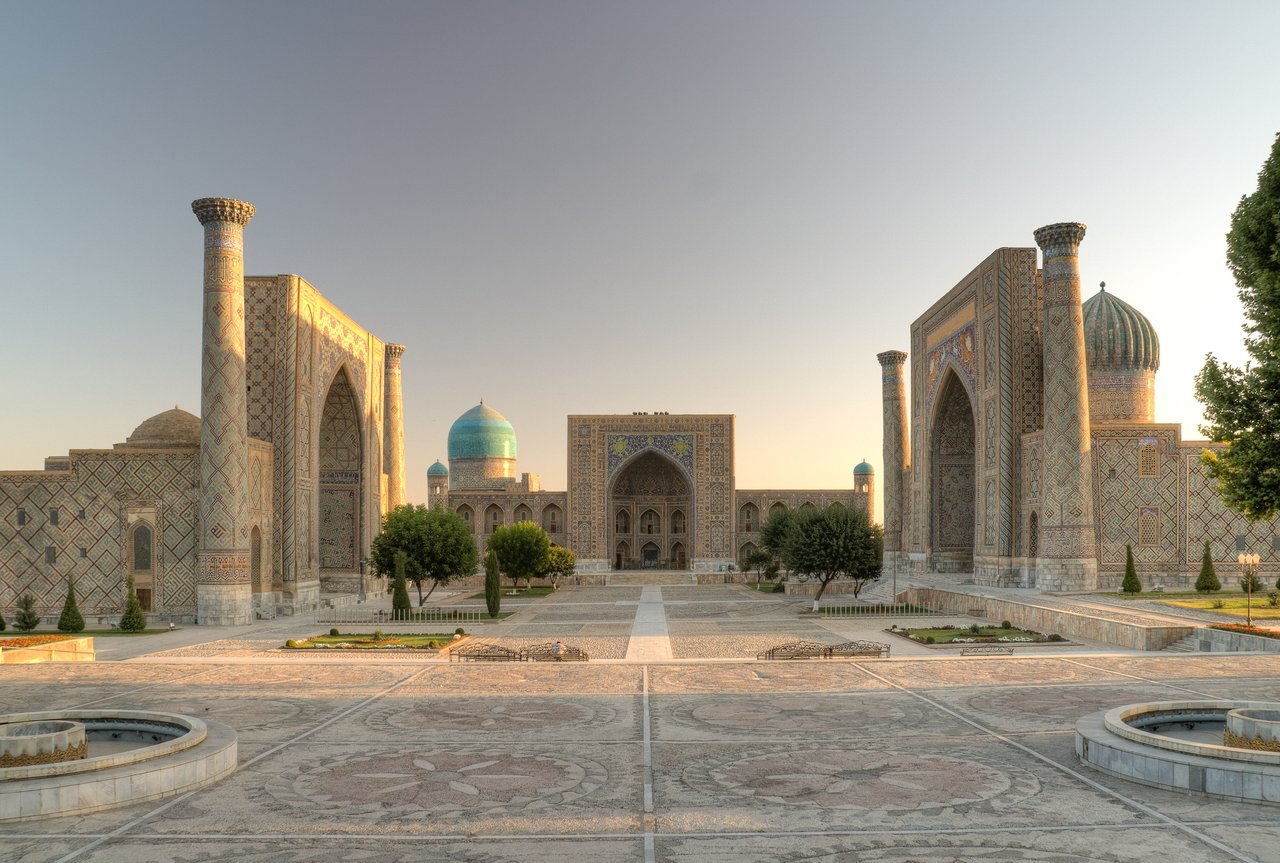
Photo: Ekrem Canli · via Wikimedia Commons
Rubio Brings Business Army to Samarkand in First Central Asia Trip
A bouquet welcome on a Sunday night
U.S. Secretary of State Marco Rubio arrived in the historic Silk Road city of Samarkand on the evening of October 18 for his first visit to Central Asia as America's top diplomat, Reuters reported. Uzbek Foreign Minister Bakhtiyor Saidov embraced him warmly on the tarmac while two women in elaborate gold-and-black traditional chopon dresses presented him with a bouquet. The stop is the first leg of an October 17-22 tour that will also take Rubio to Mumbai and Jamnagar in India, according to the State Department.
Pigeons and pop music at Registan Square
On Monday morning Rubio toured Registan Square alongside Saida Mirziyoyeva, the daughter of Uzbekistan's president and head of the presidential administration. His Uzbek hosts released hundreds of pigeons into the sky and filled the vast square with local pop music, Reuters reported. The square, a complex of three imposing azure-tiled madrassas dating to the Timurid Empire, served as the backdrop for Rubio's press remarks, in which he called the city a centuries-old crossroads of trade.
Five ministers around one table
Rubio then sat down with the foreign ministers of Uzbekistan, Kazakhstan, Kyrgyzstan, Tajikistan and Turkmenistan under the C5+1 diplomatic forum, which gathers the five Central Asian states with the United States to discuss security, trade and shared concerns. "The United States wants to be a strong partner in Central Asia," Rubio said, in remarks reported by AFP. "Central Asia has just not gotten the level of attention from our policymakers over the last 20 years that it deserves. But that's changing. That's why we're here now."
Fifty-four deals worth around $12 billion
The visit's headline deliverable was commercial. Uzbekistan's presidential press service announced 54 agreements and prospective initiatives valued at around $12 billion at the American-Uzbek Business and Investment Council session, a figure President Shavkat Mirziyoyev confirmed at his meeting with Rubio in Samarkand. Euronews reported that Mirziyoyev called for a comprehensive action plan to implement them, naming critical minerals, renewable energy, electricity storage, data centres and artificial intelligence as priority areas, and proposing a joint trade, investment and technology cooperation programme running to 2035.
Minerals at the centre of the pitch
Securing access to the region's rare earth and mineral supplies was the administration's stated emphasis, Reuters reported. The two sides signed a bilateral critical minerals memorandum, with Washington saying progress was made on uranium and other natural resources. According to the Times of Central Asia, projects involve ReElement Technologies, Traxys and Trafigura in exploration, processing technology and supplies, Wabtec in localising railway equipment production, plus satellite communications with Amazon Leo, medical technology with GE HealthCare and agricultural efficiency with Valmont Industries. The State Department said more than 200 U.S. business leaders travelled with Rubio; Rubio himself said nearly 300 American companies were represented.
Artemis Accords gain their 77th signatory
The visit also launched the first U.S.-Uzbekistan Enhanced Strategic Partnership Dialogue, covering trade, energy, technology and security. In Rubio's presence, Foreign Minister Saidov signed the Artemis Accords, the U.S.-led framework of principles for peaceful space exploration, making Uzbekistan its 77th signatory. Rubio welcomed Tashkent's interest in U.S. civil nuclear technology. The C5+1 joint statement backed expanding mineral processing and higher-value production inside Central Asia and further developing the Trans-Caspian Trade Route.
Competition named, balance kept
The geopolitical framing was explicit. The Trump administration has cast resource-rich Central Asia, wedged between Russia, Iran and China, as a battleground deserving more attention than past governments gave it. "I mean, look, it's competition," Rubio told journalists. "We have products, we have companies, they make things, and we just want fair competition and an opportunity." Uzbekistan projected balance: "Uzbekistan's been clear: they want to be friends to everybody," Rubio said, standing beside Mirziyoyeva. Trump hosted the five Central Asian leaders at the White House last November.
Next stop: India, with questions trailing
On Monday evening Rubio was due to dine with President Mirziyoyev and attend the business council event before flying to India — his second official visit there this year — for talks on the strategic partnership, regional dynamics and energy cooperation. PBS noted the trip comes as some question whether Rubio is keeping the most pressing matters at a distance; in Samarkand he fielded questions on Ukraine, saying neither side was winning the war and that Washington saw nothing good coming from it.
Sources
- Reuters: Rubio seeks to expand Central Asia ties with pomp-filled Uzbekistan visit
- US wants to be strong partner for central Asia: Rubio
- Uzbekistan 12bn business drive gathers pace during Rubio visit
- Uzbekistan Announces $12 Billion in Agreements During Marco Rubio Visit
- Secretary Rubio Travel to Samarkand, Mumbai, and Jamnagar