Huang's European Roadshow Ends in Berlin With a Call for Every Industry to Adopt AI
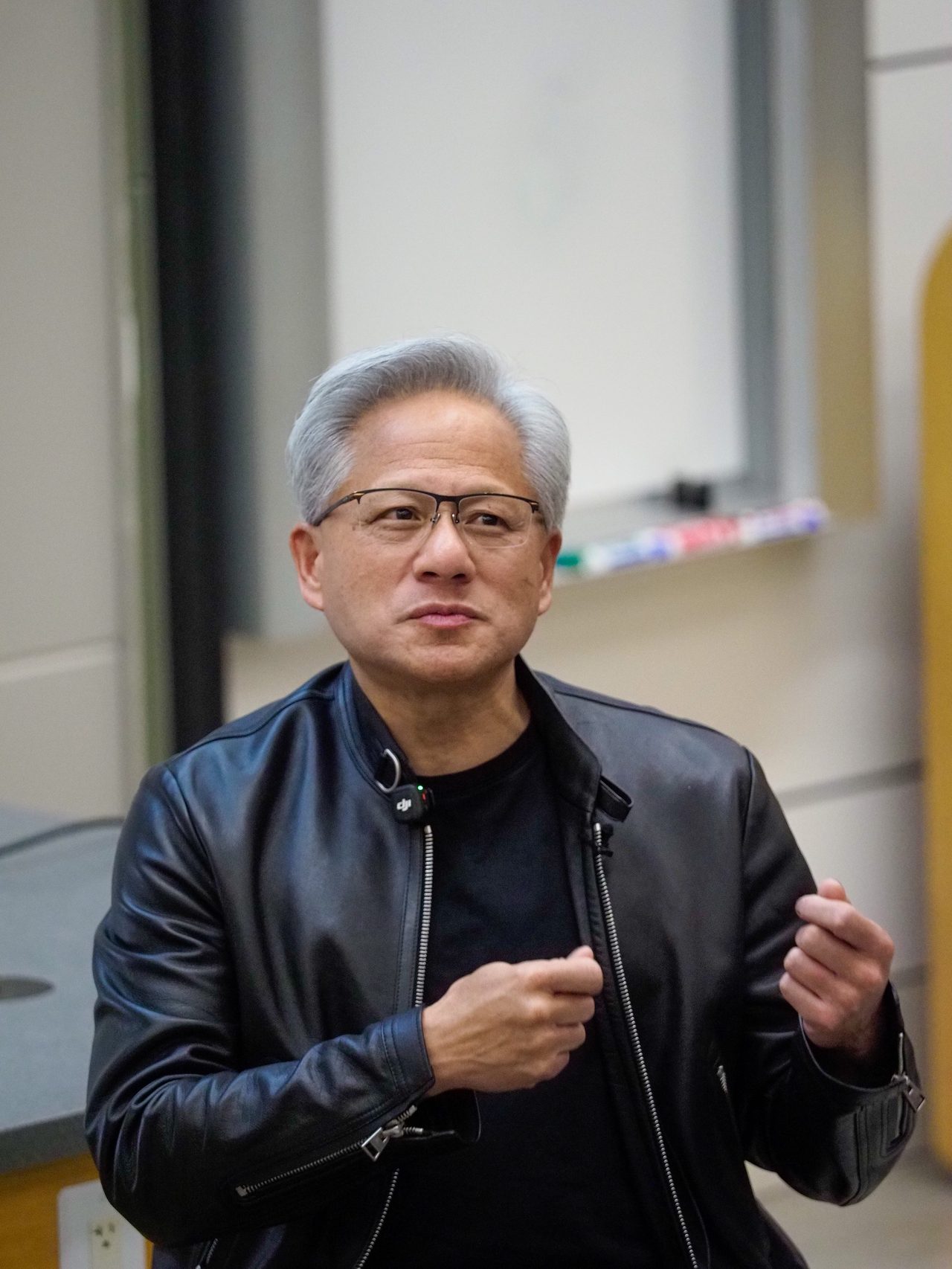
Photo: Anderseidesvik / CC BY-SA 4.0 · via Wikimedia Commons
Huang Ends European Tour With a Direct Order: Every Industry Should Adopt AI
Four countries in a week, Berlin as the finale
Nvidia CEO Jensen Huang closed his European roadshow at the Tempodrom in Berlin on October 21, at the GTC Berlin keynote, after stops in Paris, London, Stockholm and Dublin. The Associated Press reported that roughly 3,000 developers, analysts and journalists attended the address, where Huang, in his trademark leather jacket and sneakers, said "Europe's AI economy is starting, and it's accelerating, and it's great to see." Bloomberg noted that he struck a bullish note precisely as some investors grow more skeptical about the sums being poured into the infrastructure underpinning artificial intelligence.
Nearly $10 billion committed across Europe
Nvidia says it has committed nearly $10 billion to Europe's technology ecosystem and works with more than 12,000 partners there, a figure repeated in Quartz and WIRED coverage of the keynote. Bloomberg reported earlier in the tour that the company had put roughly $8 billion into the continent over the past year, and that Huang announced in Paris that another $2 billion in European AI deals would be unveiled within a week. The Decoder reported that four French companies — healthtech platform Doctolib, robotics developer Genesis AI, planning-software maker Pigment and materials-discovery startup Entalpic — were among the new recipients. Fortune added that in London Nvidia took minority stakes in five UK start-ups and pledged $250 million in compute over five years for UK AI safety and security research.
A container-sized AI factory that goes live in two weeks
The headline product was DSX POD, a reference design for complete Vera Rubin AI factories that partners assemble, integrate and validate inside modular containers before delivery. Quartz reported that Nvidia says the design cuts deployment time at a prepared site from six months to as little as 14 days. WIRED described it as a plug-in data center. The Register, quoting the product description, said a DSX Pod starts with seven liquid-cooled Vera Rubin NVL72 racks linked by about 17 kilometers of Spectrum-X cabling, delivered as transportable containers, with worldwide delivery planned for early 2027.
Fifty billion dollars for a one-gigawatt factory
In the keynote transcript published by Investing.com, Huang said a one-gigawatt AI factory costs about $50 billion once land, power, the building shell, computing equipment, networking, storage, power systems and cooling are counted, and that a three-month delay in deployment means roughly $10 billion in lost revenue. That arithmetic is the core of his argument to Europe: after a hall is powered and cooled, every month of idle capacity is a month of unbooked tokens.
Regulate applications, not the technology itself
In a public conversation with German Chancellor Friedrich Merz, Huang cautioned that policymakers cannot regulate their way to technological leadership. "There's nothing to regulate if the industry doesn't thrive," he told Merz, according to Business Insider. He argued that regulation should focus on AI applications, the way internet-using products are regulated, while conceding that safety has to be paramount. The Register and The Associated Press both document the parallel pitch for OpenShell and Sentry, tools that confine autonomous agents in a digital sandbox with minimal privileges.
Manufacturing and robotics as the European edge
Huang argued that Europe's precision in mechatronics, electronics and mechanical systems gives it an edge in physical AI. Reuters reporting, carried by New York Post, says Germany's Agile Robots plans to produce 1,000 to 2,000 petite humanoids next year in collaboration with Nvidia, with production due to begin late this year, and that Huang shared the Berlin stage with tiny duck-shaped robots developed by French startup Pollen Robotics with Hugging Face, asking them to perform somersaults. Reuters also noted Europe's handicap: no home-grown player on the scale of Nvidia, Anthropic or OpenAI.
Germany's template: public money, private engineering
CryptoBriefing reported that Germany's chancellor, the Federal Ministry for Economic Affairs and Energy, and the Federal Ministry for Research, Technology and Space signed a joint declaration of intent with Nvidia covering AI models for physical AI, with public funding expected in the high hundreds of millions of euros, compute coming from Deutsche Telekom's Industrial AI Cloud, Nvidia supplying chips, software and engineers, and roughly a dozen German companies including Siemens and Audi. CryptoBriefing also reported country-level deployment targets: about 18,000 Grace Blackwell systems for Mistral AI in France, 14,000 Blackwell GPUs in the UK, and 10,000 Blackwell GPUs for an industrial AI cloud in Germany.
Sovereign AI as a business model
Fortune argued that Nvidia's European spending spree is best understood as something bigger than a regional push: a bid to become the default infrastructure layer wherever sovereign AI gets built, with the risk that sovereignty ends up meaning dependence on a single American chipmaker. Huang's answer was that sovereignty depends on who controls the data, service and ability to advance the technology — not simply on where the chips are made. "So long as you can operate the service yourself, that's the most important," he said. Fortune also noted Nvidia is now worth more than $5 trillion, and that a handful of U.S. hyperscalers still account for roughly half of its data center business.
Protests, delivery dates and the order book
A Greenpeace protester briefly interrupted the keynote, pressing Huang on claims that Nvidia semiconductors have turned up in drones operated by Russia; he promised to talk later and asked security to avoid rough handling, according to The Associated Press. A report from The Register also highlighted Huang's framing of a new industrial revolution, with AI performance improved a millionfold over ten years. The open questions now are whether the European order book converts into deployed capacity, and whether DSX POD units arriving in early 2027 can break the months-long build cycle that has held the continent back.
Sources
- Bloomberg: Nvidia CEO Huang Pitches Europe on All Industries Adopting AI
- Associated Press: Nvidia CEO cheerleads for Europe's nascent AI sector
- Quartz: Nvidia CEO Jensen Huang urges Europe's industries to adopt AI
- WIRED: Jensen Huang's Vision for Europe Runs on Plug-In Data Centers
- Fortune: Nvidia's European spending spree is about much more than Europe