China's Medtech Is Catching Up With Global Brands
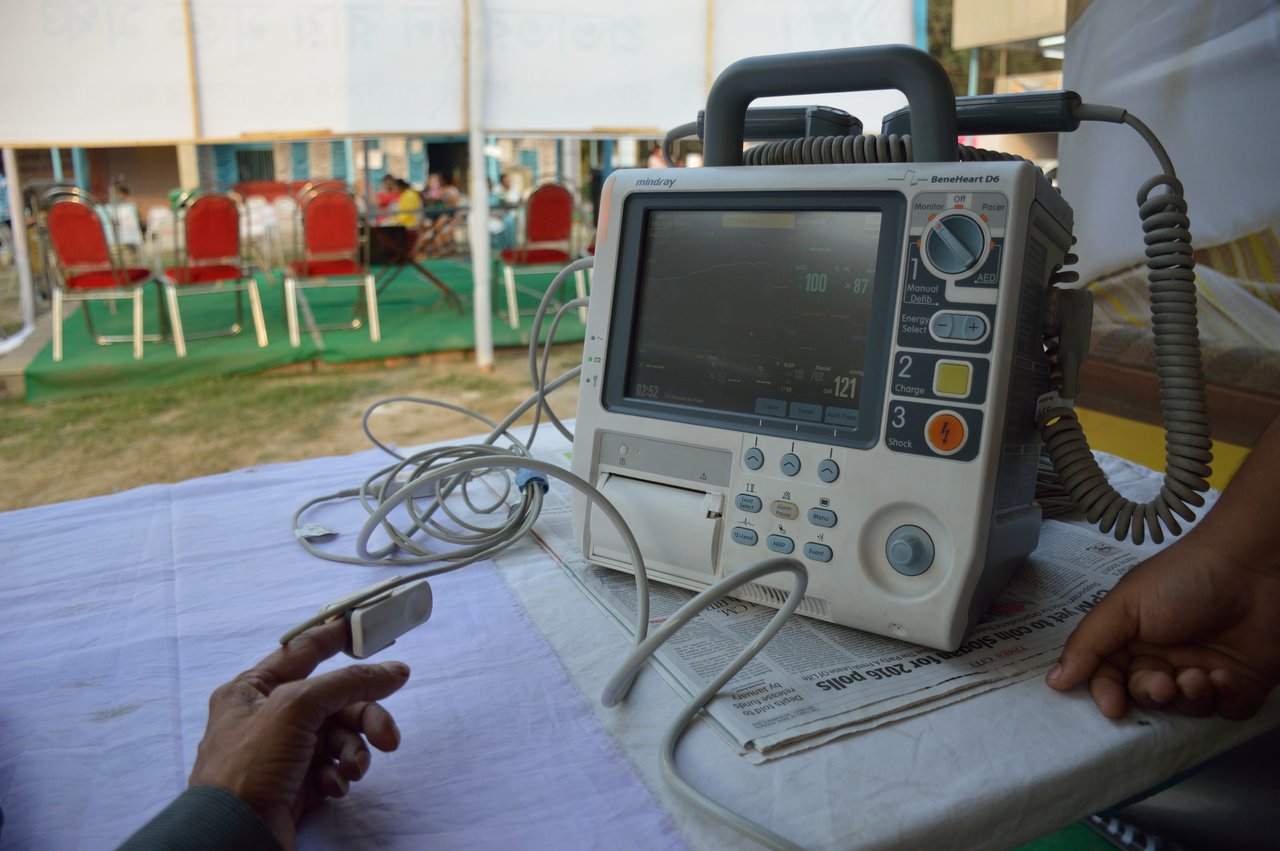
Photo: Biswarup Ganguly / Wikimedia Commons · via Wikimedia Commons
China's Medtech Is Catching Up With Global Brands
A trillion-yuan market built in five years
China's medical equipment market expanded 60.5% between 2021 and 2025 to reach 1.44 trillion yuan, about $208 billion, according to data released at the 2026 China Medical Equipment Conference in Chongqing. Exports totaled $45.8 billion. Precedence Research puts the medical devices market at $47.52 billion in 2025, rising to $50.37 billion in 2026 and $84.66 billion by 2035, a compound annual growth rate of 5.94% from 2026 to 2035. Another market sizing from Towards Healthcare sees growth from $48.34 billion in 2026 to $108.96 billion by 2035 at 9.45%. The U.S. International Trade Administration, citing a BMI forecast via Chozan, gives $55.2 billion by 2029. Definitions differ, but the direction is the same: steady expansion.
BMI sees innovation offsetting procurement pressure through 2030
The official assessment is that innovation will cushion price cuts. BMI, a Fitch Solutions company, said on Oct. 6 that mainland China's medical device market will maintain robust growth through 2030 despite procurement-driven pricing pressure and domestic competition. Expanded guidance will improve regulatory clarity while raising compliance demands, and accelerating innovative-device pathways will support development of higher-value products. Registration data points the same way. China Medtech Radar's count of official National Medical Products Administration records finds 680 domestic Class III records in the second quarter of 2026, including 101 vascular intervention registrations from 76 domestic registrants. In the first quarter, 82 domestic registrants were active across cardiovascular, neurovascular and peripheral fields, moving from first-generation stents into structural heart and bioresorbable platforms.
Stent prices down over 90% as tenders favor domestic bids
The proximate driver is volume-based procurement. Bonafide Research notes that centralized tenders run by the National Healthcare Security Administration aggregate national volumes to force price cuts, with coronary drug-eluting stents seeing average unit reductions exceeding 90%. A 2026 Beijing municipal hospital tender illustrates the shift: 17 hospitals with a combined budget of about 382 million yuan sought 177 units covering CT, MR, DR, C-arm, DSA and ultrasound, with the import-allowed field marked No across the board. The European Commission, in a report summarized by Vemerix, found that 87% of an examined sample of 35,504 Chinese public tenders contained explicit or implicit prohibitions on imports. At the end of 2025, China had 33,210 medical-device manufacturers, according to NMPA statistics cited by Chozan, while patient monitoring procurement alone totaled 6.139 billion yuan for 72,157 units in 2025.
GE and Intuitive feel the squeeze and localize R&D
That is bad news for incumbents that long dominated Chinese hospitals. Nikkei Asia frames the story as exporters checking into Hong Kong hospitals that long relied on GE, Philips and Siemens. GE HealthCare has lost about 20% of its value since January, with tariffs accounting for about half of the year-over-year gross margin decline, according to Yahoo Finance reporting of its earnings call. In surgical robotics, Intuitive Surgical placed only two da Vinci systems in China during the quarter, with Da Vinci 5 yet to receive clearance in mainland China, citing lower tender activity, domestic robotic competition and pricing pressure. The response has been to localize. In December 2025 GE HealthCare opened an R&D center in Tianjin, designated as its Magnetic Resonance Eastern Hemisphere headquarters R&D center and its only system-level MRI research base outside the United States.
Robotics and AI set the next decade of contest
The next battleground is robotics and AI. GlobalData, reported by Healthcare Asia Magazine and RockingRobots, projects China's robotic surgical systems market will grow at a 12% compound rate between 2026 and 2036, with China accounting for around 30% of the Asia-Pacific market in 2025. Towards Healthcare values China's medical robotics market at $1,881.57 million in 2025, rising from $2,176.79 million in 2026 to about $8,081.25 million by 2035, a 15.69% rate. IDC, cited by China Daily, estimates China's AI-powered healthcare application software market reached 3.54 billion yuan, or $528 million, in 2025 and could expand to 14 billion yuan by 2030. Smaller segments show the same pull: biopsy devices valued at about $628.53 million in 2025 are forecast to reach $1.16 billion by 2034, a 7.03% rate. Financing has held up even as listings lagged, with BioWorld recording $14.6 billion in med-tech financings as the IPO drought persisted. A BIO-Europe survey of 81 leaders, summarized by The Catalyst Brief, split 29 for the U.S. versus 24 for China as the most important future partnership source, with Europe at 11 — a sign that China's threat, and attraction, is now global.
Sources
- Nikkei Asia: China's medtech scores bright prognosis as it gains on global brands
- Fitch Solutions BMI: China Medtech Growth Supported By Innovation Push
- BioSpace: China's surging biotech sector represents both competition and lifeline for the US
- Precedence Research: China Medical Devices Market Companies, Size & Trends 2026-2035
- China Daily: Medical AI deepens roots across hospitals