Hunter's Moon Glows Orange as Saturn Stands Guard
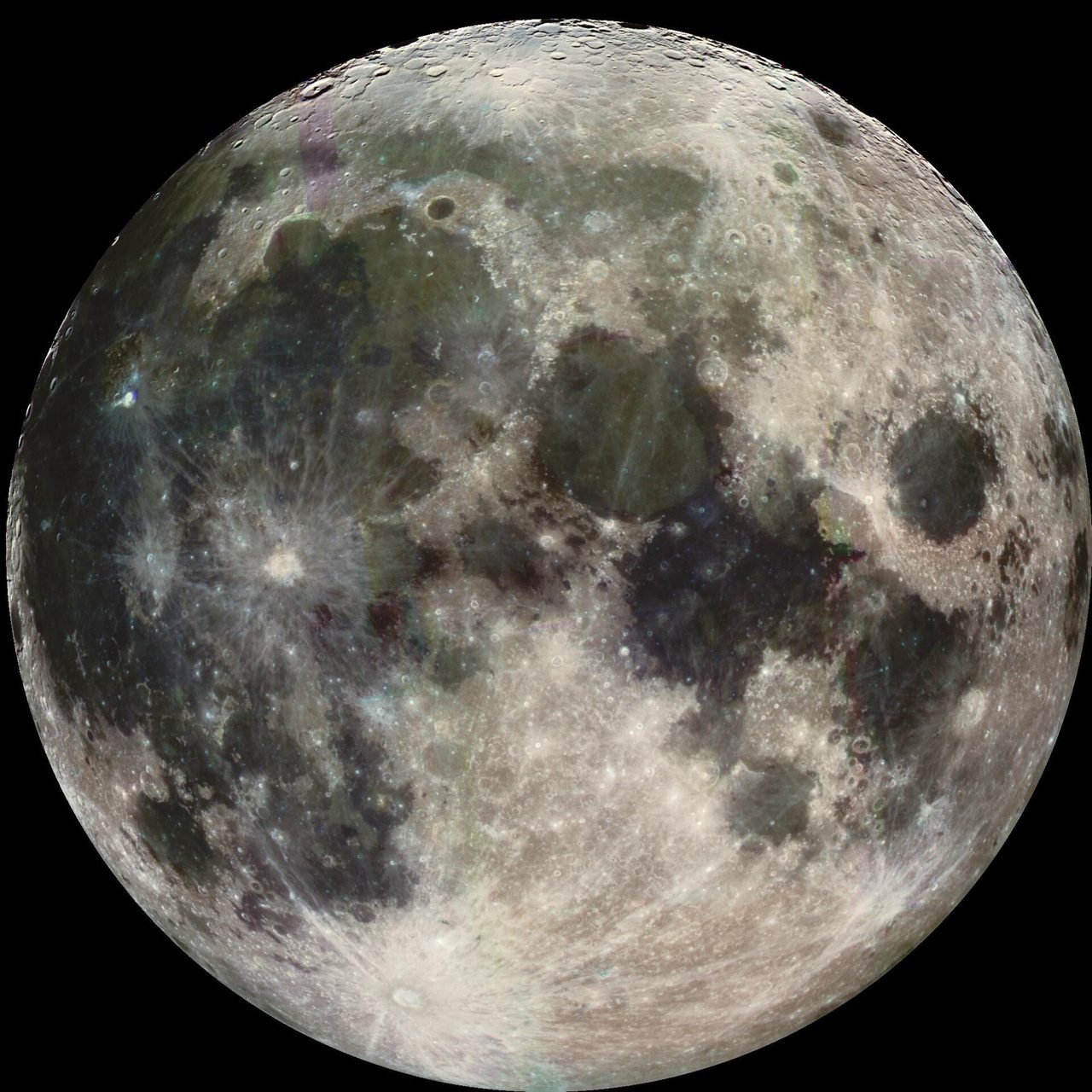
Photo: NASA/JPL/USGS / Public domain · via Wikimedia Commons
Hunter's Moon Glows Orange as Saturn Stands Guard
A full moon climbs at sunset, with Saturn beside it
October's full moon, the Hunter's Moon, puts on its show this weekend. It rises above the eastern horizon around sunset on Sunday, Oct. 25, and stays essentially full on Monday night too, giving skywatchers two evenings to catch it. The Old Farmer's Almanac calls Sunday evening the best time to look. On Sunday the moon stands in Aries with Saturn just to its upper right, a gold-colored point of light; on Monday it rises above the Pleiades star cluster, M45.
Full phase comes after midnight in the east, Sunday evening out west
The moon turns full at 12:12 a.m. EDT on Monday, Oct. 26, the same instant worldwide, 04:12 UTC. In time zones farther west that moment still falls on Sunday evening: 11:12 p.m. Central, 10:12 p.m. Mountain and 9:12 p.m. Pacific. A full moon looks round for about three days, so from Oct. 25 through 27 it will appear full and bright on each night.
The orange glow is atmosphere, and the giant size is illusion
Near the horizon the Hunter's Moon often turns yellow-orange or even red, because its light passes through a thicker slice of atmosphere that scatters away the blue wavelengths. Foreground buildings and trees make it look enormous, the classic moon illusion. Once it climbs higher, it returns to its usual brilliant white.
A hunter's calendar written in moonlight
The Hunter's Moon is the first full moon after the Harvest Moon. With the harvest cleared and fields lying bare, deer fattened by summer and active in the rutting season were easier to spot, and Indigenous North American and colonial traditions used the bright evening moonlight to extend the hunt and lay in meat for winter. Other Indigenous names tell the same seasonal story: the Dakota's Drying Rice Moon, the Anishinaabe's Falling Leaves Moon, the Ojibwe's Freezing Moon, the Haida's Ice Moon, and the Cree's Migrating Moon for birds heading south.
Moonlight steals the show from Saturn and the meteors
Saturn is up all night, but the moon's glare may make the ringed planet hard to pick out with the naked eye, when it looks like just another bright star; a telescope reveals its famous rings. The Orionid meteor shower, fed by dust from Halley's Comet, is still active around the same nights but will be largely washed out. No equipment is needed for the main event: find a dark spot with a clear view east and watch moonrise after sunset. Photographers should be ready for the few minutes when the moon hugs the horizon and burns orange.
Not a supermoon, but bigger ones are queuing up
This Hunter's Moon is not a supermoon. The run of larger, brighter full moons starts next, led by the Beaver Moon on Nov. 24, followed by the Cold Moon on Dec. 23, with the sequence of consecutive supermoons continuing into the early months of next year. A supermoon happens when full phase falls near the moon's closest approach to Earth, making it look somewhat larger and brighter than average. With 13 full moons in 2026, the Hunter's Moon is number 11, and the final two are both supermoons, so the autumn and winter skywatching calendar only gets better.
Sources
- CNN: What to expect from the hunter’s moon
- Space.com: October full moon 2026: When, where and how to see the Hunter's Moon
- Forbes: Full Moon October 2026: When To See The ‘Hunter’s Moon’ Rise
- weather.com: Hunter's Moon: When and where to see October's full moon
- BBC Sky at Night Magazine: Don’t wait for the Hunter’s Moon – catch the Moon tonight and you’ll see it chase Saturn across the sky