Hochul's Lead Hits 14 Points as Siena Sees a Bluer New York
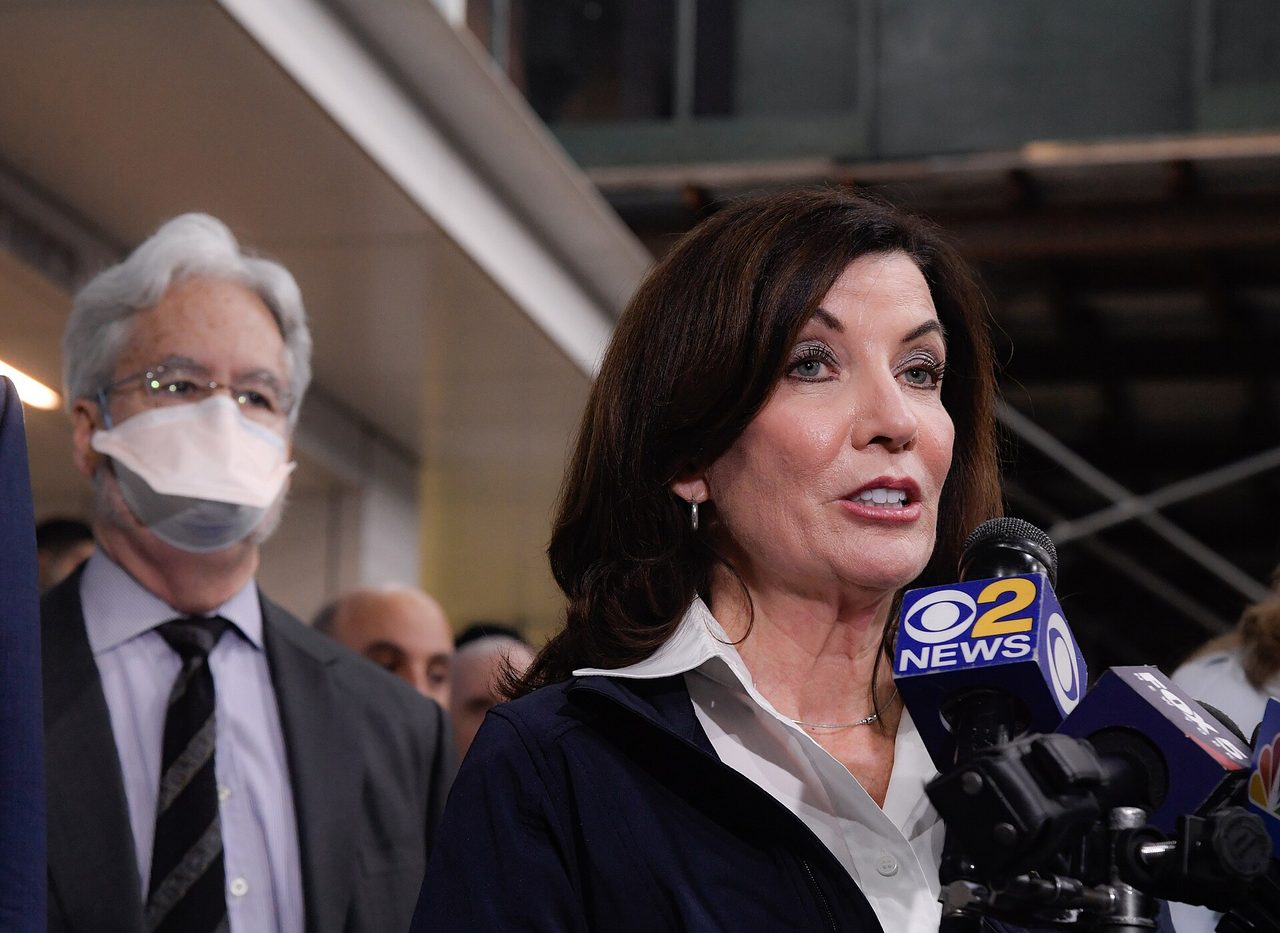
Photo: Metropolitan Transportation Authority of the State of New York (Marc A. Hermann / MTA) / CC BY 2.0 · via Wikimedia Commons
Hochul's Lead Hits 14 Points as Siena Sees a Bluer New York
A 54-40 margin with six days until Election Day
With about a week to go before Election Day, a new Siena College survey of likely New York voters puts Democratic Gov. Kathy Hochul at 54% and Republican challenger Bruce Blakeman, the Nassau County executive, at 40%, with 6% undecided. The poll interviewed 807 likely voters from Oct. 19 through 22, with 494 reached by mobile or landline phone and 313 by text-to-web, and carries a margin of error of plus or minus 4.1 percentage points. A month earlier the same poll had Hochul ahead by nine, 50% to 41%.
Cracking 50% favorability for the first time
For the first time since she took office, a majority of voters views Hochul favorably, 51% to 45%. Blakeman is better known than a month ago: the share with no opinion of him fell from 31% to 21%, and his favorability rose to a personal best of 39%. But his unfavorables also hit a record 40%, leaving him narrowly underwater. Statewide, 61% view President Donald Trump unfavorably against 36% favorably, with his job approval at 37%.
Women by 23, men by 6, independents flipped
Hochul leads among women by 23 points and among men by six. White voters are closely divided, while she carries Latinos by better than two-to-one and Black voters 81% to 16%. Among independents she leads 51% to 40%, a sharp turnaround from September, when Blakeman led that group 44% to 39%. Geographically the race is two contests at once: Hochul dominates New York City 67% to 23%, while she and Blakeman run virtually even in the downstate suburbs and upstate.
Dueling endorsements cut in opposite directions
By 45% to 30%, voters call New York City Mayor Zohran Mamdani's endorsement of Hochul a positive for her campaign. By 48% to 28%, they call Trump's endorsement of Blakeman a negative for his, with only about 29% calling it a positive. That split captures the campaign's closing argument: Blakeman has worked to tie Hochul to the democratic-socialist mayor, while Hochul has tied Blakeman to an unpopular president.
Mamdani climbs to 69-28 in the city
Mamdani's own numbers improved. Statewide he stands at 47% favorable to 43% unfavorable, little changed from 46% to 44% in September. Inside New York City he is at 69% favorable to 28% unfavorable, up from 60% to 31% a month ago, a nine-point gain. Democrats lead further down the ballot too: Attorney General Letitia James leads Saritha Komatireddy 54% to 39%, and Comptroller Tom DiNapoli leads Joseph Hernandez 59% to 32%.
Two-thirds expect a Hochul win, including 40% of Republicans
Regardless of preference, 68% of voters expect Hochul to win against 23% for Blakeman, including 40% of Republicans; even among GOP voters, only 49% predict a Blakeman victory. Siena pollster Steven Greenberg's verdict was blunt: Blakeman is "quickly running out of time to close a gap that is growing rather than narrowing." A Marist poll released the same day pointed the same way, with Hochul ahead 53% to 42% among likely voters, surveyed Oct. 22 through 25 among 1,448 registered voters with a margin of error of plus or minus 3.9 points for likely voters. Last week's Quinnipiac survey had it 55% to 41%.
Blakeman camp cries voter suppression, disputes the samples
Blakeman rejected the numbers, calling the polls "voter suppression tactics designed to discourage Republicans and manipulate the outcome," and insisting his internal surveys show a single-digit race while accusing Marist of undersampling Republicans. Hochul, campaigning with Mamdani having returned the favor on the trail, is treating the lead as a turnout mission with early voting already underway. One caution for her: Marist, unlike Siena, shows Blakeman ahead among independents 49% to 39%, so that bloc remains the most survey-sensitive swing group.
Beyond the governor's mansion
The size of the statewide margin matters past one office. Double-digit leads for James and DiNapoli, plus a generic congressional edge for Democrats, would signal a blue-leaning environment in New York heading into the midterms rather than a narrow Hochul-only win. For Republicans, parity upstate and in the suburbs keeps the race from looking like a rout, but the New York City deficit of 67% to 23% sets a steep arithmetic bar with ballots already being cast.
What the final week decides
The last week is a turnout fight. Hochul must bank a big city margin and hold suburban and upstate losses to a draw; Blakeman must convert soft independents and men, where he trails narrowly, into actual votes, and hope likely-voter screens are missing Republicans. Whether the widening from September's nine points to today's 14 reflects real movement or model differences will be settled when the votes are counted.
Sources
- amNewYork: New Siena poll: Hochul leads Blakeman by 14 points as Mamdani's NYC popularity grows
- New York Post: Hochul holds 14-point lead over Blakeman in home stretch of NY governor's race
- City & State: New Siena poll has Hochul up 14 points over Blakeman days before election
- Newsday: Kathy Hochul leads Bruce Blakeman in New York governor race
- BTPM: Hochul opens up double-digit lead over Blakeman in latest Siena poll