Rubio Brings 200 Business Leaders to Central Asia in a Bid for Room in Russia and China's Backyard
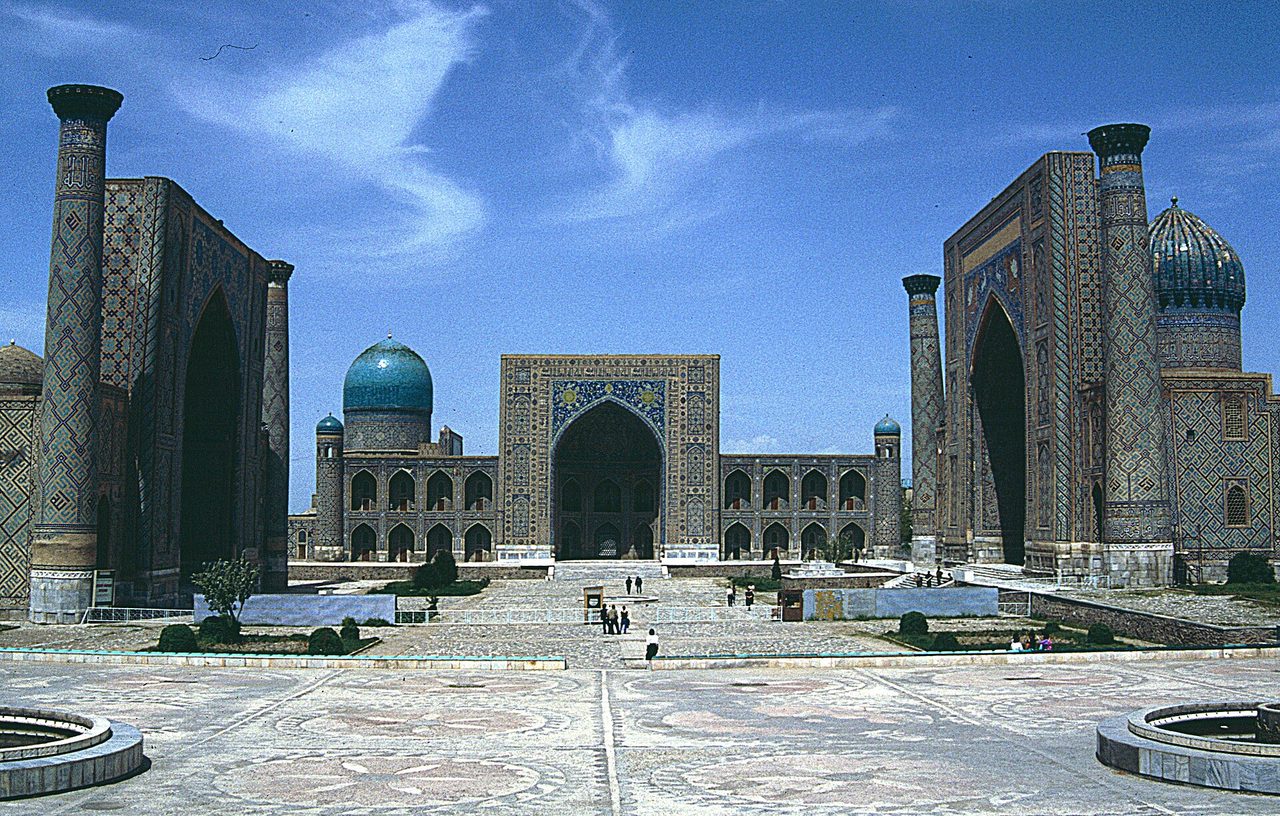
Photo: Ziegler175 / CC BY-SA 4.0 · via Wikimedia Commons
Rubio Brings 200 Business Leaders to Central Asia in a Bid for Room in Russia and China's Backyard
Rubio's first Central Asia trip pairs ministers with business chiefs
US Secretary of State Marco Rubio leaves on October 17 for a five-day swing through Uzbekistan and India — his first visit to Central Asia in office. He opens in Samarkand at a C5+1 ministerial with the foreign ministers of Kazakhstan, the Kyrgyz Republic, Tajikistan, Turkmenistan and Uzbekistan, then holds separate bilateral meetings with senior officials from all five. The headline act is the commercial delegation travelling with him: the State Department says he leads "more than 200 business leaders," while Special Envoy Sergio Gor's earlier announcement said "more than 100 American companies." Rubio then flies to Mumbai and Jamnagar in India, where the focus shifts to energy cooperation.
The State Department calls it 'historic' and promises American technology
The State Department's October 13 announcement labelled the trip "historic," saying strategic cooperation through the C5+1 platform promotes "a more peaceful and prosperous future" for the United States and the Central Asian states, with talks centred on deepening regional economic connectivity and strengthening energy security. Speaking in New Delhi, Gor called the Samarkand meeting a chance to "showcase American ingenuity, American technology" and said plainly that the US wants to "compete" in resource-rich Central Asia. A US official briefing reporters put it another way: this is not just bilateral meetings and not just a C5+1 session — "we're actually bringing over 200 American companies that are coming with us."
Critical minerals and the Middle Corridor head the agenda
Much of the agenda rotates around tungsten, uranium, rare earths and copper, with delegations expected to work through project financing, geological data sharing and the question of where processing actually happens. The second pillar is transport: the Trans-Caspian route, better known as the Middle Corridor, which carries freight from Kazakhstan across the Caspian and through the South Caucasus toward Europe and has gained value as routes through Russia became harder to use. The World Bank estimates that pairing infrastructure investment with trade and transport reforms could more than triple corridor volumes by 2040, halve travel times, lift GDP by 3.3% and create 2 million jobs — and that it will take more than $55 billion. Kazakhstan's data show 4.1 million tons moved in 2025, down 8.9%, while container traffic rose 36% to 77,000 TEU.
Tungsten deals and billions in pledges have already landed
The commercial groundwork predates the trip. The Times of Central Asia reported that US firm Cove Capital and Kazakhstan's Tau-Ken Samruk agreed to develop two tungsten deposits, with a projected $1.1 billion investment covering two processing plants and a metallurgical facility. Other reporting says Kaz Resources may receive up to $1.6 billion in US government financing to mine tungsten in Kazakhstan — up to $900 million from the Export-Import Bank and up to $700 million from the International Development Finance Corporation. At the C5+1's tenth-anniversary summit in Washington in November 2025, US officials announced commercial deals exceeding $25 billion. The US ambassador to Kazakhstan has said bilateral commercial deals between Kazakh and American companies alone reached $17 billion in the fourth quarter of 2025. Uzbekistan says $7 billion of a $35 billion portfolio has been implemented, and a State Department official said the two countries have announced more than $30 billion in new investments into the United States over the past year.
China is the dominant economic partner; Russia still supplies security
Washington is pushing into ground already thick with Russian and Chinese presence. Ariel Cohen, a nonresident senior fellow at the Atlantic Council, told RFE/RL that the Trump administration is focused on American interests and on global competition with China. "Clearly, China is the dominant economic partner, and Russia still provides a lot of security connections, but the United States is not walking away and is not abandoning that sandbox," he said. Figures cited in Frontiers in Political Science point to the same division of labour: in 2024, China and Russia accounted for nearly equal shares of Uzbekistan's foreign trade turnover, 18.9% and 17.6% respectively, with China becoming Uzbekistan's leading trading partner in 2023. Moscow's own numbers underline the point — Prime Minister Mikhail Mishustin said in September that friendly countries now take 85% of Russia's trade, and Russia-China trade rose 25.6% year on year in the first half of 2026 to $134.2 billion.
The five republics want balance, not a forced choice
For Kazakhstan, Uzbekistan and their neighbours, the American push is both leverage and a test. Analysts argue the republics want diversified investment, value-added processing and transit revenue without cutting ties to Moscow or Beijing — and that extracting tungsten or rare earths for shipment abroad, with processing kept overseas, would leave little behind locally. Regional cooperation is seen as the multiplier: the Eurasian Development Bank estimates intra-regional trade reached $12.3 billion in 2025, nearly double the 2020 level, while exports within the region hit $8.1 billion in the first seven months of 2026, up 25.4%, with Kazakhstan and Uzbekistan accounting for more than 80%. Delegates must also navigate the republics' pragmatic engagement with the Taliban and existing trade with Iran.
Next stop: India's energy talks and a December G20 invitation
After Samarkand, Rubio heads to India for energy discussions that connect Central Asian minerals to the Indian Ocean's fuel map. Trump has reportedly invited Uzbek President Shavkat Mirziyoyev and Kazakh President Kassym-Jomart Tokayev to the G20 summit in Miami in December. Rights groups are pressing a different agenda: campaigners want Rubio to publicly demand the release of Uzbekistan's prisoners of conscience, including Karakalpak activist Dauletmurat Tazhimuratov, and the Uyghur Human Rights Project has urged him to raise the plight of Uyghurs in the region. Whether those asks make the meeting agenda will show where Washington's "commerce only" boundary lies.
Sources
- Secretary Rubio's Travel to Samarkand, Mumbai, and Jamnagar
- Rubio Heads To Central Asia As US Seeks Bigger Role In Region Dominated By Russia, China
- US wants to 'compete' in Central Asia, ambassador says ahead of Rubio visit
- OilPrice: U.S. Targets Central Asia's Energy and Critical Minerals in Major Trade Push
- Rubio to Lead Major U.S. Business Delegation to Uzbekistan for C5+1 Talks