China's EV Transition Is Really Four Transitions, Moving at Four Speeds
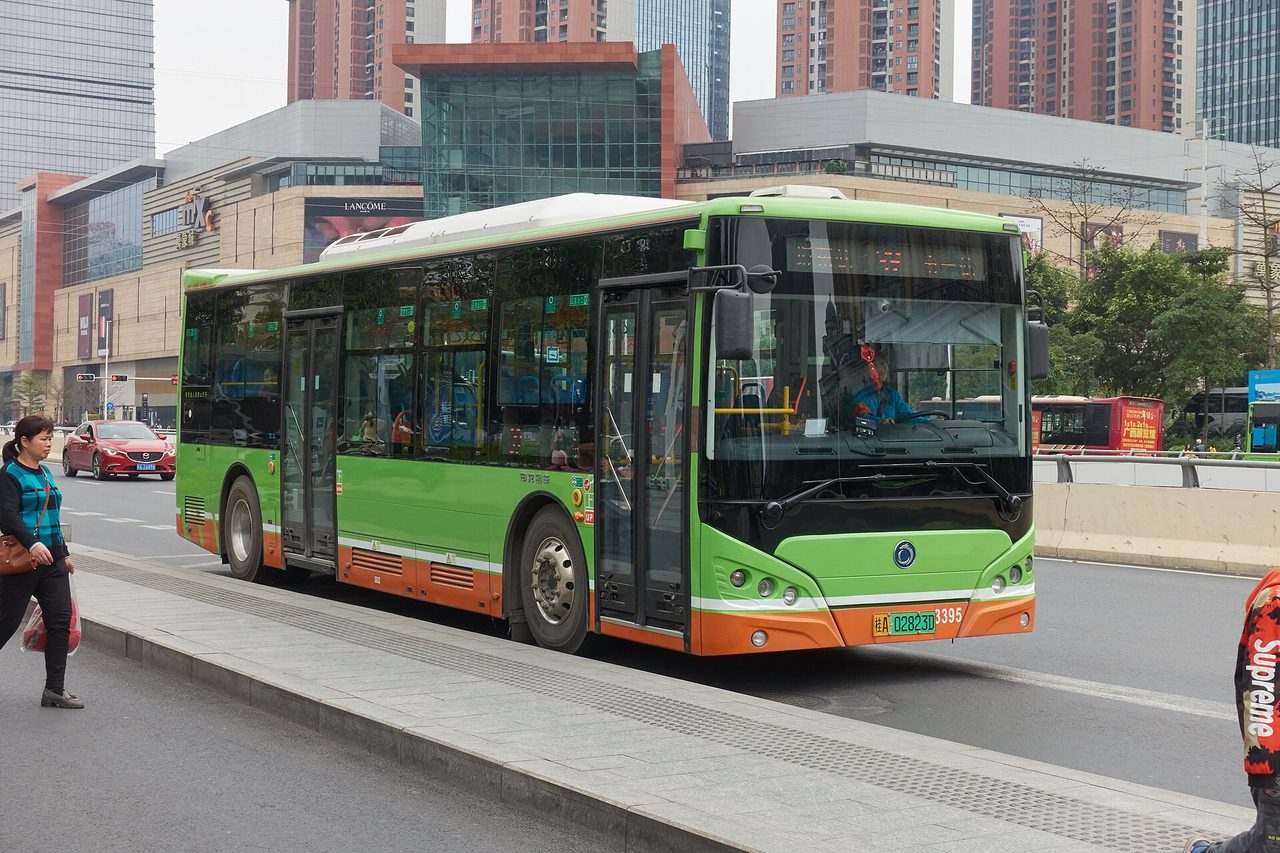
Photo: TKK4000-Motomachi-Chukagai / CC BY-SA 4.0 · via Wikimedia Commons
China's EV Transition Is Really Four Transitions, Moving at Four Speeds
One number — national EV market share — hides most of what is happening in China. Read the market by vehicle type instead, and four different transitions come into view: city buses are already renewing their first electric fleets, cars have become mainstream even as domestic sales fall, heavy trucks are climbing fast, and coaches have lost the long haul to high-speed rail.
City buses are replacing EVs, not diesels
Chinese urban buses electrified first, and the question in procurement is no longer whether to buy electric but which model replaces the electric bus bought in the first wave. The IEA estimates that of China's more than 680,000 electric buses, almost 70% were deployed before 2020. The 2025 equipment-renewal programme funds replacing new-energy buses and even whole traction batteries into 2026 — now managing renewal inside an already-electric segment.
Cars went mainstream just as domestic demand stalled
EVs took just over half of Chinese new-car sales in 2025, with nearly 700 electric models on sale; the IEA estimates nearly 70% of battery-electric cars in China were cheaper than comparable conventional cars even before incentives. Demand then turned: CPCA data show September NEV retail at 1.084 million units, down 16.7%, while penetration hit a record 67.0%. The denominator shrank faster: overall passenger-car retail fell 28%, and January-September retail was down 21.7% to 13.33 million. Petrol-car sales nearly halved.
Heavy trucks are the fastest lane
Electric heavy trucks were about 29% of Chinese sales in 2025, roughly double their 2024 share, and the segment runs on economics: intensive use and predictable routes turn fuel and maintenance savings into a business case. A Sinopec research institute executive said half, or even more, of trucks sold this year could be electric. XCMG's Hanjing long-haul truck uses an 800-volt architecture whose megawatt-class charging refills 20% to 80% in under 20 minutes.
Coaches lost the long haul to high-speed rail
Battery-electric coaches were only about 10% of Chinese coach sales in 2025, and the reason is not just bigger batteries. China ended 2025 with more than 50,000 kilometres of high-speed rail carrying over 4.5 billion passenger trips, covering 500-kilometre clusters in one to two hours.
Exports carry the market now
CAAM data show September NEV exports of 571,000 units, up 160%, including 352,000 BEVs (up 130%) and 219,000 plug-in hybrids (up 220%). NEVs were about 54% of all vehicle exports, above half for a fourth straight month, and January-September NEV exports reached 4.006 million, up 130%. Passenger-car exports rose to roughly 917,000 in September, up more than 60%. AlixPartners expects nearly 10 million Chinese vehicle exports in 2026; the CPCA's Cui Dongshu forecasts 11.5 million to 12 million.
Joint-venture brands are being left behind
NEV penetration ran at 84.5% for domestic Chinese brands, 44.9% for luxury brands and just 15.9% for mainstream joint ventures, whose retail fell 36% to 310,000 units in September. BYD led NEV retail with 246,816 units, a 22.8% share, ahead of Geely (11.0%), Leapmotor (7.2%) and Tesla China (6.0%). Tesla illustrates the pivot: China retail fell 11.9% to 381,088 units in January-September while Shanghai exports rose 108% to 361,972, now 49% of its wholesale volume.
Policy has switched from support to tightening
The purchase-tax exemption for NEVs was halved on 1 January 2026, a 2% consumption tax on lithium-ion batteries returned in September (rising to 4% in September 2027), while sodium-ion and solid-state cells stay exempt to the end of 2028. On 12 October the finance and taxation ministries said the VAT export rebate for NEVs drops from 13% to 9% on 1 April 2027. Deutsche Bank estimates that costs BYD about 5,000 yuan of net profit per exported vehicle. The CPCA's Cui Dongshu argues the competitive edge comes from supply chains and powertrain engineering, not the rebate.
Batteries and driver assistance enter the rule-making phase
September NEV sales of 1.823 million were 61.6% of all vehicles sold, and battery-electric models alone reached a 45% share. Changan and CATL's "Golden Bell" solid-state battery targets 400 Wh/kg and about 1,500 kilometres of range, with production from 2027; Greater Bay Technology began all-solid-state cell output on a 1 GWh line in Nansha on 13 October. SMM cautions that planned solid-state capacity of more than 1,119 GWh by 2035 contrasts with 1-15% utilisation in 2026-2030. Driver assistance is also being regulated: 70.5% of new passenger cars carry Level 2 combined assistance, says MIIT, and a mandatory L3/L4 safety standard takes effect on 1 July 2027.
Europe is putting a ceiling on the export lane
The EU and China agreed to cap hybrid imports at 350,000 vehicles a year from December, rising 6% annually, after the EU imported 302,000 Chinese hybrids in 2025; Brussels had estimated imports could reach about 800,000 this year. Duties of up to 35.3% on Chinese battery-electric cars in 2024 pushed exporters into hybrids, whose EU shipments tripled to $7.5 billion in the first half of 2026. Brands building locally sit outside the quota: BYD starts mass production in Szeged, Hungary, in the fourth quarter of 2026.
What to watch next
The four questions now: whether bus replacement budgets hold, when domestic car demand stops falling, how the December quota and the 2027 rebate cut reshape exports, and whether solid-state cells move from pilot lines to volume. Price competition and fading subsidies are already forcing consolidation, with analysts expecting a mass shakeout of Chinese EV brands by 2030.
Sources
- CleanTechnica: China's EV Transition Is Four Different Transitions
- CnEVPost: China NEV sales hit year-to-date high in September as export surge offsets domestic decline, CAAM data shows
- Electrek: Tesla's China business is flipping: sales down 12%, exports double
- Automotive World: China's car market slumps as Beijing trims export lifeline
- Fortune: Overseas demand helped drive China's 64% car export surge as EU reaches deal to cap Chinese hybrids