China Looks Like It's Dumping Treasuries. The Custody Trail Leads Somewhere Else
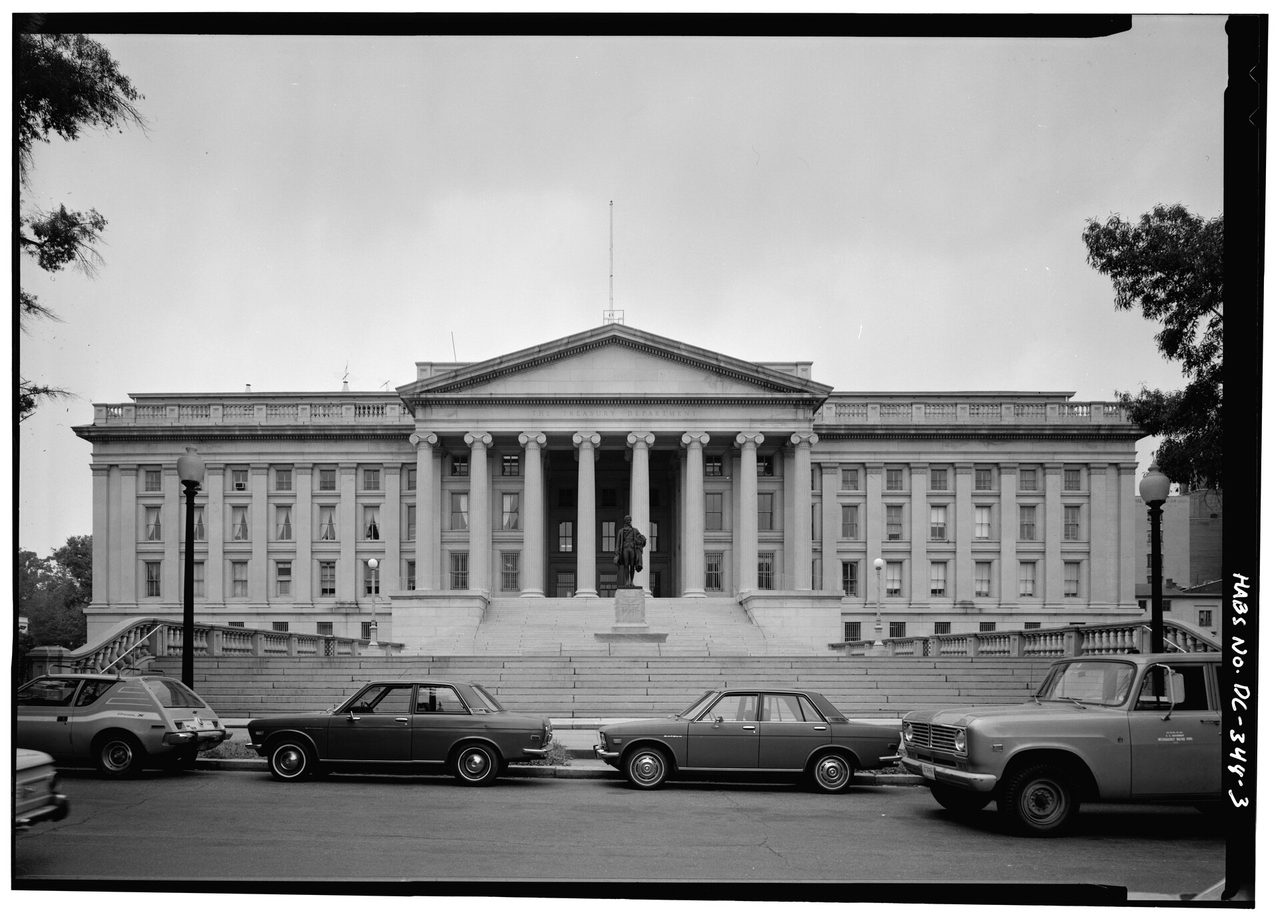
Photo: Historic American Buildings Survey / public domain · via Wikimedia Commons
China Looks Like It's Dumping Treasuries. The Custody Trail Leads Somewhere Else
Reported holdings fall to an 18-year low
China's officially recorded US Treasury holdings dropped to $590.7 billion in August, down $27.3 billion from $618 billion in July, according to Treasury data released on Friday. Reuters-style arithmetic aside, the South China Morning Post notes this is the weakest print since August 2008, when the figure stood at $573.7 billion. A year ago China held about $700 billion; as recently as April 2022 it held $1 trillion; at its November 2013 peak it held more than $1.3 trillion.
Foreign totals rose $83 billion anyway
Total foreign holdings climbed to $9.33 trillion in August, up roughly $83 billion from July. Japan, the largest holder, cut $36 billion to $1.1 trillion, its lowest since December 2024, while the UK added $11 billion to top $1 trillion for the first time. The increases that drew attention came from Canada, up $38.3 billion to $464.6 billion, and Belgium, up roughly $19.8 billion to $490.5 billion. The Cayman Islands and Luxembourg sat close behind, at $463 billion and $448.2 billion.
Canada's book quadrupled in five years
Bloomberg reported that Vitaliy Liberman of DoubleLine, combing through the list of foreign creditors, found Canadian accounts had quietly amassed nearly $600 billion of Treasuries and bonds backed by federal housing agencies — more than quadrupling in five years, and doing so in the middle of a tariff war and a Canadian boycott of US goods.
Custody accounts hide the real owner
The Treasury itself explains the mechanism: its data is collected primarily from US-based custodians and broker-dealers, and securities held in overseas custody accounts may not be attributed to their actual owners. Holdings booked under Canada or Belgium, in other words, may belong to someone else.
The mortgage-bond jump is the tell
The sharpest signal sits in agency mortgage-backed securities: Canadian accounts went from about $21 billion in mid-2021 to roughly $162 billion, while China's own reported holdings of the same paper have fallen nearly 50% since the start of 2024. It is a smaller market with fewer big players, which makes the anomaly harder to explain away. The line circulating on Wall Street: "It's not Canada. It's the other Canada."
Belgium ran this play in 2014
There is precedent. In 2014, Belgium's reported holdings surged more than 40% in just five months, turning it into one of the biggest holders, and China was widely assumed to be the reason. Analysts note Beijing also holds Treasuries through third-party custodians such as Euroclear in Belgium and Clearstream in Luxembourg, which US data files under those countries. The European Central Bank treats the possibility as real enough to model an upper-bound adjustment.
Setser: better at hiding dollars than leaving them
"China has been much better at hiding its dollars than it's been about getting out of the dollar," Brad Setser, a former Treasury official now at the Council on Foreign Relations, told Bloomberg. He argues the evidence that China uses a Canadian custodian for part of its agency portfolio is especially strong, and says both the Treasury and agency tallies need adjusting for bonds held in Canada and Europe. One report estimating on that basis puts China's true exposure roughly $500 billion above the official number.
Not everyone is convinced
The New York Post stresses that there is no direct evidence linking China to Canada's buying spree, and some analysts think Canadian hedge funds explain part of it. "I'm not quite comfortable saying clearly this is all China," Alex Etra, a senior macro strategist at Vanda Research, told Bloomberg. Bloomberg notes the claim is unconfirmed; China's foreign-exchange regulator and Canada's regulator declined to comment.
What it means for yields and the deficit
If Beijing never left and merely rebooked its holdings, one of the market's recurring fears — a steady Chinese exit from Treasuries — carries less weight, and foreign demand at US auctions may be sturdier than the headline suggests. If instead the selling is real, the buyer of last resort is increasingly money booked in Canada, Britain and Belgium, and the US still pays for its deficit through that chain. With the 10-year Treasury at 5.11% and the 10-year Chinese government bond at 1.66%, the gap itself keeps pulling capital toward US assets.
Canada may pass China within 18 months
Doug Porter, chief economist at Bank of Montreal, argued in a late-August report that Canada is on track to overtake both Belgium and China within 18 months, leaving only Japan and Britain ahead. Meanwhile China keeps converting reserves into bullion: the central bank added about 23 tonnes in September, its largest monthly purchase since October 2023, taking reported holdings to around 2,410 tonnes on a 23rd straight month of buying. Gold was 8.5% of official reserves at end-September, up from 5.5% at end-2024, and imports ran above 1,000 tonnes, worth $158.8 billion, in the first eight months of 2026.
The next two data releases decide it
The answer will come from coming monthly TIC prints and the Treasury's twice-yearly detailed survey with custody breakdowns. Until then, markets are pricing between two stories — China leaving, or China hiding — with opposite implications for Treasury yields, the dollar and the yuan.
Sources
- Fortune: 中国在抛美债还是换地方囤?(China looks like it's dumping Treasury debt but may actually be stashing it in Canada and Belgium)
- SCMP: China cuts US Treasury holdings to 18-year low in August as American debt fears mount
- Bloomberg: China's Backdoor Bond-Buying Talk Swirls on $600 Billion Buildup
- New York Post: China may be secretly stashing US debt holdings in Canada, Wall Street analysts suspect
- The Globe and Mail: Canada on track to become a top-three holder of U.S. government debt, surpassing China