Bennu Was Born Where Fire Met Ice, Asteroid Samples Reveal
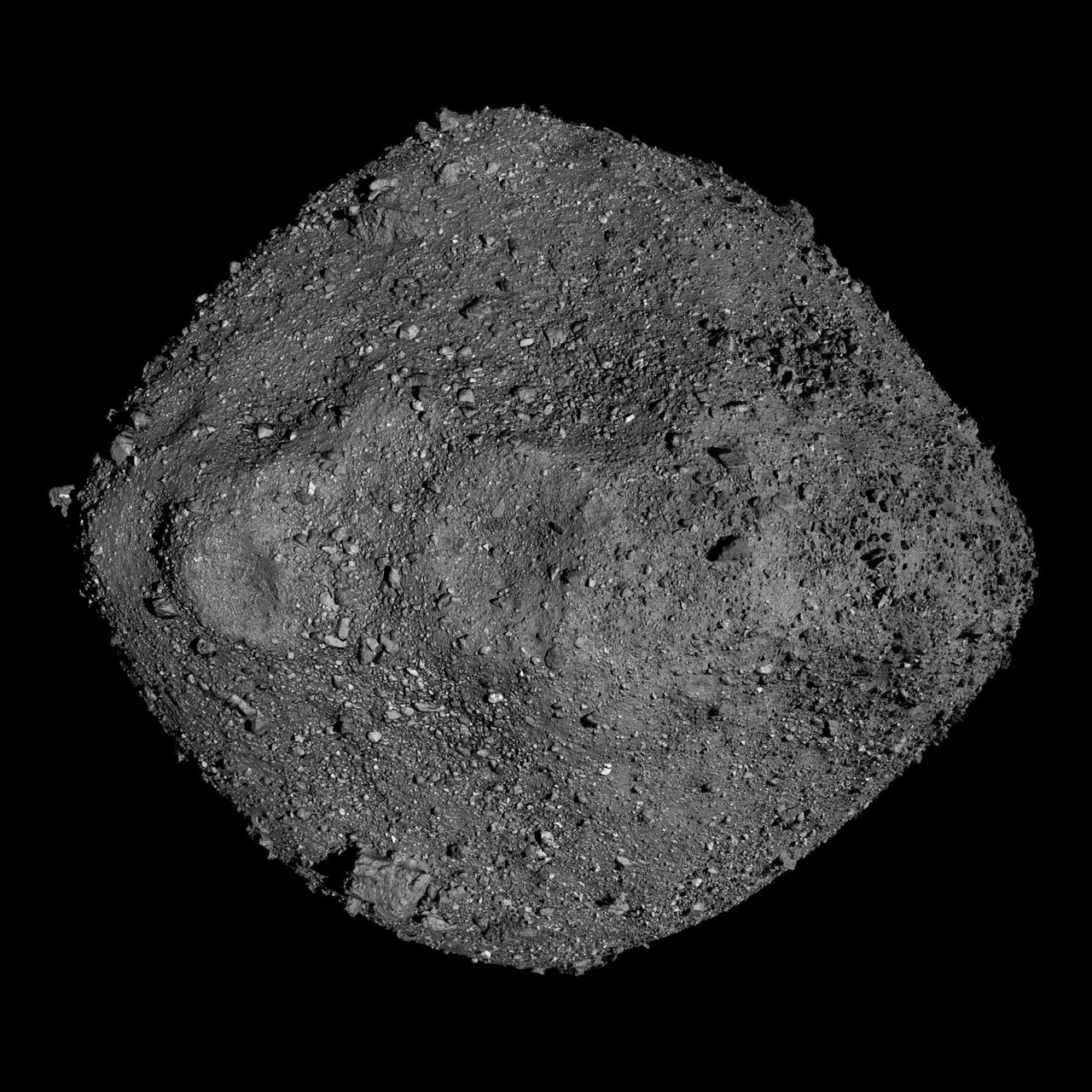
Photo: NASA/Goddard/University of Arizona / Public domain · via Wikimedia Commons
Bennu Was Born Where Fire Met Ice, Asteroid Samples Reveal
Half a gram of dust rewrites Bennu's birthplace
Scientists have pinned down where asteroid Bennu was born, and the answer is not where most researchers expected. A team led by Maria Schonbachler, professor of isotope geochemistry at ETH Zurich, analyzed just half a gram of material returned by NASA's OSIRIS-REx mission. The results, published on Sept. 23 in the journal Science Advances, trace Bennu's ingredients to a mixing zone near the young solar system's water-ice line about 4.5 billion years ago.
Iron, titanium and chromium spell out a fingerprint
The team measured isotopes of three elements — iron, titanium and chromium — across five portions of Bennu material. Isotopes are variants of the same element with slightly different masses, and their ratios act as a chemical fingerprint of where the material came from. Iron and titanium turned out to be remarkably uniform throughout the samples, while chromium showed somewhat more variability, which the researchers attribute at least partly to later alteration by liquid water inside Bennu's parent body.
Bennu, Ryugu and rare meteorites share one reservoir
The fingerprint overlaps strongly with samples from asteroid Ryugu, visited by Japan's Hayabusa2 mission, and with the rare, carbon-rich CI meteorites occasionally found on Earth. That three-way match indicates all three bodies formed from the same reservoir of early solar system dust. Bennu, in Schonbachler's words, "is a hybrid: the material does not clearly match either the inner or the outer solar system."
Not the cold outer reaches after all
Some scientists had suggested the parent bodies of Bennu and Ryugu formed far from the Sun in the outer solar system, perhaps alongside comets, and later than the planets. The new analysis challenges that picture. Instead of the distant outer disk, the parent material likely assembled near the water-ice line — the boundary in the planet-forming disk where water vapor freezes into ice — roughly where Jupiter sits today, a few astronomical units from the young Sun.
Jupiter played gatekeeper, ice acted as glue
The proposed scenario gives Jupiter a starring role. As the giant planet grew, its influence limited the inward drift of larger particles, leaving the birth region dominated by fine dust streaming in from both sides of the line. Near the boundary, ice evaporated as temperatures shifted and recondensed in cooler regions, concentrating water; ice itself acted as a glue binding fine particles into larger aggregates. Iron and titanium are distributed so evenly through the Bennu material that the parent object must have been built from thoroughly mixed fine dust, not a single coarse clump.
A glimpse of the stuff that built Earth
Because its water-bearing minerals and organic compounds have changed little over 4.5 billion years, Bennu looks like some of the most primitive material available for study. "Bennu may offer our best glimpse of the original mix of chemical elements from which the terrestrial planets were ultimately built," Schonbachler said. OSIRIS-REx, the first U.S. mission to collect material from an asteroid, launched on Sept. 8, 2016, operated at Bennu between 2018 and 2021, and parachuted about 120 grams (0.26 pounds) of regolith into the Utah desert on Sept. 24, 2023 — the largest asteroid sample ever returned from space.
Sources
- ScienceDaily: NASA's asteroid Bennu samples reveal a 4.5-billion-year-old secret
- Space.com: Asteroid samples from NASA's epic OSIRIS-REx mission show Bennu was born from fire and ice
- Phys.org: Bennu asteroid samples point to a surprising origin involving Jupiter
- Scienmag: Asteroid Bennu's true birthplace revealed near the water-ice line of the young solar system
- Universe Today: Asteroid Bennu Has an Identity Crisis, and Jupiter Might Be to Blame