Texas County’s Polling-Place Cuts Meet Long Lines on Election Day
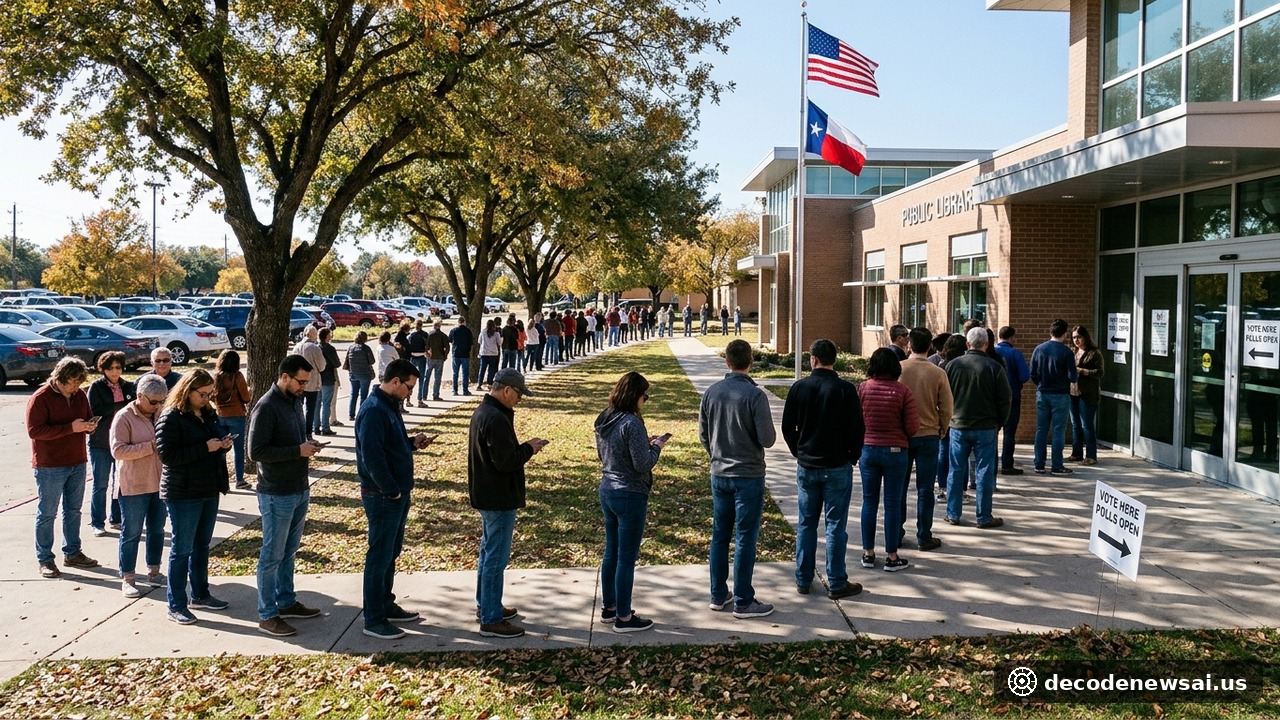
Photo: AI-generated
A one-third reduction set the stage
Voters in Tarrant County, a closely watched North Texas battleground, encountered long lines at some polling locations on November 3, 2026, after county officials reduced the number of Election Day voting sites. Democracy Docket reported from the county that Republican local officials had cut Election Day locations by roughly 30%, forcing some voters to change where or when they planned to cast a ballot. The reduction was approved before Election Day. Tarrant County commissioners voted 3-2 for a list of 224 Election Day sites, compared with 316 used in the 2022 midterm elections. The county also listed 47 early-voting locations. The decision followed a contentious public process in which residents, civic organizations and local officials argued over access, cost and the distribution of polling places. Republican commissioners and county election officials said the new arrangement reflected practical constraints. Some facilities were no longer available or did not meet operational or accessibility requirements, while other locations were considered underused. Democratic commissioners and voting-rights advocates argued that removing sites would make voting less convenient, particularly for people who depend on nearby community centers, college campuses or locations reachable between work shifts.
Reported waits varied by location and time
The Election Day reporting showed that the problem was not uniform across the county. Democracy Docket cited county election-site data indicating that, during the morning rush, 18 locations had waits of about an hour and another eight had waits approaching two hours. NBC 5 Dallas-Fort Worth separately reported that some North Texas voters described waits of an hour or longer, with a small number reporting more than two hours. Those figures should not be read as a countywide average. Lines change throughout the day, and a wait at one site cannot establish conditions at every other site. Tarrant County operates an online map showing voting locations and estimated waits. The county warns that the map is for general reference, may be revised and is not guaranteed to be completely accurate. A missing or stale report does not necessarily mean there is no line. The accounts nevertheless show that some voters faced a meaningful time cost. One voter interviewed by Democracy Docket said the location he had planned to use was closed and that he postponed voting until a less busy period. That experience illustrates why the effect of a polling-place change cannot be measured only by counting locations: travel time, work schedules, public transportation and the availability of alternative sites also matter.
Political claims require evidence beyond party lines
The dispute became partisan because the commissioners approved the reduction along party lines. Texas Tribune reporting, republished by Fort Worth Report, described the vote and the debate over restoring sites, including campus locations. CBS Texas reported that supporters cited efficiency and site availability, while opponents warned that the cuts could disproportionately burden communities of color and students. The existence of long lines does not, by itself, prove that officials intended to suppress votes or that the changes altered the election outcome. Nor does the county’s explanation settle whether the resulting distribution was fair. A rigorous assessment would compare the locations removed and retained, voter density, demographics, travel distances, accessibility, turnout and wait-time records across election cycles. The immediate facts are narrower but significant: the county approved fewer Election Day sites than it used in 2022; several locations reported long waits on November 3; and some voters said the changes affected their plans. Whether those conditions measurably reduced participation will require a fuller review of turnout and location-level data after the election.
Sources
- Democracy Docket: Voters in battleground Texas county face longer waits after GOP slashed polling places
- ABC News: Advocates rally midterm voters after dozens of polling sites shut down in 'swing' Texas county
- The Texas Tribune / Fort Worth Report: Tarrant County removes 92 polling sites ahead of November election
- CBS Texas: Tarrant County commissioners vote to cut election polling sites
- Tarrant County: Voting Wait Times