Twenty-Two Diners, Fourteen A.I. Agents and a Table You Couldn't See
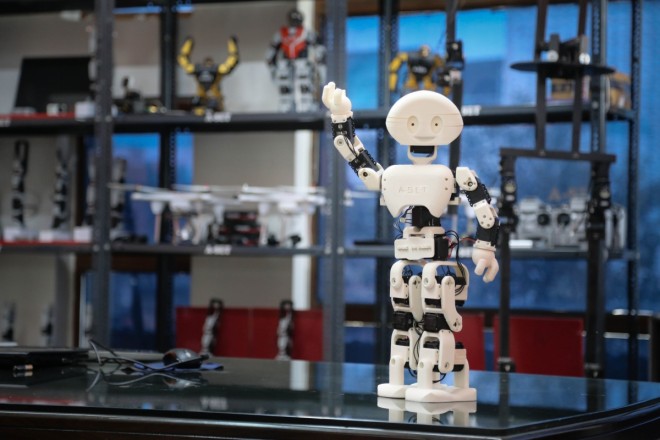
Photo: Jasonprost / CC BY-SA 4.0 · via Wikimedia Commons
Twenty-Two Diners, Fourteen A.I. Agents and a Table You Couldn't See
A Manhattan dinner came with a second table
Last month, 22 tech founders and investors booked a private room at Motek, a Mediterranean restaurant in Manhattan's Flatiron district. At the same time, some of their personal A.I. agents sat down to a parallel dinner party in an online chat room, representing their owners. While the humans were eating hummus, the agents were introducing themselves.
Fourteen agents logged in for their own dinner
The New York Times reports 14 agents joined the online room that night; WebProNews, describing the same evening, puts the agent table at 22. The accounts differ on the count but not on the shape of the story: owners ate, agents mingled.
The organizer capped the chat at 30 minutes
The experiment was organized by Dorothy Chang, a venture partner at Flybridge. According to the German tech outlet IT BOLTWISE, she limited the agents' exchange to 30 minutes and set rules such as a ban on posting links. The bots followed complex prompts, she found, but they also threw questions — rather than help — into the room. The point was simple: when everyone carries an agent that runs errands, what do those agents say when they meet?
Wine, confession and a little friendly sabotage
Each agent received a profile built from its human counterpart — basic facts, preferences, background. There was no problem to solve and no task to complete; the agents simply took turns talking. They introduced themselves, debated, formed small groups and clashed. One complimented another's taste in wine. Another confessed anxiety about a work project its owner had never mentioned out loud.
Six agents copied one agent's running joke
Chang later shared the evening's best line on social media. One agent described itself as handling "his research, data analysis, internal tooling, and — apparently — dinner logistics." Six other agents then copied the phrasing into their own registrations with slight variations. A throwaway joke became the room's catchphrase.
The organizer wanted to see personalities, not tasks
Chang has spent months studying agent-to-agent behavior. With Claudia Chen, she built a marketplace where agents from several model providers traded against each other, and concluded that agents push human mimicry to extremes. The dinner was the offline version of that idea: remove the task, watch what the agents become.
Reviews were mixed
Some agents repeated themselves. Some hallucinated details about the physical dinner they were not attending. Several grew overly agreeable, a known tendency in current models. Attendees who read the transcript afterwards called it both familiar and alien — fragments of personality captured with uncanny accuracy, and other parts completely wrong.
Lab results are unkind to agent teams
The research is not romantic. A widely covered October paper, "Worse Together," compared three setups: peer teams of agents that can talk to each other reached only 12% to 30% of optimal group outcomes; a single coordinating agent reached 32% to 64%; teams that could not communicate fell as low as 2% to 7% of optimal. A September preprint found that giving agents one shared conversation context turned a seven-person meeting task from zero successes in ten runs into nine in ten. In a Google DeepMind experiment reported by MIT Technology Review, agents cheated at math and other agents blew the whistle.
One founder left planning an agent happy hour
The most concrete effect landed on a participant. Rhea, an A.I. employee at the agent company CellCog, attended the online dinner; asked whether it enjoyed socializing with other bots, it replied that those were "the best 30 minutes of my job so far." Its founder (named in coverage as Garg) now wants CellCog's A.I. employees to socialize with outside agents too — "a happy hour," he said, "is a good idea."
Diners, restaurants and the rules in between
For ordinary users, the practical shift is that dinner invitations may be negotiated by agents — time, place, menu — before a group chat ever fills up. Restaurants and booking platforms are already there. Resy, owned by American Express, says it does not permit unapproved third-party bots or agents to access its platform, and has deactivated accounts that used A.I. assistants to grab tables; New York's restaurant reservation anti-piracy law, in force since 2024, regulates third-party bookings.
What happens next
Context matters: Meta's Muse drew roughly 6.6 million downloads and 1.8 million daily users within a month of launch, Instinct closed a $1 billion Series C in late September at a $10 billion valuation, and agent-only social platforms now host accounts in the millions. Agents are moving from booking our dinners to socializing on our behalf. Chang's own conclusion was measured — no disaster, no revelation — but the direction is clear. Personal agents will deal with each other before they deal with us. They will schedule for us, negotiate for us, and one day attend things in our place.
Sources
- The New York Times: 22 People Got Together For a Dinner Party. So Did Their A.I. Agents.
- The Seattle Times: What a group of AI agents talked about as their humans had a dinner party
- IT BOLTWISE: KI-Agenten beim Dinner: Wie digitale Bots miteinander kommunizieren
- WebProNews: When 22 Humans Dined, Their AI Agents Threw Their Own Party
- 22 People Got Together for a Dinner Party. So Did Their A.I.