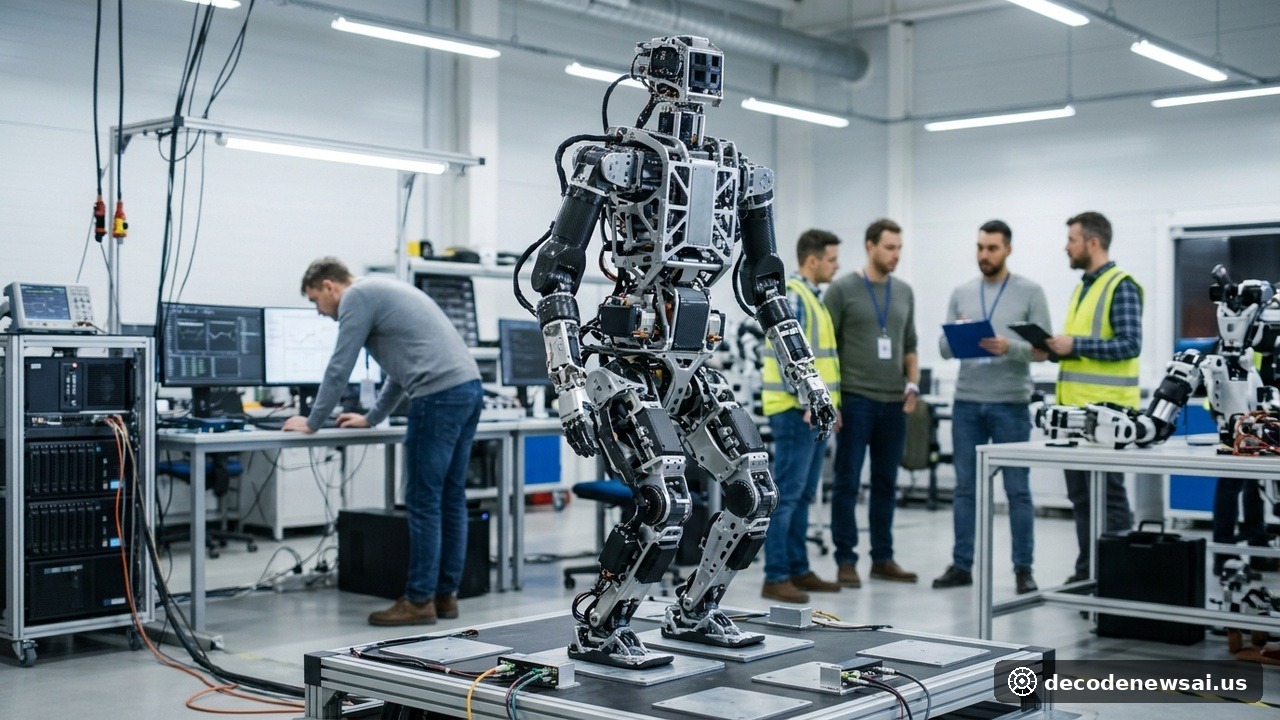
On November 5, 2026, premier technology and financial publications including GeekWire, The Robot Report, TechRepublic, and Unite.ai reported that Oregon-based robotics developer Agility Robotics officially completed its business combination with special purpose acquisition company Churchill Capital Corp XI, commencing public trading on the Nasdaq Global Market under the ticker symbol "AGLT." The merger and its associated financing facilities generated approximately $465 million in gross capital before transaction expenses, establishing an enterprise valuation of roughly $2.5 billion. The milestone establishes Agility as the world’s first pure-play bipedal humanoid robotics manufacturer to debut on public equity markets, opening an unprecedented chapter for embodied artificial intelligence commercialization across industrial sectors worldwide. Industry observers hailed the listing as a watershed event validating humanoid robotics as an investable public asset class.
Tapping Public Markets to Finance Capital-Intensive Humanoid Industrialization
The decision to enter the public equity domain arrives at a pivotal juncture as the emerging humanoid robotics sector transitions from controlled laboratory demonstrations into rigorous industrial pilot programs. Amid escalating competitive pressure from well-capitalized tech titans, including Tesla’s Optimus program and venture-backed contenders such as Figure AI, robotics hardware companies face staggering capital expenditure requirements to finance supply chain tooling, mechanical validation, and distributed fleet deployments. In an era marked by tighter venture capital disbursements, Agility strategically leveraged the public SPAC structure to secure vital growth liquidity. Market participants had closely watched whether public investors would embrace pre-profit frontier hardware companies amid broader macroeconomic uncertainty.
Regulatory disclosures revealed that the transaction combined approximately $164 million remaining in the SPAC's trust account following shareholder redemptions, a $201 million private placement in public equity (PIPE) led by electronics manufacturing conglomerate Foxconn, and $100 million in prior equity financing secured by Agility. Chief Executive Officer Peggy Johnson confirmed in media interviews that public listing was accelerated by substantial commercial traction, highlighting over $300 million in multi-year committed customer agreements for its next-generation Digit 5 humanoid platform. Executive leadership emphasized that the influx of public growth capital will directly fund expanded manufacturing throughput at its state-of-the-art facility in Salem, Oregon, enabling the production of hundreds of commercial units annually. Johnson stated that public market visibility provides corporate customers increased confidence in Agility's long-term financial staying power.
Over 65,000 Hours of Industrial Field Experience Solidifies Operational Advantage
Unlike early-stage robotics enterprises reliant entirely on simulated kinematic modeling, Agility has cultivated significant operational moats through sustained commercial logistics deployments. According to company technical briefings, the Digit humanoid fleet has accumulated more than 65,000 operational hours across real-world enterprise customer facilities. The bipedal robot has completed live customer integrations with major international supply chain operators, including contract logistics titan GXO Logistics, German automotive supplier Schaeffler, and Toyota Motor Manufacturing Canada. These multi-facility commercial tests demonstrated Digit's capacity to seamlessly navigate legacy warehouse infrastructure without requiring facility redesigns, validating its ability to handle continuous bulk tote transfers under rigorous production constraints.
The upcoming Digit 5 model incorporates substantial mechanical and sensory architectural advancements, featuring redesigned lightweight lower-limb actuators, high-density industrial battery modules, and certified human-safe collaborative interaction frameworks. Agility co-founder and Chief Robot Officer Jonathan Hurst observed that the real-world operational datasets gathered during thousands of autonomous tote-handling shifts provide an irreplaceable data flywheel. Hurst noted that continuous field exposure enables physical AI algorithms to master environmental unpredictability, dynamic obstacle avoidance, and physical payload variations in ways purely synthetic simulations cannot replicate, providing warehouse operators dependable autonomous throughput. Company engineers highlighted that Digit 5's battery life enables full eight-hour shifts with minimal automated recharge intervals.
Public Scrutiny Over Significant Cash Burn and Nascent Commercial Revenues
Despite securing the mantle of Wall Street’s maiden humanoid robotics stock, Agility faces immediate and intense analytical scrutiny from institutional investors demanding clear paths toward operational profitability. Securities filings indicate that substantial research allocations and advanced prototype manufacturing resulted in a net loss of $362 million during the first half of 2026, while trailing quarterly revenues hovered near $1.8 million. The pronounced disparity between early-stage top-line commercial sales and capital market valuations highlights the high-stakes execution risks inherent in pioneering frontier hardware categories within public equity environments. Financial analysts noted that scaling hardware assembly while managing custom software integration presents immense margin friction.
Financial analysts and Wall Street robotics equity research desks emphasized that public reporting mandates will subject Agility’s quarterly cash burn, unit economics, manufacturing bill of materials, and customer retention metrics to rigorous ongoing transparency. Skeptics point out that if hardware scaling falters or corporate clients delay firm purchase orders, public shareholders may quickly penalize the stock. As industrial automation clients deliberate long-term capital deployment schedules for humanoid workforces, Agility’s financial performance on Nasdaq will serve as an authoritative benchmark determining whether physical artificial intelligence platforms can successfully bridge the commercialization valley of death and generate sustainable industrial returns for institutional backers. Investors will scrutinize subsequent quarterly filings to measure whether gross margins expand as automated manufacturing lines ramp up production.