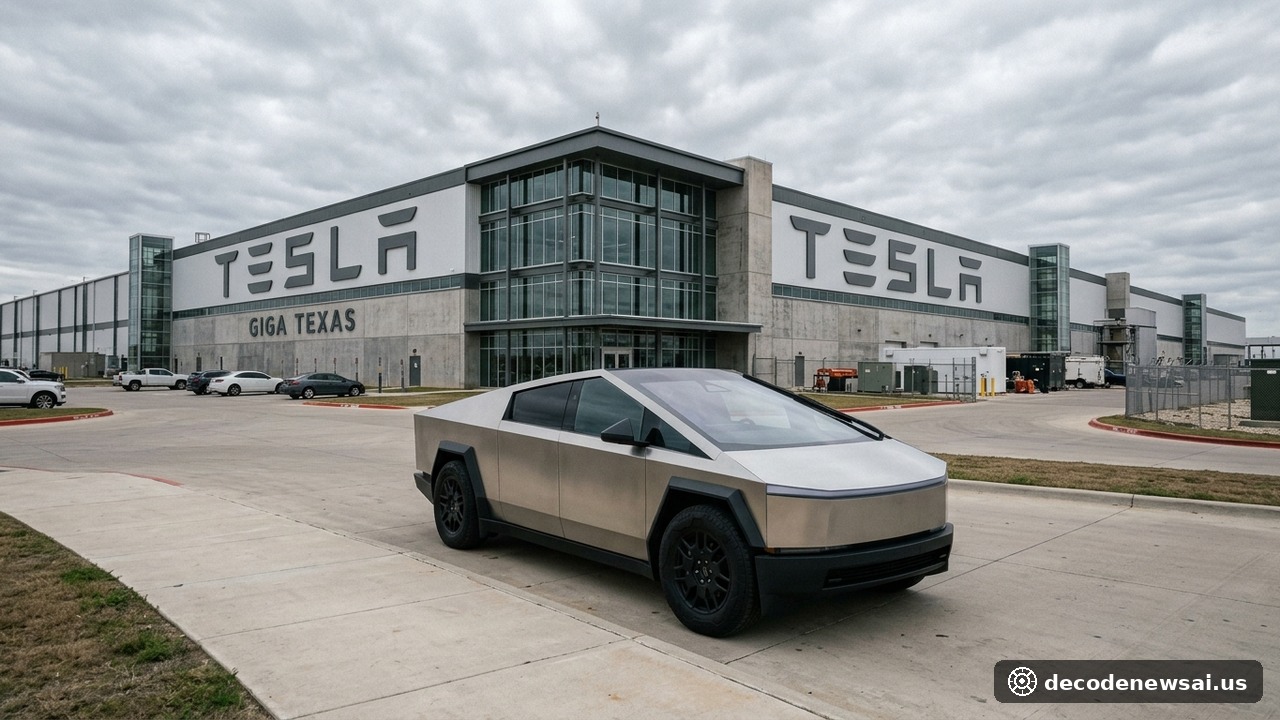
Musk Confirms Texas Plant Wind-Down to Reallocate Factory Footprint to Robotaxis
On November 6, 2026, Tesla, Inc. Chief Executive Officer Elon Musk published an official announcement on social media platform X, confirming that the company will wind down manufacturing of its controversial Cybertruck at Gigafactory Texas around the middle of 2027. Musk stated that the operational decision is designed to reallocate assembly space and manufacturing capacity toward ramping up production of the Cybercab, Tesla's dedicated, purpose-built autonomous robotaxi vehicle designed without traditional steering wheels or foot pedals.
The impending termination of Cybertruck production concludes one of the most polarizing and engineering-intensive product chapters in the automaker's history. First unveiled as a futuristic concept vehicle in November 2019, the stainless-steel pickup suffered multi-year commercialization delays before achieving initial customer handovers in late 2023. However, sustained volume ramp challenges, high production scrap rates, and persistent component costs restricted profitability. Furthermore, the vehicle's angular stainless-steel exoskeleton presented insurmountable regulatory compliance challenges under pedestrian impact and vehicle homologation standards across Europe, China, and Australasia. In October 2026, Tesla officially sent cancellation notices to reservation holders across Australia and New Zealand, confirming the vehicle would not enter local commercial distribution.
Production Hurdles and International Regulatory Barriers Constrain Global Reach
Automotive equity analysts and technology strategists interpreted the production pivot as a structural reallocation of corporate capital from niche automotive hardware toward autonomous software and network services. By paring back a high-overhead pickup truck line that failed to achieve mass-market adoption outside North America, Tesla frees substantial factory floor space, electrical infrastructure, and robotic tooling at its primary Austin campus to support the scheduled production ramp of the Cybercab.
Financial markets responded with calculated resilience following the announcement. While equity investors acknowledged the lost development expenditures associated with Cybertruck's bespoke stamping infrastructure, Wall Street research desks noted that scaling autonomous mobility fleets carries substantially higher gross margin potential than low-volume electric trucks. Shares of Tesla experienced initial pre-market volatility on November 6 before stabilizing during regular New York trading hours.
Strategic Realignment Toward Autonomous Mobility Platforms Anchors Long-Term Roadmap
The transition underscores broader structural realignments across the global automotive sector, where legacy vehicle forms are increasingly subordinated to autonomous commercialization. By channeling capital expenditures into proprietary neural network training, localized fleet dispatch platforms, and high-volume robotaxi manufacturing, Tesla aims to establish an unassailable commercial footprint in urban autonomous rideshare networks ahead of global competitors.
Tesla has said the freed capacity will go to Cybercab production, the vehicle at the centre of its robotaxi plan, and the stock recovered after an initial dip when US markets opened on November 6.