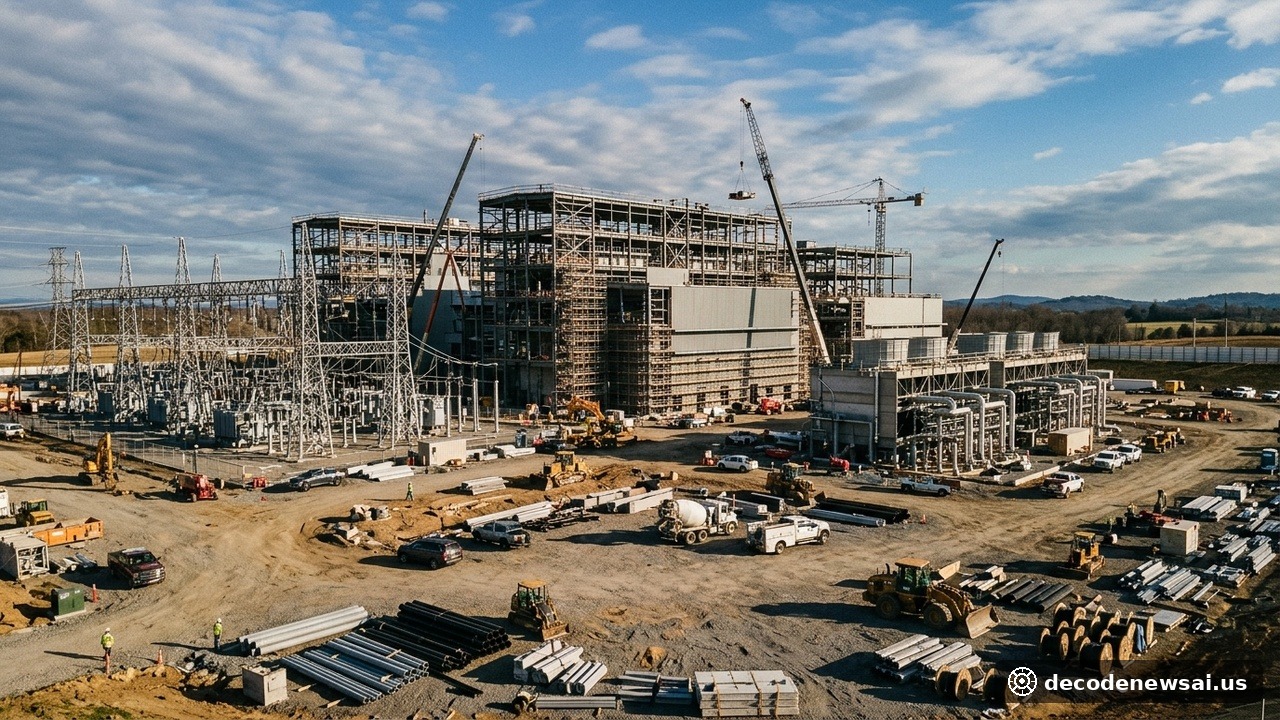
Australian data center operator IREN said on November 5 that some infrastructure being built for Microsoft will be delivered later than previously expected, even as it reported rapid growth in its AI cloud business and outlined another major spending plan. Microsoft requested changes to the network design, while supplier timing also affected the schedule. As a result, IREN moved its target of putting more than $4 billion in annualized run-rate revenue into operation from the end of 2026 to January 2027, with a possibility that the target could slip to the end of February. The company still expects to spend about $15 billion in the remainder of its fiscal year.
Microsoft design changes push back the operating target
IREN said the delivery changes followed a customer-requested network redesign intended to support newer generations of AI models. The company said delays caused by Microsoft's requested changes would not trigger delay credits or financial penalties. IREN is developing 200 megawatts of data center capacity for Microsoft in Texas. The first phase, known as Horizon 1, has entered service, while the remaining phases are still moving through construction and commissioning.
The schedule shift matters because IREN has made a target of more than $4 billion in annualized run-rate revenue a central measure of its expansion. The company now expects that contracted capacity to become operational in January 2027 rather than by the end of 2026, while warning that the date could extend to the end of February.
That run-rate figure needs careful interpretation. It is an operating metric calculated from contracted GPUs that have been commissioned, using assumed hourly pricing and annualized utilization. It is not the same as revenue recognized under generally accepted accounting rules. IREN says actual recognized revenue may be materially lower and will depend on delivery, testing, customer acceptance and utilization. The distinction is important: a company can have a large contracted revenue run rate without recognizing the full amount in its financial statements immediately.
IREN said the redesign was intended to enable the 200-megawatt deployment to serve newer frontier AI models. The revised schedule still depends on completing the infrastructure and bringing it into service.
AI cloud revenue accelerates, but losses remain substantial
IREN reported total quarterly revenue of $228 million, up 66% from the previous quarter. AI cloud revenue rose to $200 million from $71 million in the prior quarter, an increase of 182%. The AI cloud segment reported a gross margin of 86%. Yet IREN recorded a net loss of $263 million, underscoring the cost of building and financing a large computing platform while its business is scaling.
At the end of September, IREN's operating annualized run rate was about $1 billion. It expects roughly one-quarter of that amount to be recognized as revenue in the December quarter, a company estimate rather than a guarantee.
IREN also reported a revenue backlog of $20.3 billion, up 22% sequentially. Approximately two-thirds of that backlog was associated with investment-grade counterparties. Backlog can provide visibility into future business, but it is not cash already collected. Its conversion into revenue depends on the company delivering capacity and satisfying contractual service requirements.
IREN is expanding from a business historically associated with bitcoin mining into a provider of AI computing capacity. It must still finance equipment, construct facilities and turn signed commitments into billable services.
A $15 billion spending plan raises funding questions
IREN expects about $15 billion of capital expenditure during the remainder of its fiscal year. It said approximately $9 billion is expected to be covered by cash, committed GPU financing and customer prepayments. The remaining roughly $6 billion is expected to come from targeted GPU financing, customer prepayments, data center financing and other corporate-level funding sources. Those additional sources remain subject to market conditions.
The company's capital commitments reached $18.95 billion at the end of September, compared with $13.81 billion three months earlier. The value of GPU hardware on its balance sheet increased to $5.82 billion from $2.04 billion. These figures show how quickly the company is committing capital to expand its computing fleet and infrastructure.
The plan creates a financing challenge. Higher borrowing costs, slower construction or delayed equipment deliveries could increase the time between spending money and receiving cash from customers.
IREN argues that its land, power access and data center assets provide flexibility in how it funds expansion. Its contracts with major customers, including Microsoft and Nvidia, are also part of the financing story. Still, the portion of the plan that depends on future financing is not secured in the same way as cash or already committed facilities. Investors will therefore watch whether the company can obtain funding on acceptable terms without placing excessive pressure on its balance sheet.
Investors weigh execution risk against new AI demand
IREN's results arrived during a sharp selloff in AI infrastructure stocks. Reuters reported that the shares fell about 17% during regular trading on November 5, before rising about 4% in extended trading after the earnings release. The price movement reflected competing views: investors were concerned about the Microsoft delivery schedule and the capital demands of the business, but the rapid increase in AI cloud revenue offered evidence of demand.
IREN also disclosed new contracts signed after the quarter ended. One five-year agreement was priced at approximately $22 million per IT megawatt in estimated annual revenue and included customer prepayment covering 90% of the associated GPU capital expenditure. A separate short-term contract was priced at approximately $40 million per IT megawatt. The company also said it had contracted H100 GPUs at double previous pricing. These contract terms suggest that customers may be willing to pay more for scarce computing capacity and to prepay a larger share of equipment costs.
Those terms should not be treated as a universal price for the market. They relate to particular contracts, and the economics depend on duration, hardware, utilization, power and service obligations. A higher revenue rate per megawatt can improve project economics, while a large prepayment can reduce the provider's upfront funding burden. But neither removes the need to deliver the capacity on schedule.
The central question for IREN is now whether it can convert a rapidly growing contract base into operating facilities and collected revenue. The Microsoft project is an important test of construction and customer coordination. The next milestones will include the revised delivery timetable, the company's ability to secure the financing still needed for expansion, and whether AI cloud revenue continues to grow as new capacity comes online. Strong demand is necessary for the strategy, but execution and funding will determine whether that demand produces sustainable returns.