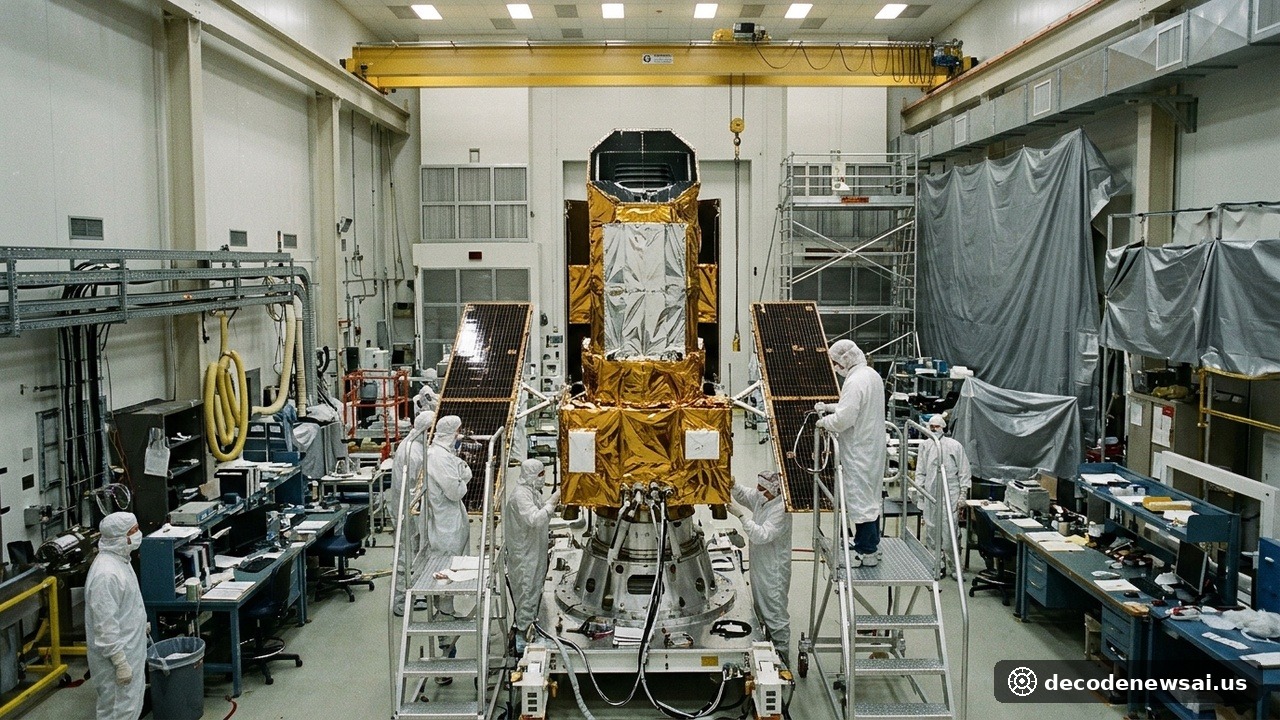
On November 5, 2026, official scientific communiques from NASA’s Science Mission Directorate, alongside coverage from Sky at Night Magazine, Spaceflight Now, Space.com, and Mashable, confirmed that the legendary Neil Gehrels Swift Observatory officially re-entered Earth’s atmosphere on Wednesday, November 4, 2026, at 7:39 a.m. EST (12:39 UTC). The spacecraft broke up over the North Sumatra region of Indonesia after nearly 22 years of continuous, breakthrough scientific operations in low-Earth orbit. Originally engineered with an operational design baseline of just two years, the space telescope redefined high-energy time-domain astrophysics by capturing thousands of cosmic gamma-ray bursts, concluding its mission after orbital decay outpaced robotic servicing initiatives.
Capturing the Universe’s Most Violent Explosions Across Nearly Two Decades of Operation
Launched in November 2004 aboard a Delta II launch vehicle from Cape Canaveral Air Force Station, Florida, the Swift Observatory fundamentally revolutionized orbital astrophysics. Designed to unravel the physical mechanics of gamma-ray bursts (GRBs)—the most energetic electromagnetic explosions in the universe—the mission paired wide-field detection capabilities with rapid autonomous slewing mechanisms.
Named in honor of its visionary principal investigator, Dr. Neil Gehrels, the satellite carried an integrated three-instrument payload comprising the wide-field Burst Alert Telescope (BAT), the high-resolution X-ray Telescope (XRT), and the Ultraviolet/Optical Telescope (UVOT). When the wide-field BAT sensor detected gamma-ray transient events across deep space, onboard flight computers calculated celestial coordinates within seconds. Autonomous attitude control reaction wheels immediately slewed the multi-ton spacecraft across the sky, aligning the narrow-field X-ray and optical instruments with the fading afterglow within tens of seconds of initial burst detection. This rapid multi-wavelength coordination allowed astrophysicists to characterize core-collapse supernovae, neutron star collisions, and black hole tidal disruption events with unprecedented temporal fidelity.
Astrophysicists worldwide relied on Swift's automated real-time telemetry broadcasts distributed via the Gamma-ray Coordinates Network (GCN). Over its multi-decade operational tenure, the satellite dispatched tens of thousands of automated alert notices to ground-based optical observatories, enabling astronomers across six continents to coordinate immediate follow-up spectroscopic campaigns. This planetary observation network demystified short-duration gamma-ray bursts as the cosmic signatures of binary neutron star mergers, providing the observational foundation that subsequently validated gravitational-wave multi-messenger astronomy.
Intense Solar Maximum Drives Atmospheric Drag as Robotic Servicing Proposals Lapse
The spacecraft’s demise was accelerated by extreme space weather dynamics during the current solar maximum cycle. Elevated solar ultraviolet radiation and intense geomagnetic storms heated and expanded Earth's thermosphere, significantly increasing aerodynamic drag across low-Earth orbital regimes. Lacking an active chemical propulsion system to counteract continuous altitude attrition, Swift’s orbital altitude degraded at an accelerating pace over the preceding twenty-four months.
NASA mission directors and aerospace engineers exhaustively evaluated multiple contingency life-extension architectures, including partnering with commercial space exploration firms to execute an autonomous rendezvous and robotic re-boost maneuver to elevate the telescope into a stable graveyard orbit. However, technical complexities associated with autonomous uncooperative docking, compressed launch preparation windows, and strict federal agency budget allocations prevented a physical servicing mission from materializing before atmospheric capture became irreversible.
Tracking data from the United States Space Force 18th Space Defense Squadron and international orbital tracking radars confirmed that Swift entered the dense upper atmosphere traveling at over 17,000 miles per hour, undergoing violent aerodynamic heating and structural disintegration over the Indian Ocean adjacent to North Sumatra. NASA safety assessments confirmed that while the vast majority of the aluminum structure and optical assemblies vaporized completely during atmospheric friction, a minimal quantity of dense titanium and refractory alloy components plunged harmlessly into remote oceanic waters without causing terrestrial property damage.
A Lasting Scientific Legacy That Defines the Future Architecture of Time-Domain Astronomy
The final atmospheric descent of the Swift Observatory marks the conclusion of a golden era in spaceborne high-energy astrophysics. Throughout nearly 22 years of orbital exploration, Swift observed more than 1,500 gamma-ray bursts, generated definitive multi-wavelength surveys of active galactic nuclei, and yielded empirical datasets that anchored more than 10,000 peer-reviewed scientific publications across astrophysics and cosmology.
Astrophysicists across international research consortiums observed that while the physical satellite has burned up, its foundational operating principles—real-time autonomous targeting, open scientific data telemetry, and rapid cross-spectral handoffs—remain the permanent gold standard for observational astronomy. Successor orbital platforms, including the joint Chinese-French Space Variable Objects Monitor (SVOM) and planned next-generation transient survey missions, directly incorporate the architectural lessons pioneered by Swift, ensuring that humanity’s multi-messenger vigil over the universe’s most extreme cataclysms endures into future decades.