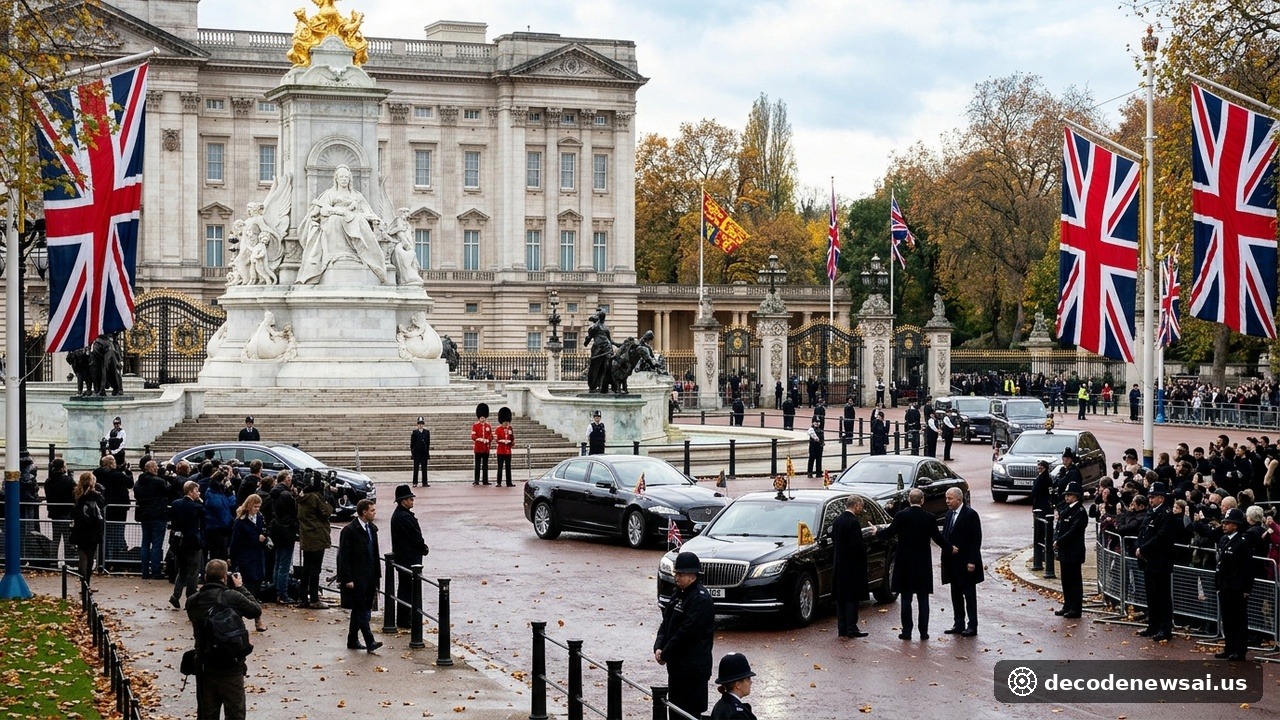
King Charles III actively welcomes and relishes being deployed by the British Government into complex, exhausting, and politically charged diplomatic situations around the world, a senior Royal Household courtier confirmed on Thursday, November 5, 2026. As the King approaches his 78th birthday, Downing Street increasingly views the monarch as an indispensable constitutional "secret weapon" capable of building diplomatic bridges that elected party politicians cannot reach.
The frank assessment from within Buckingham Palace offers rare insight into how the royal family navigates contentious geopolitical crosscurrents while strictly maintaining constitutional neutrality.
Clear Pattern of Politically Charged Deployments in Fifth Year of Reign
Reflecting on the monarch's official overseas schedule as Charles enters the fifth year of his reign since ascending the throne in September 2022, the senior palace aide noted that a distinct operational pattern has emerged under successive British administrations. Downing Street has repeatedly called upon the sovereign to undertake demanding foreign visits fraught with delicate political sensitivities, leveraging the institution of the Crown to stabilize foreign relationships during turbulent times.
The aide's remarks followed the conclusion of an intensive nine-day royal tour spanning three Caribbean nations, including Antigua and Barbuda and Guyana, where the King represented the United Kingdom at the biennial Commonwealth Heads of Government Meeting (CHOGM). Conducting public engagements in tropical heat approaching 40 degrees Celsius as well as sudden tropical downpours, the monarch navigated complex debates surrounding the historical legacy of the transatlantic slave trade, colonial reparations, and diplomatic tensions sparked by comments from British Conservative Party leader Kemi Badenoch. During an appearance at the Sir Viv Richards Stadium on Antigua's Independence Day, the royal couple endured a sudden deluge that interrupted ceremonial anthems; Queen Camilla joked that she had never been so wet in her life, while Charles quipped to hosts that he was growing watercress on his suit.
The senior aide summarized the grueling trip as a resounding diplomatic victory: "We're just in the fifth year of the reign and I think what we're seeing is a very clear pattern emerging of the Government asking the King to head into quite politically charged situations, quite challenging situations. I would say, in the round, this has been a complex visit. It's been challenging. It's been exhausting. But the takeaway is that it's been very successful, and I think the King has demonstrated his statecraft both by word and deed. It's a great secret weapon to send the King."
Overcoming Obstacles Across Four Prime Ministers and Transatlantic Tiers
On the domestic political front, King Charles maintains a constructive and close working relationship with sitting Labour Prime Minister Andy Burnham, conducting confidential weekly audiences at the palace. During a formal banquet hosted for Commonwealth leaders, the King displayed characteristic self-deprecating wit when addressing the rapid turnover in Westminster politics, remarking to international premiers that it had been a distinct honor to meet so many prime ministers on his tour—"almost as many as I've had at home." Since his accession in September 2022, Charles has formally constitutionalized and worked alongside four distinct British prime ministers.
The courtier emphasized that the sovereign rapidly establishes genuine working rapport across ideological boundaries, noting: "The King very quickly finds a way to establish a good working relationship with the sitting prime minister, so they get on very well. I see them together every week, and it genuinely is a good relationship, but as it is with all the prime ministers and all the ex-prime ministers as well, with almost every single one of them, you can find something that they really care about that the King really cares about."
This personal diplomatic acumen was starkly proven during the King's high-stakes state visit to the United States earlier this year. Ahead of that transatlantic voyage, Liberal Democrat leader Sir Ed Davey repeatedly urged the Government to cancel the itinerary, warning publicly that Charles risked acute diplomatic embarrassment in meetings involving President Donald Trump. Rejecting calls for cancellation, Charles delivered an authoritative, acclaimed address before a joint session of the United States Congress, neutralizing partisan friction and fulfilling crucial strategic objectives requested by Downing Street.
Equanimity on Republican Movements and Enduring Royal Soft Power
Regarding Commonwealth realms actively exploring transitions away from the British monarchy toward independent republican governance, the palace affirmed that King Charles remains entirely relaxed and supportive of self-determination. Citing the amicable precedent established when Barbados transitioned to a parliamentary republic in 2021 while reaffirming its devotion to the broader Commonwealth voluntary association, the palace confirmed that the Crown holds no resistance to sovereign constitutional updates.
Addressing persistent media questions regarding whether an aging royal couple—with Charles about to turn 78 years old—can sustain such rigorous international itineraries, senior courtiers responded that the monarch draws profound energy from public duty: "This is literally what he was born to do, he's very good at it, and he enjoys the reaction he gets from people in the doing of it." As traditional multilateral diplomacy grows increasingly fractured by polarized electoral politics, the British Crown's nonpartisan prestige continues to serve as an agile instrument of statecraft.