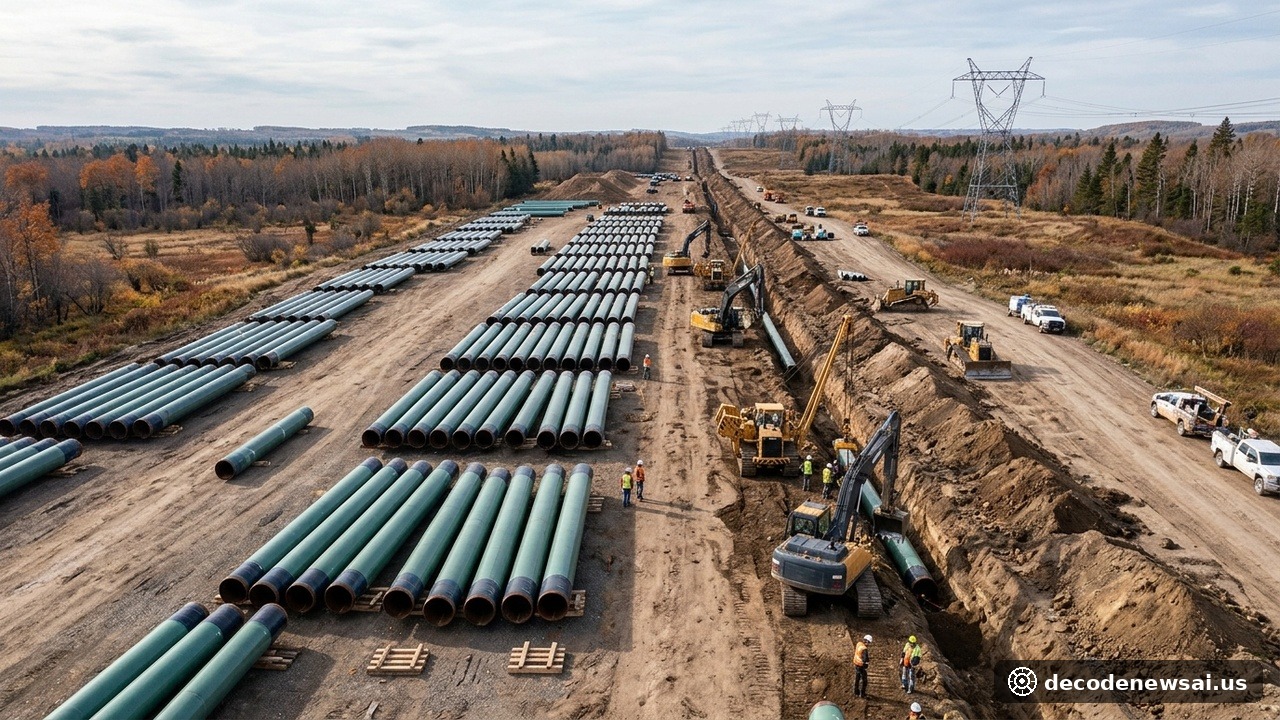
TC Energy raised its 2026 earnings outlook and approved approximately C$3 billion in new growth projects on November 5, pointing to rising demand for natural gas from power generation, artificial intelligence data centers and liquefied natural gas exports. The Canadian pipeline operator is advancing expansions in the U.S. Midwest while moving ahead with a second phase of the Coastal GasLink system in western Canada. The announcements show how energy infrastructure companies are positioning their networks for a decade in which electricity demand from computing and exports could reshape regional gas flows.
Higher outlook reflects stronger pipeline performance
TC Energy increased its 2026 comparable EBITDA forecast to C$11.8 billion to C$12.0 billion, from its previous range of C$11.6 billion to C$11.8 billion. Comparable earnings were C$0.94 per share in the third quarter, above the analyst estimate of C$0.86. Comparable EBITDA reached C$3.0 billion, an increase of 13% from the same period a year earlier.
The company's U.S. natural gas pipelines business recorded a 17% increase in comparable EBITDA to C$1.25 billion. Its Canadian natural gas pipelines business increased 4.4% to C$953 million. TC Energy attributed the stronger results to higher pipeline volumes, favorable regulatory and commercial settlements, and projects that entered service ahead of schedule and under budget.
The company also expects comparable EBITDA of C$12.3 billion to C$12.5 billion in 2027. It projects annual compound growth of 5% to 7% from 2026 through 2031. Those targets depend on converting a large development pipeline into approved, contracted and operating assets, rather than simply announcing projects.
Midwest expansions target power generation and data centers
Among the newly approved investments, the Crossroads Expansion is expected to cost about US$1.8 billion and add 1.4 billion cubic feet per day of transportation capacity. The American Midwest project is expected to cost about US$400 million and add another 1.0 billion cubic feet per day. Together, the two projects would add 2.4 billion cubic feet per day of capacity to serve growing power-generation demand in the U.S. Midwest, including demand from data centers.
Both projects are supported by long-term take-or-pay contracts and are expected to enter service in 2030. Under these arrangements, customers pay for contracted transportation capacity even if they do not use all of it. That structure can make pipeline revenue more predictable than income tied directly to short-term commodity prices or daily throughput.
TC Energy said the two projects represent approximately US$1.9 billion of net capital and are designed to use its existing network position. Their planned capacity additions are intended to serve utilities and other customers as electricity demand increases. Data centers are part of that demand outlook because large computing facilities require reliable power around the clock, potentially increasing the need for gas-fired generation and the pipelines that supply it.
The company also approved the ANR Optimization project, an estimated US$100 million expansion that would add about 0.3 billion cubic feet per day of firm transportation service. The project is intended to support coal-to-gas switching in parts of the United States. TC Energy described the projects as expansions along existing pipeline corridors, a strategy that can reduce the need to build entirely new routes while adding capacity where customers have contracted for service.
Coastal GasLink expansion supports LNG exports
In western Canada, TC Energy approved the second phase of the Coastal GasLink expansion, with an estimated cost of C$4.9 billion. The project will add five compressor stations and increase firm transportation capacity by approximately 2.0 billion cubic feet per day, taking the system to about 4.5 billion cubic feet per day. Construction is expected to begin in early 2027, with the expansion targeted to enter service in the early 2030s.
Coastal GasLink connects natural gas supplies in northeastern British Columbia to the LNG Canada export facility in Kitimat. Expanding the system would increase the amount of Canadian gas that can reach the export terminal and be processed for overseas markets. The project advanced after LNG Canada and its joint-venture partners made a positive final investment decision on the next phase of the export development.
TC Energy said LNG Canada will lead project execution and construction, while Coastal GasLink will remain the owner and operator of the pipeline. The commercial structure includes limits on Coastal GasLink's capital commitments and its exposure to construction-cost and schedule risks. The company also said the project secured up to C$3.3 billion in project-level financing, with its proportionate share of committed equity reaching up to approximately C$250 million.
The expansion is part of a broader shift in Canada's energy infrastructure strategy. Additional LNG export capacity could give Canadian producers greater access to overseas markets, but the benefits depend on construction, customer demand and the economics of long-term gas supply. Projects with multiyear construction schedules also face risks from labor, equipment, permitting and cost changes.
Long-term demand projections are not guaranteed projects
TC Energy estimates that North American natural gas demand could increase by about 51 billion cubic feet per day between 2025 and 2035, driven primarily by LNG exports and gas-fired power generation. It also expects Canadian electricity demand to double by 2050. The company's investment thesis is that data centers and other power-intensive industries will require reliable electricity, supporting additional gas-fired generation and transportation capacity.
The company described a substantial pipeline of potential investment. Approximately C$6 billion of projects had been sanctioned during 2026, while another C$6 billion was pending approval. TC Energy said it had more than C$40 billion in additional opportunities in origination. These categories represent different stages of development. Approved projects are further along than proposals awaiting approval, while opportunities in origination may still require customer commitments, regulatory decisions and investment approval.
The distinction matters for investors. A large project pipeline can signal demand and potential growth, but it should not be treated as committed spending or guaranteed future earnings. Each project must secure the necessary approvals, meet commercial requirements and be delivered on schedule and within budget. TC Energy's results suggest its existing network is benefiting from stronger natural gas demand, but its longer-term growth targets depend on successful execution of the next wave of infrastructure.
For the energy sector, the link between AI and natural gas is becoming more concrete. Data centers do not consume gas directly, but their electricity requirements can support new generation capacity and, in turn, demand for pipeline transportation. LNG exports create another source of demand for gas infrastructure. TC Energy is positioning itself to serve both trends, while relying on long-term contracts and regulated assets to manage some of the risks associated with major capital projects.