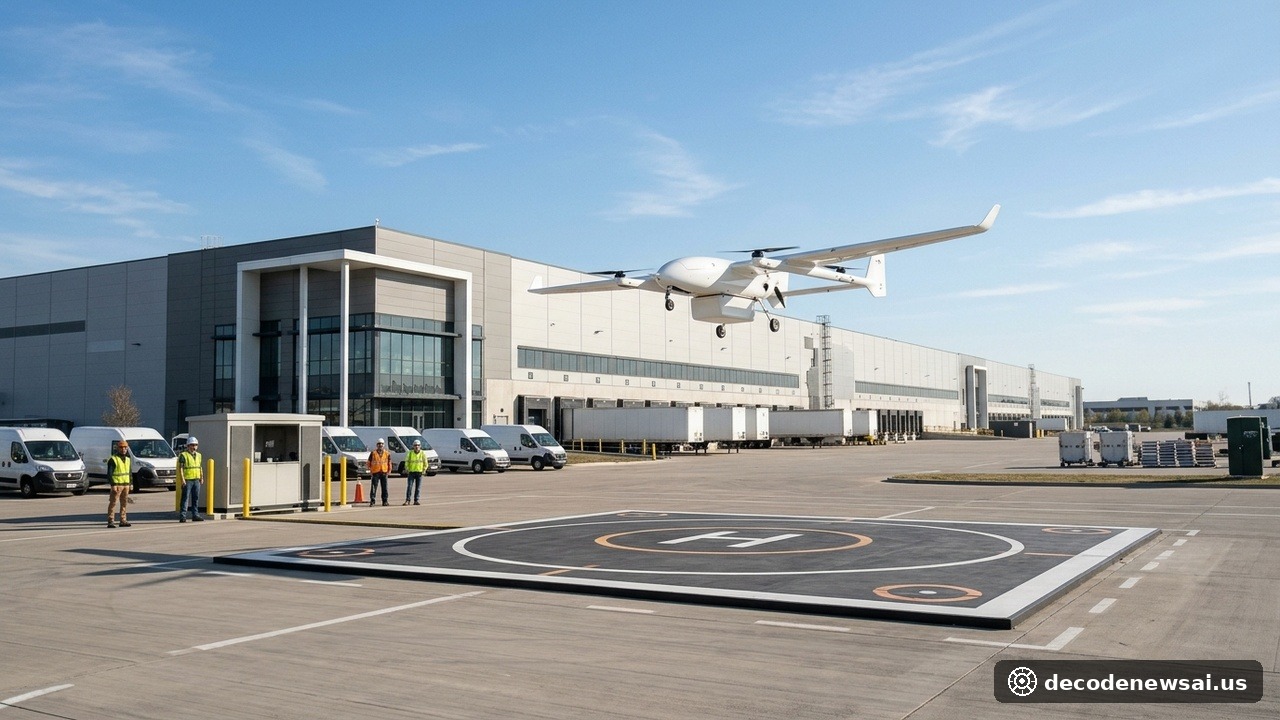
Autonomous delivery pioneer Zipline officially announced on Thursday, November 5, 2026, that it raised $1.5 billion in fresh equity capital at a $21.5 billion post-money valuation. Coinciding with the funding milestone, retail giant Walmart cemented an expansive multi-year commercial agreement with Zipline to construct and deploy 300 additional drone delivery hubs nationwide, accelerating the transition of aerial logistics from regional pilot tests into mainstream commercial retail infrastructure across the United States.
The substantial capital infusion and corporate expansion highlight surging commercial adoption of autonomous electric delivery aircraft, underscoring intense enterprise demand for rapid, low-emissions fulfillment networks that bypass congested surface transportation grids.
Valuation Nearly Triples in Ten Months Under Landmark Financing Round
The $21.5 billion post-money valuation marks an extraordinary financial escalation for the South San Francisco-based aerospace company. When Zipline closed an equity round exceeding $600 million in January 2026, the company was valued at $7.6 billion. Securing a $21.5 billion valuation in November represents a nearly threefold expansion in equity worth in less than 10 months, positioning Zipline among the highest-valued private aviation and autonomous robotics enterprises in the world.
The $1.5 billion investment round was led jointly by investment firms Paradigm, WCM Investment Management, and Layer Global. A distinguished group of venture capital powerhouses and strategic corporate partners participated in the round, including Valor Equity Partners, Fidelity Management & Research Company, global mobility operator Uber, Tiger Global Management, J.P. Morgan, ARK Invest, and Salesforce Ventures. Zipline confirmed that the newly secured proceeds will be allocated primarily toward scaling advanced automated drone manufacturing facilities within the United States, expanding engineering and flight-operations hiring, and constructing high-density automated dock infrastructure across major metropolitan regions.
According to reporting from Axios, Zipline originally pioneered its autonomous flight systems by deploying long-range fixed-wing drones across developing nations, notably delivering temperature-sensitive blood supplies and critical vaccines to rural hospitals throughout Rwanda. In recent years, the company broadened its engineering mandate to develop specialized short-range acoustic-dampened delivery systems capable of delivering everyday consumer goods, hot restaurant meals, and over-the-counter pharmaceuticals directly into suburban backyards.
Walmart Commits to 300 Drone Hubs Delivering Orders in 30 Minutes
Walmart serves as the primary commercial anchor powering Zipline's rapid consumer deployment. Since initiating collaborative flight operations in 2021, Walmart's automated aerial delivery programs have completed more than 2 million commercial customer deliveries across the country. Operating 21 active commercial stations across Texas and Arkansas, Zipline's specialized Platform 2 (P2) drones currently transport consumer orders weighing up to 8 pounds directly to residential drop zones.
Under the expanded multi-year pact, Walmart will integrate Zipline launch hubs across 300 additional store locations nationwide. Eligible households residing within operational delivery radiuses can purchase tens of thousands of consumer products, groceries, over-the-counter pharmaceuticals, and household necessities directly through the Walmart mobile app or online storefront, receiving doorstep deliveries in as little as 30 minutes. Greg Cathey, Walmart's senior vice president of e-commerce fulfillment transformation, emphasized that customer engagement patterns have matured rapidly: "We see customers try drone delivery for the novelty and then continue to come back to it for the convenience when they need something in minutes."
Reflecting on the scale of commercial uptake, Zipline founder and Chief Executive Officer Keller Cliffton remarked to Bloomberg Television that enterprise and consumer enthusiasm had surpassed early modeling: "I think both we and they have been quite startled by the level of customer demand. We are going to expand to every metro and then eventually every home in the U.S."
150 Million Commercial Flight Miles and Expanding Sector Applications
Transforming proprietary drone technology into an industrial-scale global logistics ecosystem, Zipline confirmed that its autonomous fleet has logged over 150 million commercial autonomous flight miles without experiencing a safety incident, while its ongoing healthcare supply chains save an estimated 14,000 lives annually worldwide.
Beyond traditional supermarket retail, Zipline's automated fulfillment network is unlocking rapid growth across on-demand restaurant dining and third-party logistics. Within the Dallas-Fort Worth metropolitan area alone, Zipline completed more than 1 million commercial deliveries this year. Analytical telemetry gathered during October revealed that the median Zipline order arrived at customer properties just 19 minutes following checkout, vastly outperforming conventional motorized courier delivery times that typically exceed 30 minutes.
A cohort of Zipline's longest-tenured restaurant partners experienced a 26% increase in delivery gross merchandise value, with 80% of that total expansion attributable directly to orders fulfilled by drone. Furthermore, strategic partner Uber announced a long-term commercial goal targeting 1 million daily drone deliveries through the Zipline network by 2029, signaling widespread commercial viability for automated last-mile aerial logistics across North American metropolitan landscapes. Industry analysts note that as consumer expectations for instant commerce solidify, autonomous low-altitude flight infrastructure represents the decisive logistical frontier for global retail supply chains.