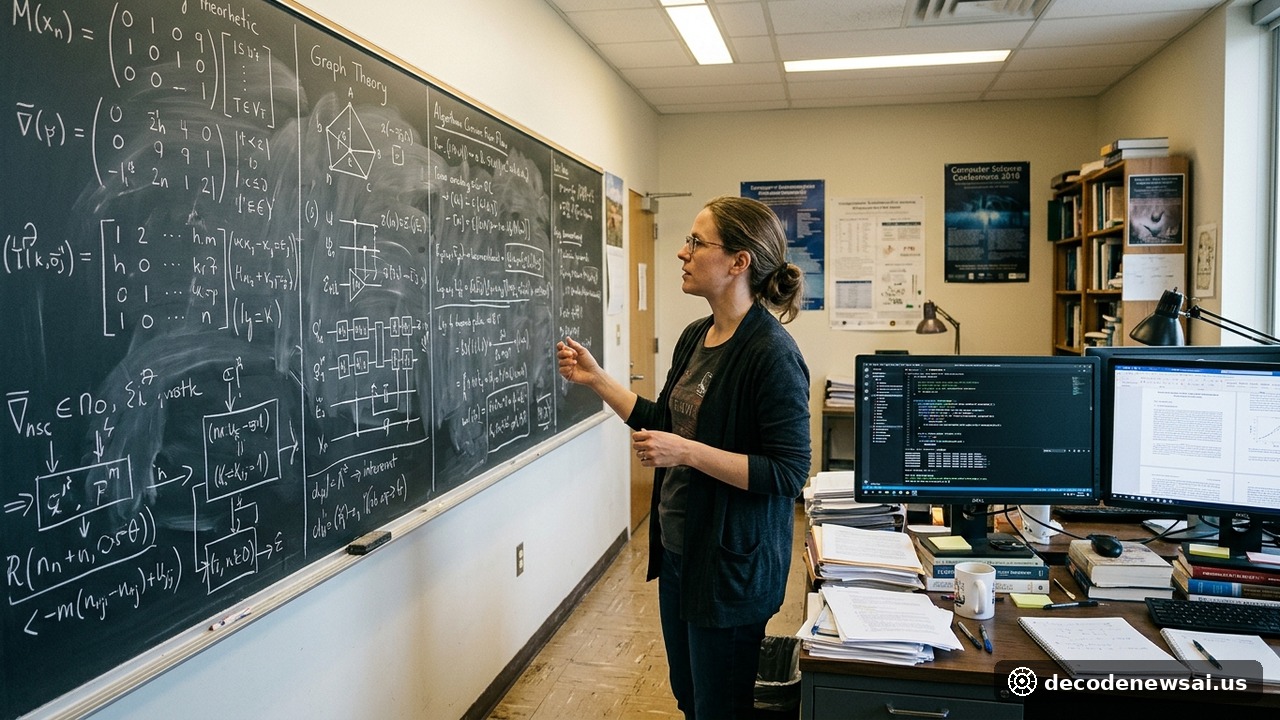
Artificial intelligence research enterprise Physical Superintelligence published an academic milestone on Sunday detailing a formal mathematical breakthrough in theoretical computer science. Working in technical collaboration with an unreleased frontier AI model developed by Anthropic, the team produced a machine-verified proof of the Aaronson-Ambainis conjecture. The discovery resolves an open computational question originating in 2007. The complete Lean formal verification codebase was published openly worldwide.
-hour Lean harness proves 2007 quantum query conjecture
The foundational mathematical proposition was formulated by complexity theorists Scott Aaronson and Andris Ambainis nearly two decades ago. The conjecture examines mathematical boundaries governing whether quantum computers can achieve exponential speedup over classical machines in black-box query complexity. Prior human mathematical literature produced only partial bounds applicable to low-degree polynomial systems. Derivations for generic arbitrary-degree polynomials remained unproven across human mathematical literature. Theoretical researchers faced prolonged investigative barriers.
The investigative team at Physical Superintelligence designed an automated reasoning harness linking frontier multimodal language models directly into the Lean interactive theorem prover. The integrated system explored thousands of candidate proof pathways across a continuous 72-hour computational session before assembling a formal machine-checked proof. The Lean proof engine validated the theorem syntax without a single logical flaw. Automated formal reasoning achieved a landmark milestone.
Theoretical physicist and company co-founder Markus Heller delivered a technical briefing outlining the mathematical derivation in San Francisco. Heller declared to correspondents: "Leveraging the symbolic reasoning capacity of frontier artificial intelligence models allowed our system to bridge in 72 hours a mathematical divide that resisted human solution for nearly twenty years." The announcement provoked intense discussion across academic mathematics circles.
Aaronson calls proof sound as researchers reproduce it
The substantive mathematical conclusion demonstrates that classical algorithms can approximate polynomial quantum outputs using a number of queries that grows only as a fixed polynomial function. The result establishes rigorous mathematical ceilings bounding prospective quantum advantages across broad classes of search and decision algorithms. Speculative claims proposing exponential speedups across generic problem spaces have been systematically constrained. Theoretical quantum complexity gained durable mathematical certainty.
Scott Aaronson, co-originator of the conjecture and computer science professor at the University of Texas at Austin, published an initial evaluation on his academic weblog. Aaronson affirmed that the proof structure appears mathematically sound, highly concise, and surprisingly elegant. He observed that integrating frontier neural generation with formal verification compilers represents an important evolution for mathematical research. Comprehensive peer review evaluations commenced across international institutions.
The open-source computational mathematics community reacted with enthusiasm to the public GitHub repository housing the complete Lean scripts. Independent researchers at Stanford University and the Massachusetts Institute of Technology successfully reproduced the automated proof pipeline on local workstations. Verification of the proof file completed in under 15 minutes. The formal proof eliminates subjective interpretative errors.
Analysts and Anthropic discuss AI proof of open problems
Technology industry analysts highlighted that the achievement demonstrates the latent capacity of frontier foundation models to resolve open problems in pure mathematics and mathematical physics. Neural models are progressing beyond routine code compilation into autonomous agents capable of resolving complex symbolic theorems. Academic research productivity stands on the verge of substantial acceleration. Technology laboratories are expanding investments in formal verification systems.
Anthropic's safety and research alignment teams congratulated the startup on executing the proof demonstration. Laboratory representatives confirmed that the experimental model leveraged specialized reinforcement learning pipelines focused on long-horizon deductive logic and formal syntax generation. The boundaries of automated computational inquiry are expanding rapidly. Technical capabilities continue to advance steadily across specialized domains.
Physical Superintelligence confirmed that the automated proof platform has been assigned to investigate an open conjecture regarding quantum entanglement distillation rates. Academic mathematicians anticipate that additional machine-verified proofs will be published across preprint servers in the coming months. Machine-assisted scientific discovery is entering an increasingly practical operational phase. The foundational methodology of academic discovery continues to evolve through human-machine collaboration.