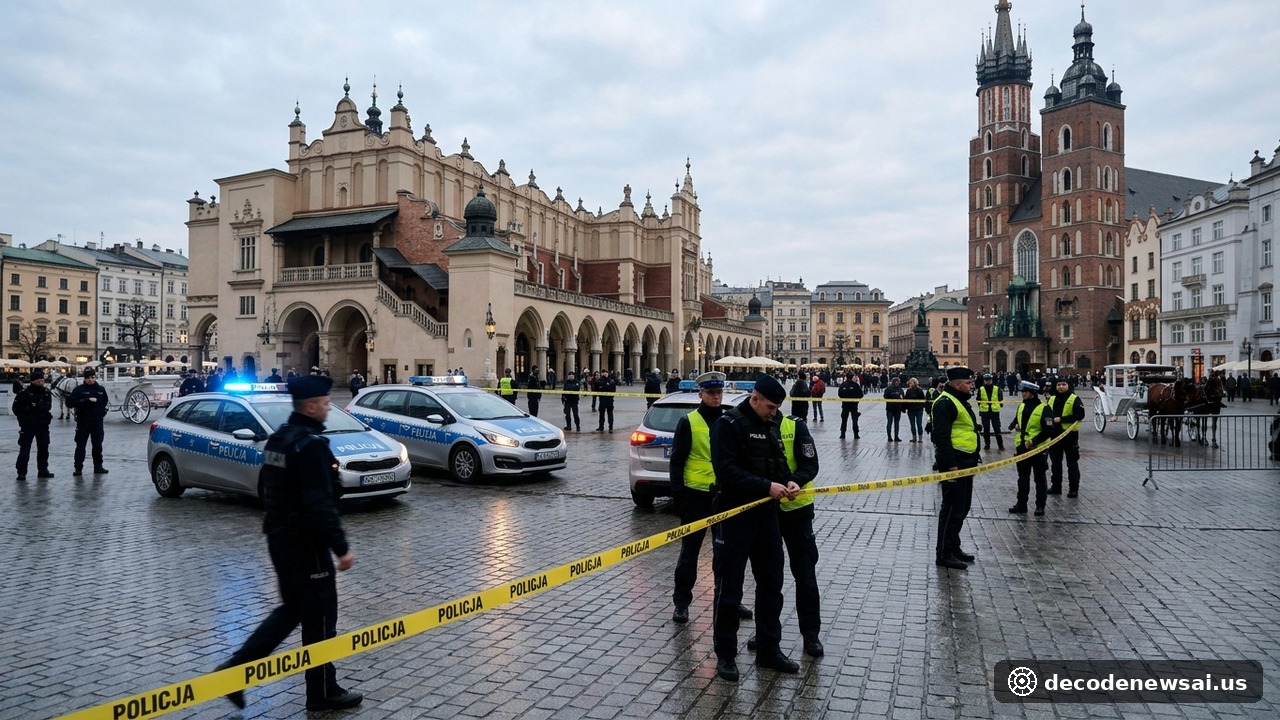
A heavily armed 25-year-old Polish assailant wearing military-style camouflage fatigues and a ballistic vest launched a devastating mass shooting inside Krakow's historic Main Market Square on Saturday afternoon, November 7, 2026. Driving a black passenger vehicle into the crowded pedestrian plaza, the lone attacker opened fire with a military-grade rifle at random civilians, street artists, and international tourists. Official releases from the Polish National Police Headquarters and the Ministry of the Interior confirmed that six civilians were killed instantly, including four women and two men, while 15 others sustained severe shrapnel and gunshot injuries, among them two responding police officers and five foreign nationals. After an intense exchange of gunfire in which police shot and neutralized the gunman, investigators searching his suburban residence uncovered three additional bodies believed to be his parents and immediate family members. Polish Prime Minister Donald Tusk convened an emergency cabinet session while Krakow Mayor Lukasz Gibala declared four days of municipal mourning, highlighting a profound ideological crisis shaking Central European security perceptions.
Tactical Chronology and Casualty Parameters of the Krakow Market Square Massacre
- Confirmed Civilian Fatalities at Scene: 6 Deceased (4 Women, 2 Men at Public Plaza)
- Non-Fatal Injuries & Demographic Profile: 15 Hospitalized (2 Responding Police, 5 Foreign Tourists)
- Gunman Tactical Loadout & Arsenal: Bulletproof Vest, Military Rifle, Vehicle Ammunition Cache
- Residential Secondary Scene Investigation: 3 Domestic Homicide Victims Discovered at Home;CP24 News International Report
What Transpired During the Fatal Rampage Across Krakow's Historic Heart?
Krakow's Main Market Square stands as one of the largest and best-preserved medieval civic plazas across the European continent, traditionally recognized as a bustling cultural sanctuary that draws millions of international visitors annually.
According to verified eyewitness accounts and corroborated security footage, the assailant accelerated his vehicle past pedestrian bollards shortly after 3:00 p.m. local time, careening through the designated horse-drawn carriage staging area and outdoor dining terraces. The driver lowered his side window and discharged continuous bursts from a high-powered semi-automatic rifle into crowds of shoppers and tourists. Pandemonium gripped the plaza as hundreds sought shelter inside the Gothic chambers of St. Mary's Basilica and the arches of the historic Cloth Hall.
What Radical Ideologies and Secondary Crimes Characterize the Suspect?
Following the assailant's surgical stabilization under armed guard at Krakow University Hospital, state security intelligence agencies reconstructed the perpetrator's background.
Polish Minister of the Interior and Administration Marcin Kierwinski confirmed that the 25-year-old perpetrator held no formal military record but maintained an extensive history of radicalization within extremist web forums. The investigation established that the gunman consumed neo-Nazi propaganda, authored militant xenophobic manifestos, and idolized white supremacist shooters across Western jurisdictions.
The tragedy escalated further when tactical units deployed reconnaissance drones and breached the suspect's residence in a rural district near Krakow, discovering the deceased bodies of three adults inside. Prime Minister Donald Tusk confirmed to assembled journalists that preliminary forensics identify the victims as the gunman's immediate relatives, indicating a premeditated domestic massacre executed prior to the civic vehicular rampage. Judicial forensic teams have impounded ballistics equipment and server logs to map the operational timeline of the assaults.
How Will the Attack Reshape Domestic Security Architecture and European Policy?
Strategic defense analysts writing for Reuters and The Guardian observe that Poland had long cultivated an international reputation as an exceptionally safe society comparatively insulated from mass public shootings and political terrorism.
The massacre in Krakow's historical epicenter has shattered civic assumptions regarding domestic tranquility, accelerating nationwide debate concerning digital extremist radicalization. European Union High Representative for Foreign Affairs Kaja Kallas condemned the act of ideological terror, emphasizing that the trauma resonates across the collective European continent. In response, Polish executive authorities ordered elevated security protocols across international transport hubs and tourism landmarks, while parliamentary factions initiated expedited consultations on mandatory firearm licensing reform.