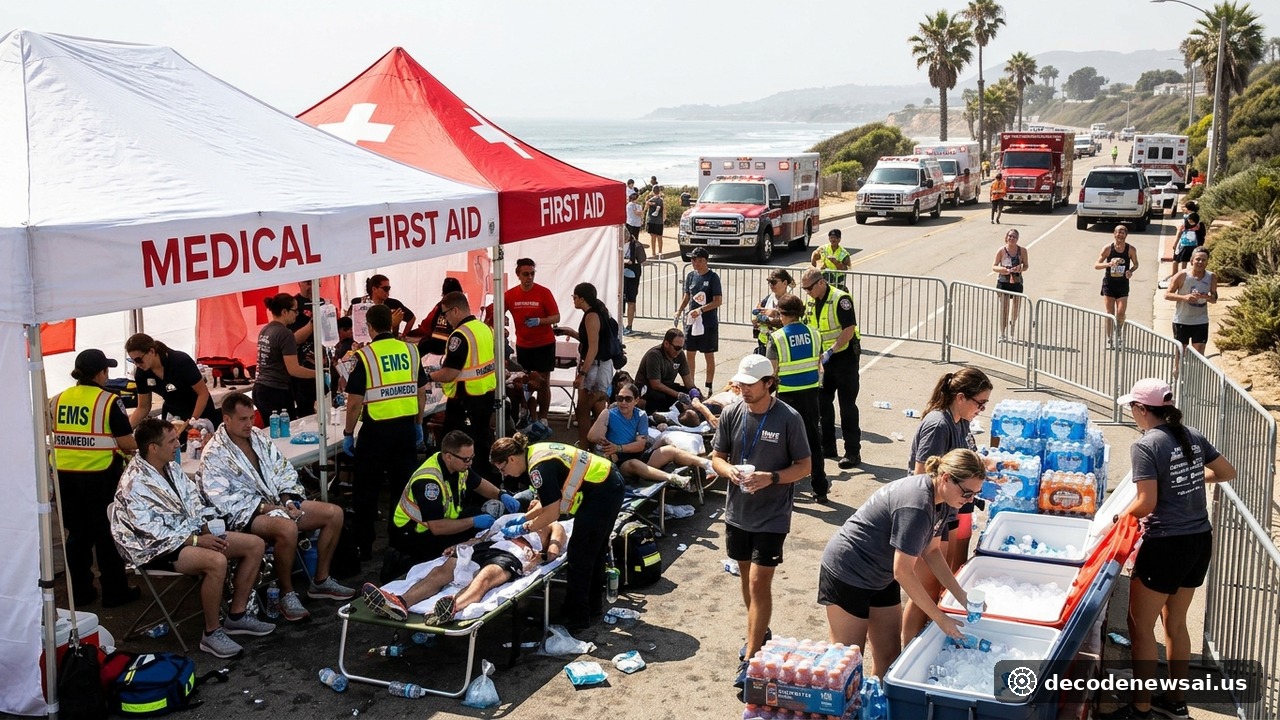
Santa Barbara law enforcement and healthcare authorities on Monday launched an administrative inquiry after twenty-seven runners were hospitalized with acute dehydration and heat exhaustion during the Santa Barbara Half Marathon. A sudden unseasonable autumn heatwave pushed coastal temperatures far above seasonal averages, overwhelming runners along the oceanfront course. Emergency medical providers responded to numerous heat-related crises throughout the event. Race safety logistics and emergency heat-mitigation protocols are under intense scrutiny. Distance running communities across the United States are monitoring the investigation closely.
Historic Coastal Heat Wave Overwhelms Half Marathon Participants
The annual athletic event commenced on Sunday morning, drawing roughly 7,500 registered participants across a scenic 13.1-mile course tracing the Pacific coastline and downtown Santa Barbara. However, meteorological data from the National Weather Service confirmed that coastal temperatures climbed to 80 degrees Fahrenheit (27 degrees Celsius) by 10 a.m. High temperatures in the coastal municipality typically average in the lower 70s during early November. The sharp unseasonable heat surge created dangerous conditions along exposed sections of the course. Physical endurance limits were rapidly exceeded.
Regional healthcare network Cottage Health confirmed Monday that 27 runners were admitted to emergency departments across its Santa Barbara and Goleta hospital campuses on Sunday. Clinical personnel administered intravenous hydration therapy and active surface cooling treatments throughout the day. By Monday morning, 24 patients had recovered and were discharged. The remaining three runners remained hospitalized in stable condition under active medical supervision. Prompt clinical interventions prevented fatal medical outcomes.
Race Director David Monico addressed operational inquiries in an official public statement released on Monday. He stated: "Event medical personnel treated numerous runners for dehydration and overheating both on the course and at the finish line, transporting 15 people from the medical tent to local hospitals. There was no unusual symptoms or anything outside of the norm for a half marathon or a marathon or some type of endurance event." Event organizers initiated an internal post-race review. Participants raised concerns regarding hydration preparations.
Water Station Intervals and Extreme Weather Protocols Face Public Scrutiny
Numerous runners took to digital running forums to report shortages of electrolyte fluid and ice sponges at critical water stations along the second half of the course. Along open stretches lacking shade, exhausted competitors slowed their pace significantly or collapsed onto grass embankments. Emergency medical transport capacity experienced severe bottlenecks during peak finishing periods.
In response to public inquiries, the Santa Barbara Police Department confirmed that detectives are reviewing municipal emergency dispatch logs and course permit applications. The administrative investigation seeks to determine whether race organizers deployed sufficient cooling misting stations and mobile paramedic patrols following the National Weather Service's heat forecast. Extreme-weather cancellation protocols across municipal sporting events have returned to the forefront of national sports governance discussions.
Sports medicine specialists noted that runners in autumn lack physiological acclimatization to sudden heat spikes. High ambient humidity combined with temperatures reaching 80 degrees severely inhibits evaporative cooling, accelerating the onset of exertional heat stroke. Rapid immersion cooling within thirty minutes is critical to prevent permanent organ failure. Scientific precautions remain imperative during endurance competitions.
Climate Volatility Forces Overhaul of American Road Racing Standards
Driven by accelerating climate volatility, major American endurance road races are repeatedly confronting anomalous meteorological disruptions. From unseasonable spring heat in Chicago to freezing gale-force downpours in Boston, conventional historical calendar planning is proving increasingly unreliable. Distance running organizing committees must establish binding wet-bulb globe temperature thresholds for event cancellation. Participant safety margins cannot be compromised.
The Road Runners Club of America released an updated operational advisory urging municipal race organizers to formally codify event-modification trigger points in race registration contracts. The guidelines mandate dedicated dual-sided hydration stations every 1.5 miles equipped with abundant potable water, electrolyte packets, and automated external defibrillators. Emergency response networks must achieve seamless operational integration.
The Santa Barbara City Council scheduled a formal municipal review during its upcoming public meeting to examine emergency response logistics during the road race. Administrative permitting requirements for large outdoor civic events will face strict regulatory revisions. While endurance athletics celebrates personal achievement, human health and safety must always take absolute precedence. Meaningful reforms will protect participants during future events.