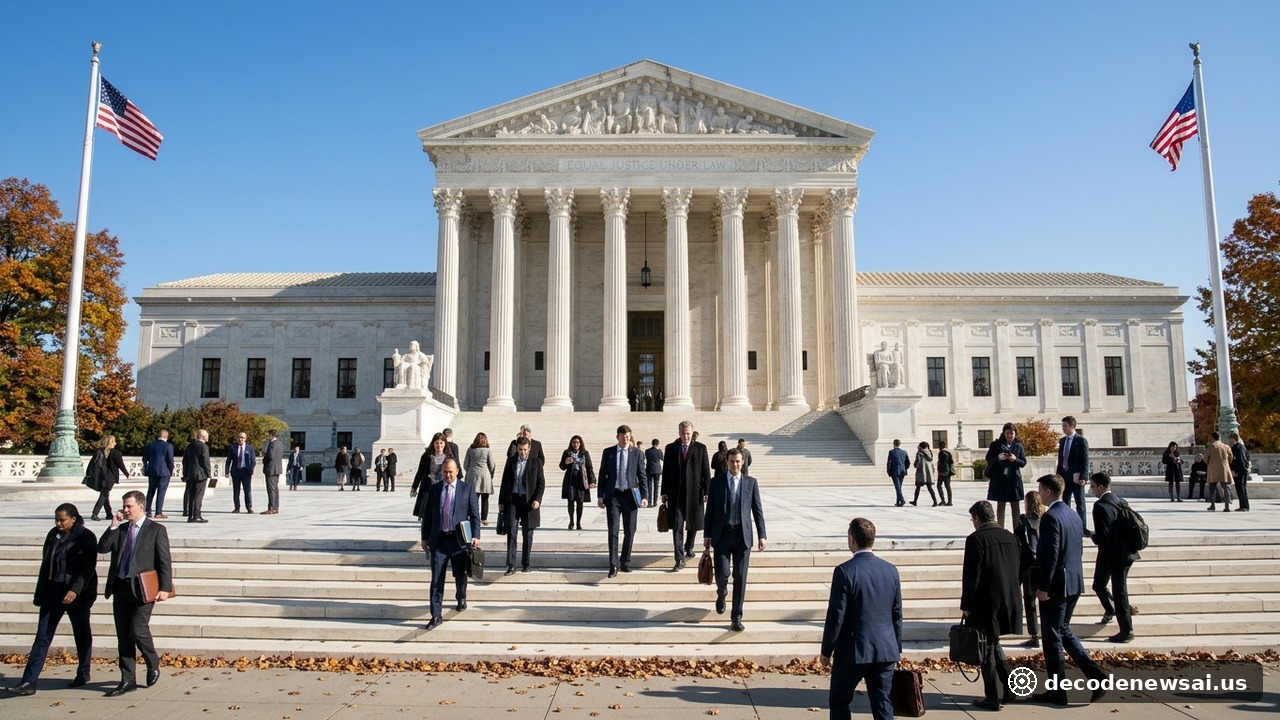
WASHINGTON - Regulated prediction market operator Kalshi formally submitted its legal brief in opposition to petition for certiorari before the Supreme Court of the United States on Sunday, November 8, challenging state attempts to classify federally overseen event derivatives as unlawful gambling. The underlying dispute, docketed under Supreme Court number 26-299, originates from petitions brought by New Jersey gaming enforcement authorities. Kalshi's 42-page brief argues that federal statutory supremacy preempts fragmented state-level gaming oversight.
CFTC authority and Mansour defend federal oversight
The constitutional dispute centers on exclusive regulatory authorities granted to the Commodity Futures Trading Commission under the Commodity Exchange Act. Kalshi operates as a federally designated contract market, subjecting all listed event contracts to explicit federal statutory compliance. The Office of the New Jersey Attorney General petitioned the high court following appellate losses, alleging that binary election contracts encroach upon sovereign state gambling police powers.
Securities law scholars from Columbia Law School observed that high court review could disrupt modern financial markets. A ruling circumscribing federal regulatory supremacy would create regulatory fragmentation across interstate financial derivative trading. Kalshi processed billions of dollars in notional volume during the recent federal election cycle. Institutional market makers routinely commended the order book liquidity and rapid information discovery generated across digital exchange books.
Kalshi Chief Executive Officer Tarek Mansour stated in an official filing disclosure: "The Commodity Exchange Act explicitly vests regulatory authority over designated contract markets in federal hands. Individual state gambling commissions have no authority to shut down federally compliant platforms." Legal counsel expressed confidence regarding the constitutional merits.
Brokers and D.C. Circuit precedent back event contracts
Event trading contracts have transitioned rapidly into institutional financial architecture over the past two years. Major broker-dealers including Interactive Brokers and Cboe Global Markets established cleared trading pathways for event derivatives. Terminal feeds from Bloomberg and FactSet now incorporate real-time implied event probability feeds directly into portfolio risk models. Hedge fund managers utilize contracts to hedge political tail risk.
The brief relies heavily on precedent established by the United States Court of Appeals for the District of Columbia Circuit. The federal appeals court ruled earlier that the CFTC exceeded administrative statutory discretion when attempting to block election contracts. Appellate judges determined that financial event contracts do not constitute illicit gambling under federal law. Kalshi urged the justices to deny review and leave the appellate ruling intact.
Market economists noted that event-driven derivative trading satisfies bona fide risk mitigation objectives for multinational corporations. Multinational enterprises facing unpredictable trade tariff revisions or sudden statutory tax changes can utilize exchange-traded contracts to offset administrative balance sheet liabilities. The decentralized price discovery mechanism operates with greater speed and transparency than subjective polling estimates.
Justices weigh Docket 26-299 amid deference shifts
Legal historians observed that the Supreme Court's potential review of Docket 26-299 occurs against a backdrop of shifting federal administrative deference doctrines. State attorneys general have attempted to exploit recent jurisdictional precedents to reclaim regulatory authority over digital commerce platforms. However, legal scholars maintain that national financial exchanges have historically remained exclusively under uniform federal oversight to prevent interstate market friction.
Supreme Court justices will review the certiorari petition during private judicial conferences scheduled for mid-December. The Supreme Court grants review to less than one percent of submitted appellate petitions. Should the court deny the petition, the circuit court decision will permanently establish nationwide operational authority for federally compliant prediction exchanges.
Financial regulatory scholars emphasized that the legal battle over Docket 26-299 carries far-reaching consequences for the future of digital asset derivatives and decentralized information aggregation. A Supreme Court ruling affirming exclusive federal jurisdiction would solidify regulatory certainty for innovative trading platforms nationwide, preventing individual states from fragmenting national risk-hedging markets. Market participants expect trading activity across macroeconomic event contracts to expand rapidly into the upcoming fiscal cycle.