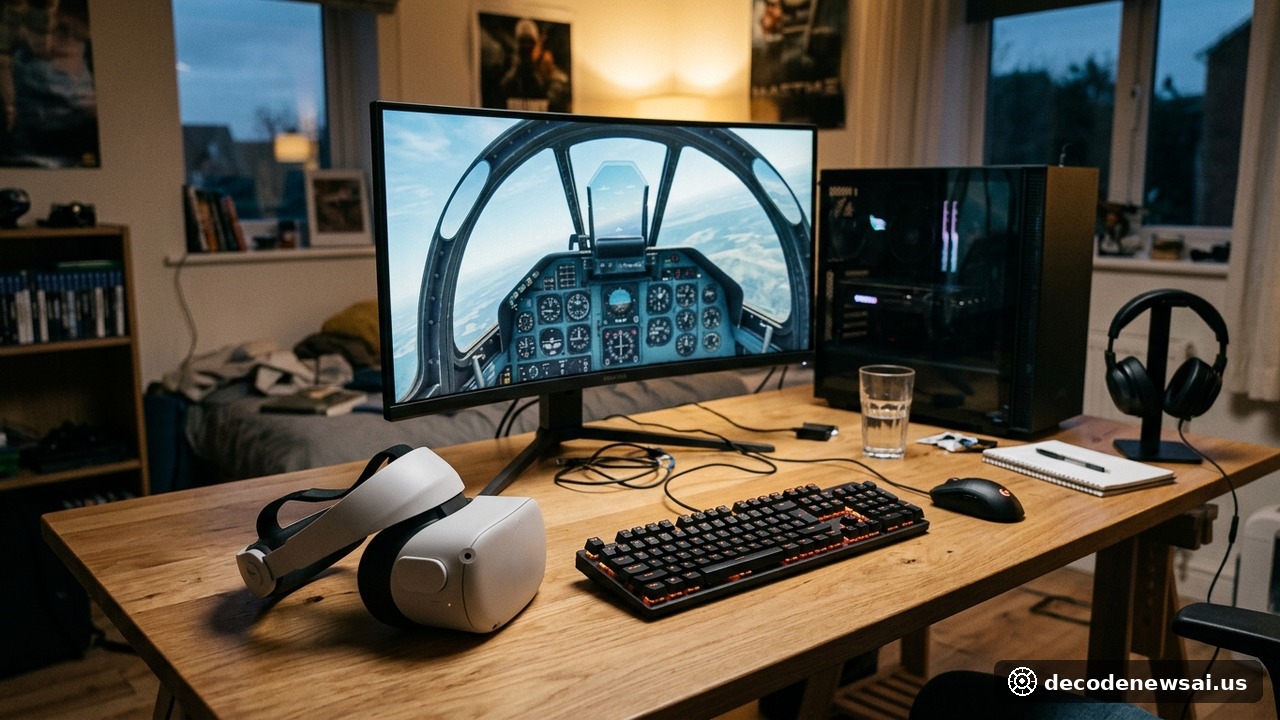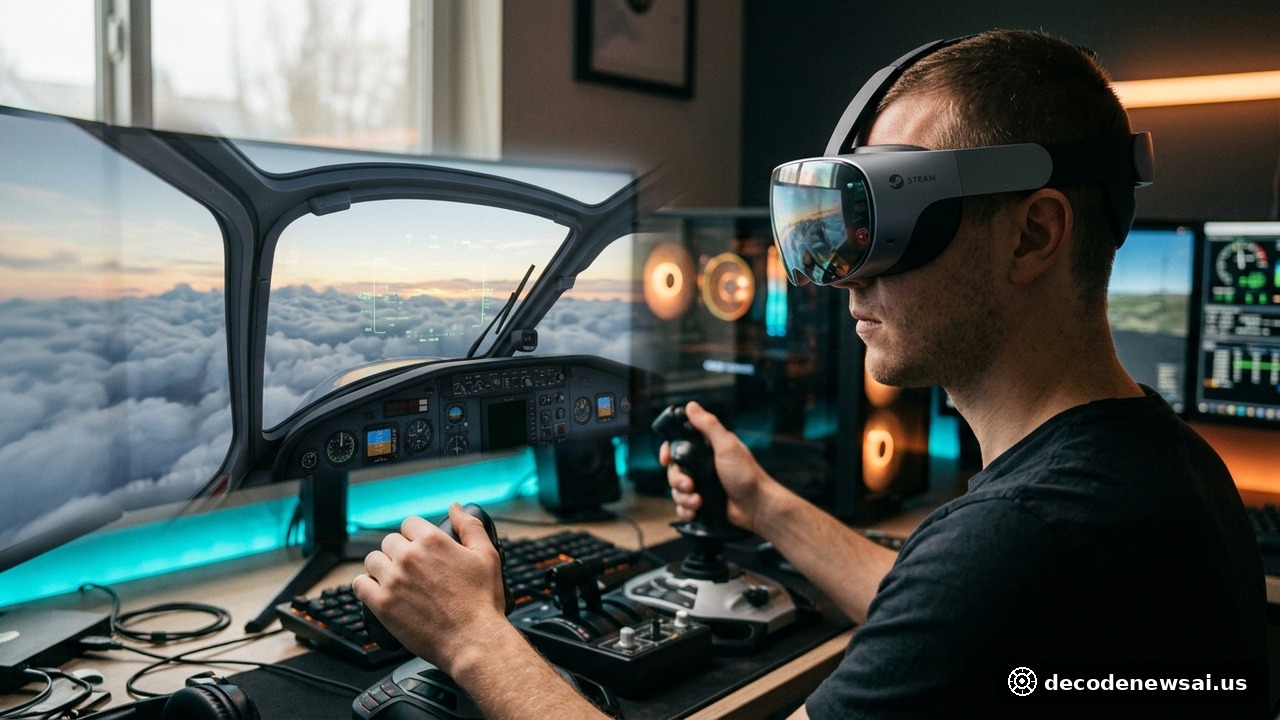
Valve Corporation released SteamOS beta firmware version 0.5.8 for the Steam Frame headset on November 10, 2026. The update adds native OpenXR Alpha-Blend passthrough for PC-tethered and wireless VR titles. Premier flight simulation platform X-Plane 12 rolled out native mixed-reality cockpit support at the same time. Virtual aviators can now blend digital cloudscapes with physical cockpit flight controls.
SteamOS 0.5.8 Beta Adds OpenXR Alpha-Blend Passthrough for PC VR
The 0.5.8 update bridges immersive digital environments and physical desktop setups. Valve's updated runtime driver lets developers assign transparency values to specific rendering layers. This works inside OpenXR-compliant simulation engines. The change targets high-performance PC virtual reality.
When active, the headset's dual RGB pass-through cameras stream low-latency stereoscopic video. That video shows the user's physical surroundings. It appears directly inside designated cockpit or workspace windows. Gamers no longer face the complete sensory isolation of traditional VR headsets.
The feature opens hybrid mixed-reality simulation workflows on desktop PCs. A hardware systems engineer with Valve's Steam Frame engineering team spoke in a community technical bulletin. The engineer said: "Enabling native PC VR passthrough allows players to remain fully immersed in intricate flight environments while keeping their physical peripherals directly in view. This update marks a significant step forward for mixed-reality simulation fidelity."
Native X-Plane 12 Mixed Reality Cockpit View Integrates Physical Flight Peripherals
Laminar Research's flagship flight simulator X-Plane 12 is the first commercial title with official support for Steam Frame's alpha-blended passthrough architecture. Flight simulation enthusiasts can configure customized passthrough masks. They do this within the cockpit camera settings.
Virtual pilots looking up through the aircraft canopy see realistic volumetric clouds, dynamic precipitation, and terrain rendering. Looking down reveals their physical throttle quadrants, rudder pedals, and instrument panels in razor-sharp focus. Blind-touch navigation is gone. Operational realism during complex instrument approaches improves substantially.
The Lead Graphics Engineer at Laminar Research noted in a developer broadcast: "Aviation simulation enthusiasts invest heavily in tactile physical avionics and throttle hardware. Valve's new passthrough integration allows virtual instrument panels and physical cockpit hardware to coexist seamlessly without breaking immersion."
Hand-Tracking Algorithms and Motion-to-Photon Passthrough Latency
SteamOS 0.5.8 also brings substantial algorithmic refinements to the headset's stereoscopic camera stitching pipeline. A lightweight neural distortion correction model reduces visual warping and parallax shift artifacts. These artifacts appear around user hands and near-field objects.
The headset runs at a 90Hz native display refresh rate. It achieves an end-to-end motion-to-photon passthrough latency of under 12 milliseconds. That effectively eliminates visual motion sickness during rapid head movements. Valve also refined infrared hand-tracking responsiveness, enabling seamless menu interactions without physical controllers.
An immersive technology hardware reviewer commented on Valve's deliberate focus on low-latency PC passthrough. The reviewer said it addresses the core needs of serious simulation enthusiasts. It also establishes a compelling blueprint for next-generation desktop mixed-reality gaming.
Macroeconomic analysts and international policy researchers highlighted structured institutional collaboration. They said it establishes long-term operational certainty across global markets. By aligning statutory guidelines with rigorous technical standards, regulatory agencies and commercial stakeholders cultivate resilient operational ecosystems. Those ecosystems can navigate evolving economic conditions.
Global industry participants look forward to tracking forthcoming milestone developments. Organizations will implement their strategic priorities throughout 2027. Cross-sector coordination remains essential for driving sustainable innovation. It also matters for delivering tangible economic benefits across public and private sectors.
Strategic planning advisors and international trade specialists noted that long-term intergovernmental frameworks generate predictable operating environments. This holds across key industry sectors. By coupling transparent administrative guidelines with rigorous scientific benchmarks, regulatory bodies and enterprise leaders establish sustainable operating models. Those models can withstand shifting macroeconomic dynamics.
Global market participants will continue observing forthcoming implementation milestones. Public agencies will execute their mandated responsibilities throughout 2027. Cross-border coordination remains vital for driving sustained operational resilience. It also matters for delivering measurable societal benefits worldwide.