Fully Stripped Thallium Ions Undergo Bound-State Decay Inside Experimental Storage Ring
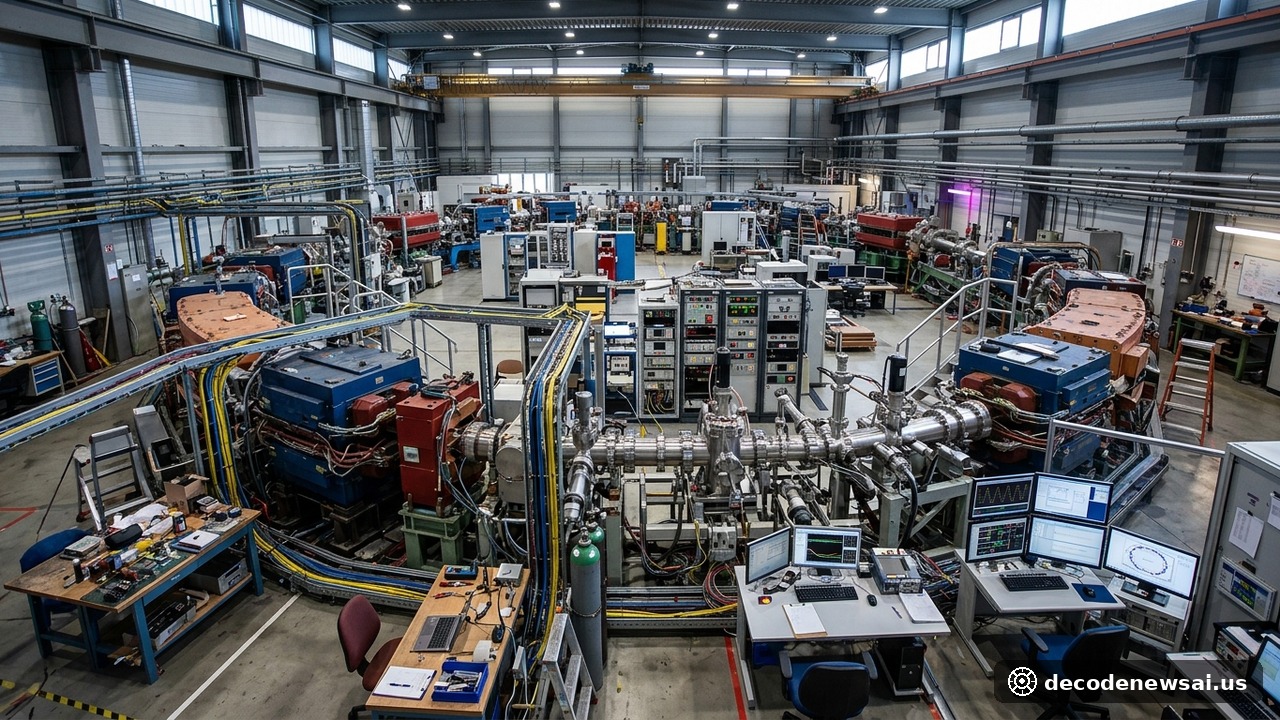
An international nuclear astrophysics research team published definitive experimental measurements on November 14, 2026, in the journal Nature, confirming the first laboratory observation of bound-state beta decay in fully-ionized thallium-205 (205Tl81+). Conducted utilizing the Experimental Storage Ring at the GSI Helmholtz Centre for Heavy Ion Research in Darmstadt, Germany, the measurement resolves a foundational theoretical puzzle in nuclear astrophysics that endured for more than half a century; the decay constant establishes an empirical benchmark calibrating isotopic chronometers that date early stellar nucleosynthesis preceding the formation of the solar system.
According to research certified by the GSI/FAIR international particle accelerator facility, neutral thallium-205 is completely stable under terrestrial room-temperature conditions; quantum theoretical physics postulated in 1947 that naked thallium ions undergo bound-state beta decay, capturing an emitted electron directly into vacant inner atomic orbitals to transform into radioactive lead-205. Engineers stripped all 81 orbital electrons, injecting a pure beam of bare thallium-205 into the ultra-high vacuum Experimental Storage Ring (ESR); the experimental data established that stripped thallium-205 decays into lead-205 with a half-life measured on the order of months.
Lead-205 possesses a radioactive decay half-life of roughly 15 million years, serving as a natural clock measuring cosmic intervals immediately preceding the collapse of the presolar molecular cloud; prior to the birth of the Sun, previous generations of asymptotic giant branch (AGB) stars synthesized heavy chemical elements through the slow neutron capture process (s-process). Because the competing production of thallium-205 and lead-205 depends critically upon stellar ionization states, the lack of laboratory decay constants previously generated significant discrepancies in modeling the duration of solar system gestation; the definitive GSI measurement eliminates historical modeling ambiguities.