Webb Pins Most Distant Fast Radio Burst to Tiny Galaxy From the Young Universe
A Millisecond Flash Caught in March 2024
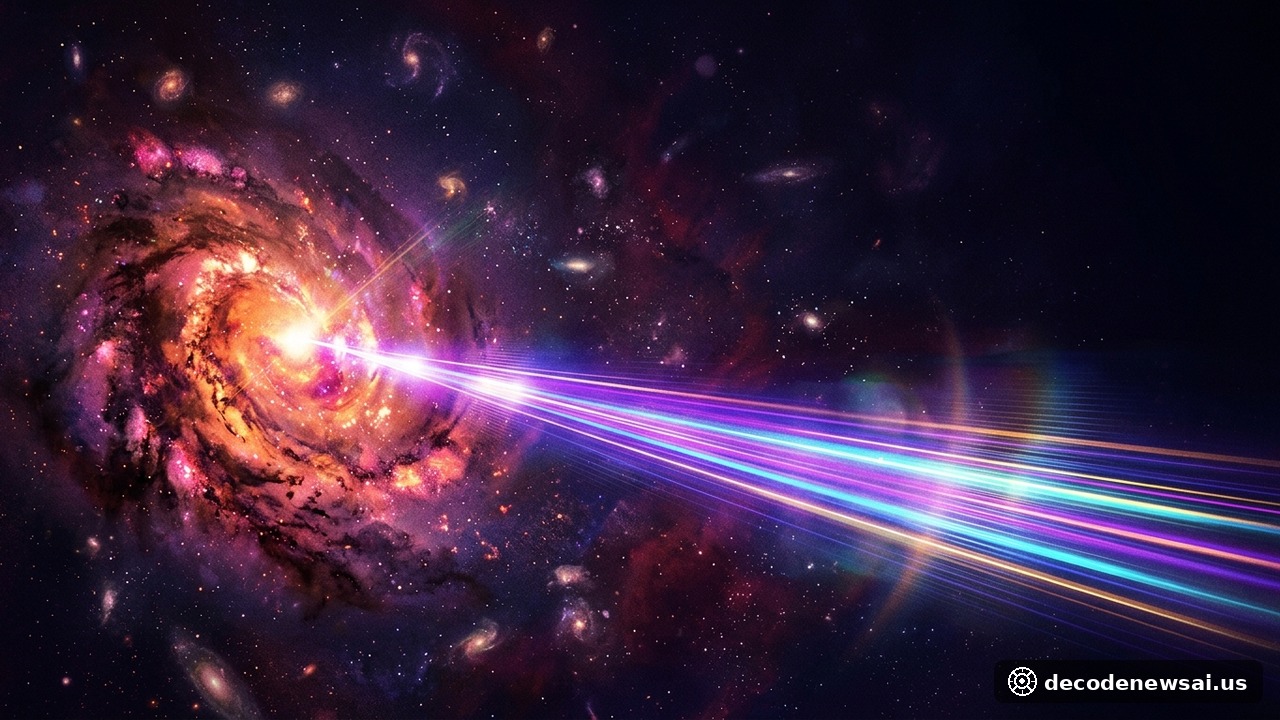
FRB 20240304B was detected on March 4, 2024, by the MeerTRAP project on South Africa's MeerKAT radio telescope array — 64 dishes of 13.5 meters each in the Great Karoo. It was a one-off, non-repeating millisecond flash of radio waves, and the radio data immediately suggested extreme distance.
A Surprisingly Tiny Host
"We thought it would be a big, nicely formed galaxy… and instead it was a little dwarf galaxy," said lead author Manisha Caleb of the University of Sydney.
The Source May Be a Young Magnetar
Because the host galaxy's stars are so young, the neutron-star-merger origin model doesn't fit — binary neutron stars take at least a billion years to merge. The finding favors the young magnetar model: a magnetar born in the supernova collapse of a young massive star, whose "starquakes" release the burst.
The result proves astronomers can now identify and study fast radio bursts from the young universe.
The Burst as a Cosmic Flashlight
The burst also acted as a "cosmic flashlight": its signal carried imprints of two intervening structures — a previously unknown galaxy cluster at redshift 0.3 (~3.5 billion light-years away) and the Virgo Cluster (~54 million light-years away) — letting astronomers trace the cosmic web.
"A fast radio burst is almost like a cosmic flashlight. It lights up everything along the path," said J. Xavier Prochaska of UC Santa Cruz.