Einstein Rings and Quadruple Images Reveal Cosmic Magnifying Glasses
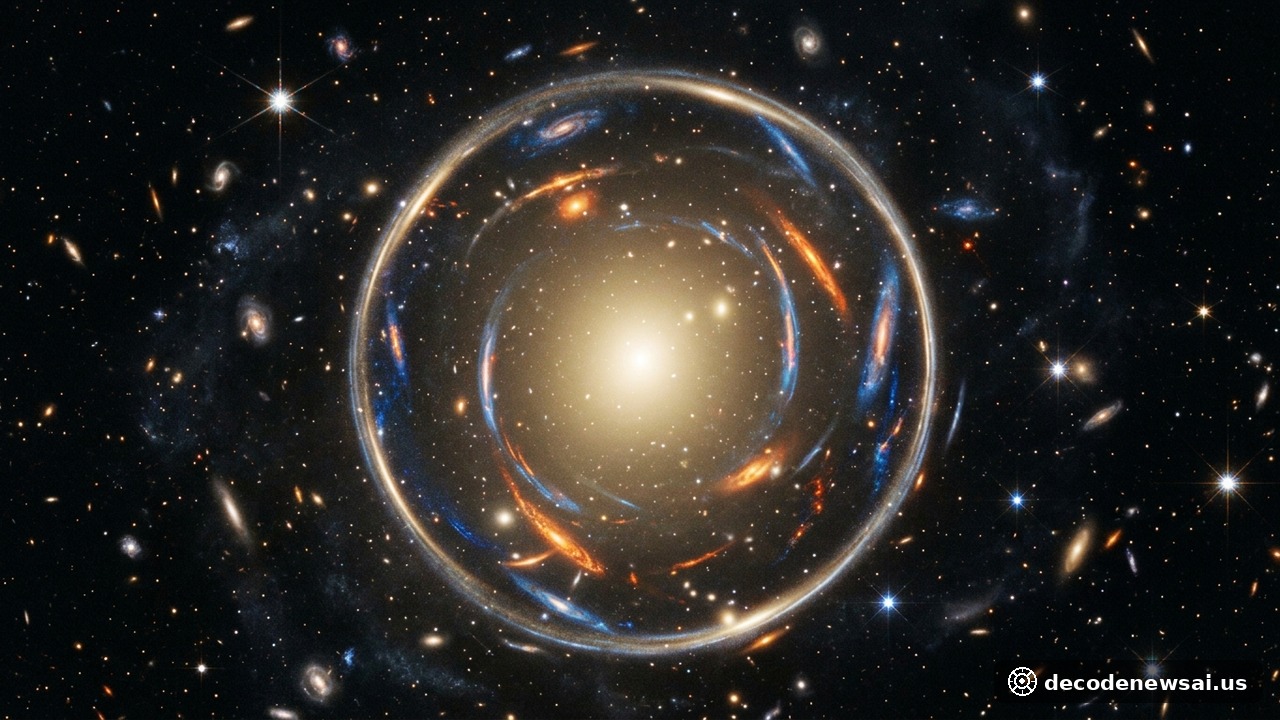
NASA's Goddard Space Flight Center released a striking nine-panel collage of strong gravitational lenses captured by the Hubble Space Telescope on Thursday. The cosmic gallery establishes critical calibration and reference targets for upcoming follow-up observations by the Nancy Grace Roman Space Telescope, which launched successfully into space in August 2026. Originally detected by the Dark Energy Spectroscopic Instrument at Kitt Peak, these distant lensing systems will help astronomers weigh invisible dark matter and test leading cosmological models. Panel F reveals a nearly complete Einstein Ring encircling a foreground spiral galaxy. Panels C and I feature quadruply lensed systems where background galaxies appear replicated four times as bright spots.
By measuring how severely background starlight is distorted and stretched, scientists calculate the exact total mass distribution of foreground galaxies, including invisible dark matter halos. Hubble's razor-sharp optical imaging can expose subtle brightness imperfections along lensed arcs that signal tiny dark matter clumps ranging from one million to one billion solar masses. By comparison, the Milky Way's dark matter halo holds roughly 1.3 trillion solar masses. Detecting these clumps directly tests cold dark matter theory.
Hubble observes primarily in visible and ultraviolet light, providing unmatched high-resolution portraits of individual cosmic objects. In contrast, Roman views primarily infrared wavelengths across a vastly wider field of view, enabling sweeping astronomical panoramas. Panel D illustrates this partnership clearly, showcasing a foreground lensing galaxy crossed by a prominent dust lane. While Hubble's visible-light vision reveals the dust structure clearly, the dust obscures whether the background arcs form a complete Einstein Ring. Because infrared light penetrates cosmic dust more effectively, Roman's future infrared scans will peer directly through the obstruction. When Roman discovers unusual or rare gravitational lenses across its sweeping wide-field sky panoramas, astronomers can direct Hubble for targeted visible-light and ultraviolet follow-up imaging.