Key Clue in Florida Learjet Crash: Tail Component Found Up to 3.8 Miles From Impact Site
Three Pieces of the Left Elevator Were Recovered Miles Away
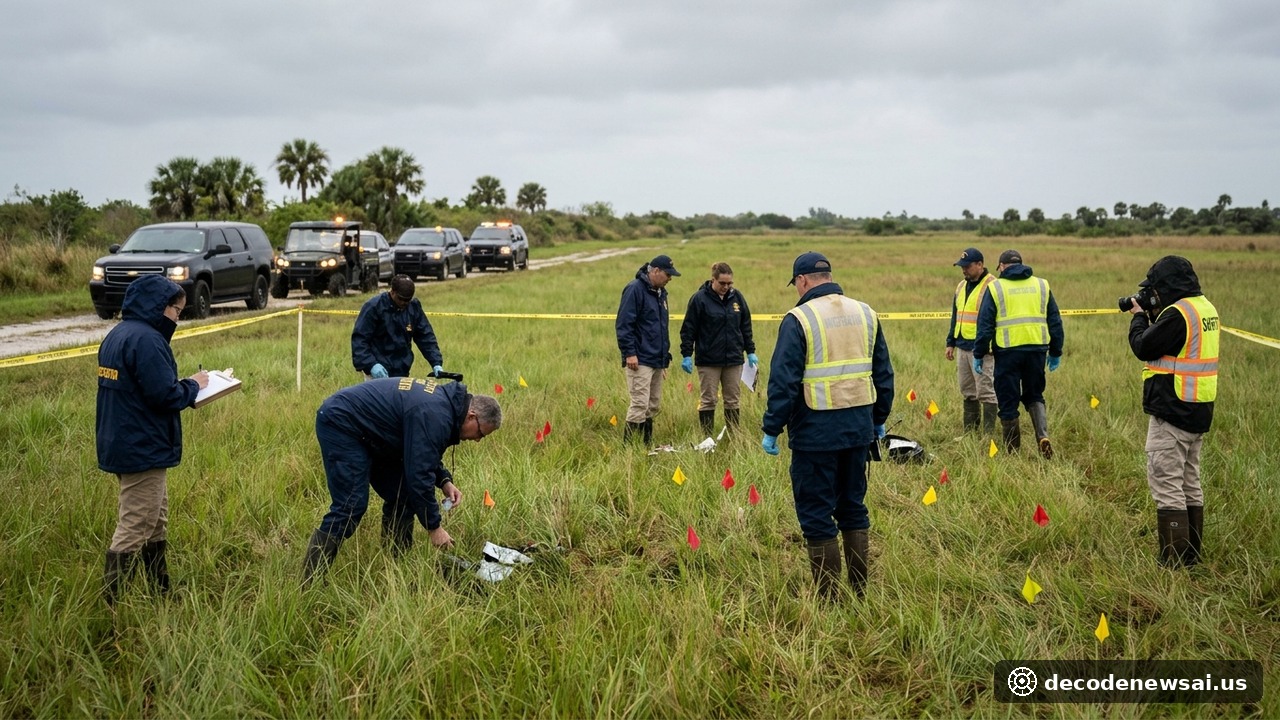
Investigators examining the fatal crash of a Learjet 60 in South Florida have recovered most of the aircraft’s left elevator in three pieces, with debris located as far as 3.8 miles from the impact site. The National Transportation Safety Board said on November 3 that the components were found between 1.3 and 3.8 miles from the crash scene in Greenacres, near West Palm Beach. NTSB board member Tom Chapman described the discovery as important evidence because it indicates that at least part of the aircraft separated before the jet struck the ground. The elevator is a movable control surface attached to the rear of the horizontal tail. It helps pilots control the aircraft’s pitch, moving the nose up or down. Chapman said that without an intact elevator, the pilot would not have been able to use that control surface to recover from the aircraft’s steep dive. He cautioned, however, that the Learjet was descending at an extreme speed. Investigators cannot say whether the elevator would have remained effective even if it had still been attached. The discovery establishes that the aircraft was breaking apart before impact, but it does not establish why the aircraft first lost control.
Investigators Have Not Determined Why the Tail Separated
The central unanswered question is whether the elevator failed first and contributed to the loss of control, or whether forces acting on the aircraft during its rapid descent tore the component away. Chapman said investigators do not yet know which explanation is correct. The NTSB will need to examine the recovered pieces alongside other wreckage, flight information, video and witness accounts before reaching a conclusion. Aviation safety expert Jeff Guzzetti told The Associated Press that the debris pattern may indicate the elevator separated relatively close to the ground. If the pieces had detached at high altitude, they might have traveled much farther from the crash site, he said. Former NTSB member John Goglia offered another possible explanation based on flight-tracking information. He said the aircraft appeared to level off briefly at about 8,000 feet, and suggested that the captain may have placed excessive stress on the tail while attempting to recover. Those are expert interpretations, not findings by the NTSB. Investigators have not said that the tail separation initiated the emergency, and they have not ruled out the possibility that it occurred as a consequence of the aircraft’s dive. Determining the order of structural failure and loss of control will be central to reconstructing the final moments of the flight.
Icing, Turbulence and Storm Conditions Remain Under Review
The Learjet 60 departed Austin, Texas, for North Eleuthera Airport in the Bahamas on November 1, carrying two crew members and seven passengers. According to the NTSB’s preliminary timeline, the crew was flying at about 35,000 feet when it reported light clear icing and moderate turbulence to air traffic control. The pilots also reported altitude deviations of approximately 700 feet. The crew later reported that ice was accumulating and requested permission to climb to 37,000 feet. Air traffic control approved the request. Less than 30 seconds later, the aircraft announced that it was descending and issued a mayday call. Subsequent radio communications described an overspeed condition and a rapidly increasing rate of descent. Media reports of the radio traffic indicate that the crew reported descent rates of about 10,000 feet per minute and then about 20,000 feet per minute. The jet crashed near Greenacres in Palm Beach County. All nine people aboard were killed. The NTSB has identified weather as a major focus of the investigation, but officials have not confirmed that the aircraft flew through an active thunderstorm. Reports of icing and turbulence are important evidence, but they do not by themselves establish that weather caused the loss of control. Investigators must determine the conditions at the aircraft’s cruising altitude and assess how weather, aircraft systems, structural forces and crew actions may have interacted.
Recorder Recovery and Wreckage Analysis Will Shape the Investigation
Investigators are also trying to establish whether the aircraft’s cockpit voice recorder was aboard at the time of the crash and whether it can be recovered. The NTSB said maintenance records indicated that a recorder had been installed, but investigators still needed to confirm that it remained on the aircraft. The impact crater was filled with water after heavy rain, and the wreckage was extensively fragmented, complicating the recovery and identification of components. Investigators are also collecting dashcam footage, eyewitness accounts and debris from the neighborhood. Roughly 600 nearby residents temporarily left their homes, and one person on the ground was reported injured. A preliminary report is expected in about a month, but it will not necessarily identify the probable cause. Determining that cause can take more than a year as investigators analyze the wreckage, recorder information, weather data, air traffic communications and aircraft systems. The left-elevator pieces are a significant lead because they help establish that the aircraft began separating before impact. But the key question remains unresolved: whether the tail damage triggered the emergency or occurred during the aircraft’s final descent. Until the NTSB completes its analysis, neither explanation should be presented as established fact.
Sources
- The Guardian: Investigators find tail pieces of Learjet that crashed in Florida, killing nine
- WFLX: NTSB: Learjet 60 crew reported icing, turbulence shortly before deadly Palm Beach County crash
- Flying Magazine: NTSB Recovers Parts of Crashed Learjet’s Elevator
- Aviation Week: Icing, Turbulence Possible Factors In Fatal Learjet 60 Crash
- Aviation International News: Florida Learjet Crash Claims Nine Lives