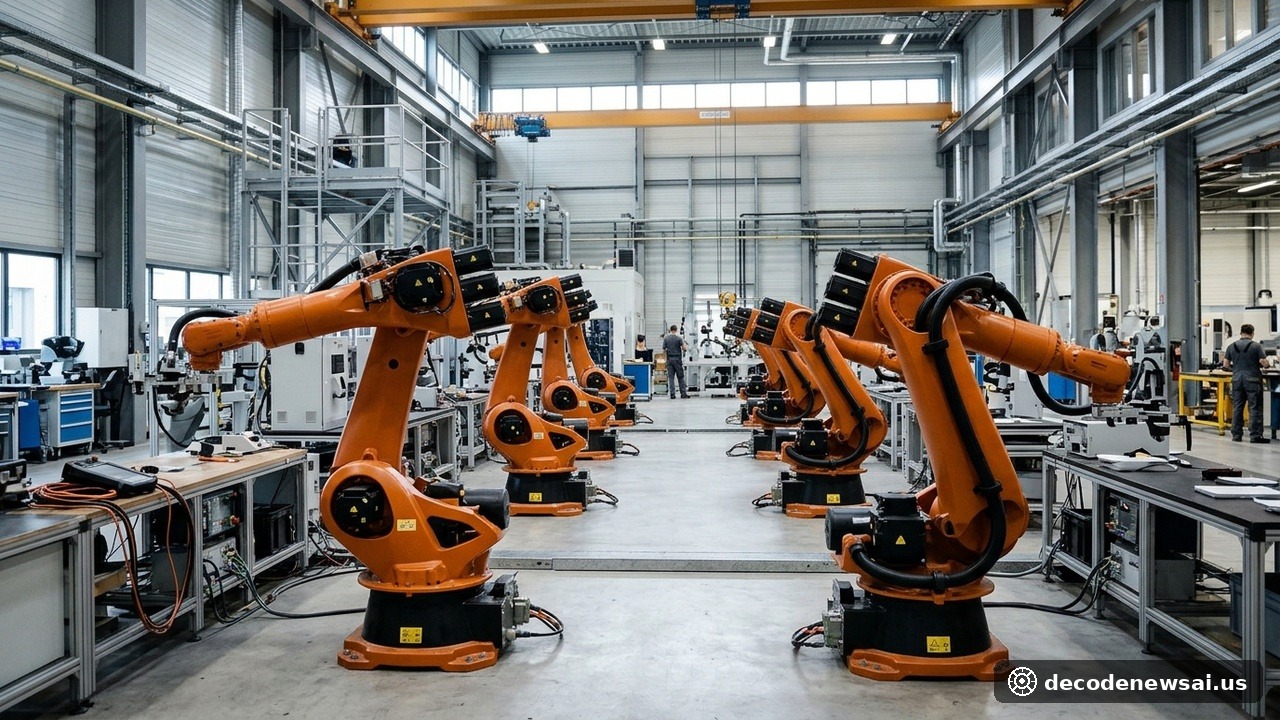
Swiss engineering group ABB said on November 5 that SoftBank had informed it that China’s foreign-investment security review authorities had prohibited the acquisition of ABB’s robotics business in China. The transaction, announced in October 2025, carried an enterprise value of $5.375 billion. ABB said it remained in close dialogue with SoftBank and that the two companies were working constructively on the transaction. ABB did not announce that the entire deal had been terminated or provide a revised timetable.
SoftBank had agreed to acquire ABB’s robotics division as part of its effort to expand into what it calls “physical AI.” The Japanese investment group has described robotics as an important part of its strategy to combine industrial automation with its artificial-intelligence investments. The transaction had been expected to close in mid-to-late 2026, subject to regulatory approvals in China, the European Union and the United States.
ABB confirms a prohibition involving the China business
ABB’s announcement specifically referred to the robotics business in China. The company said SoftBank had informed it that China’s Office of the Working Mechanism for Foreign Investment Security Review had prohibited the acquisition of ABB Robotics’ business in the country. ABB did not say whether the decision made the entire transaction impossible, or whether the parties would seek a revised structure or another approval process.
Reuters reported that China’s National Development and Reform Commission is responsible for the relevant review. Reuters, citing a Financial Times report, said regulators were concerned that robotics data could be transferred overseas and used to train artificial-intelligence models. That explanation was attributed to sources cited by the media and was not included in a publicly released regulatory decision. SoftBank declined to comment immediately, while the regulator did not immediately respond to media requests.
China is an important market for ABB’s robotics operations
China is a significant market for ABB’s robotics business. Reuters reported that it represents about 30% of the company’s robotics-related business. ABB has around 15,000 employees in China and maintains business, research and manufacturing operations across the country. Industrial robots generate data related to factory processes, equipment performance and automation systems, making cross-border ownership changes relevant to questions about data, technology and supply-chain oversight.
The decision therefore affects more than an ordinary corporate acquisition. SoftBank wanted to use ABB’s industrial robotics capabilities to strengthen its physical-AI ambitions, while Chinese authorities have increased scrutiny of foreign transactions involving domestic technology, data and manufacturing capacity. China previously ordered Meta to unwind its acquisition of AI startup Manus, another example of heightened review of cross-border deals involving technology.
The next steps remain uncertain
When SoftBank announced the acquisition in 2025, it put the enterprise value at $5.375 billion and expected the deal to close in mid-to-late 2026, subject to regulatory approvals. ABB had previously considered spinning off its robotics business before agreeing to sell it to SoftBank. If the transaction cannot proceed under its original structure, ABB has not said whether it will revive the spin-off plan, restructure the China operations or seek another solution.
Investors will be watching for any revised transaction structure, further regulatory applications and details on whether the China business can be separated legally and operationally from operations elsewhere. What is confirmed at this stage is that China has prohibited the acquisition of ABB’s robotics business in the country. Whether the broader transaction can still be completed through changes to the deal remains unclear.