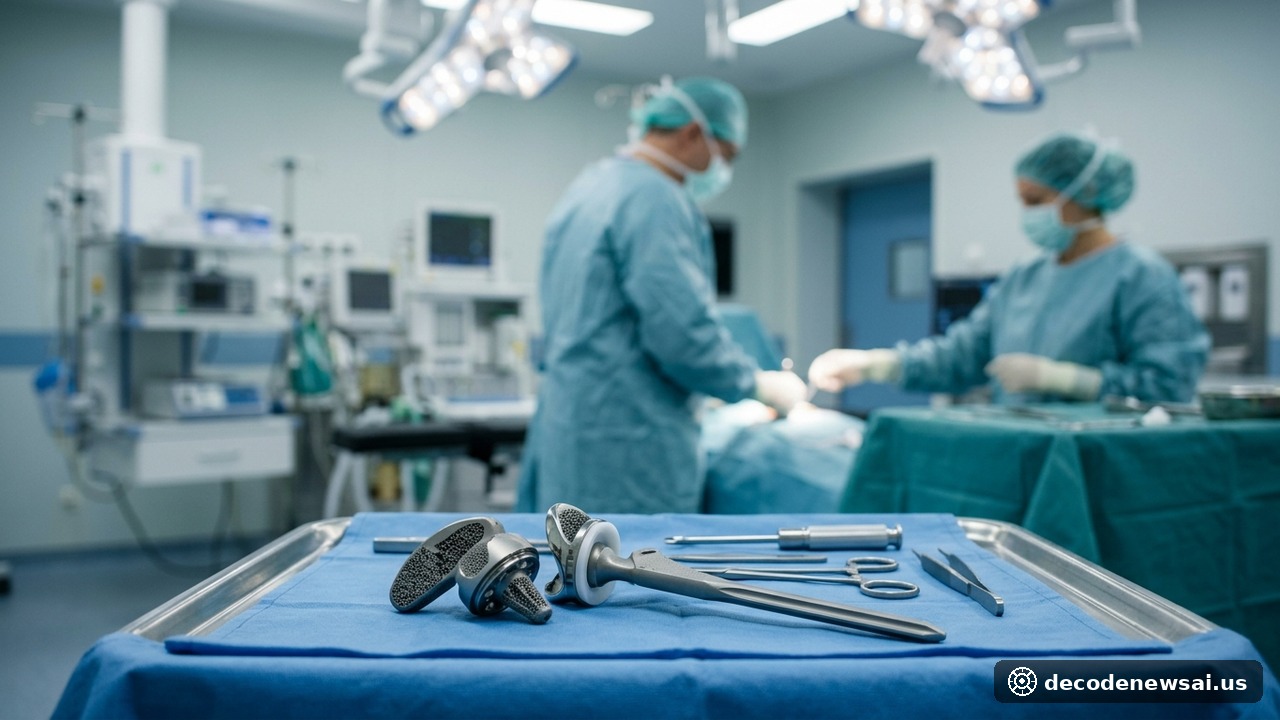
FX Shoulder Solutions, Inc., a rapidly expanding orthopedic medical technology innovator headquartered in Addison, Texas, officially announced on November 5, 2026, that it has received landmark 510(k) clearance from the United States Food and Drug Administration (FDA) to commercially market the Easytech Reversed shoulder system. The historic regulatory authorization establishes Easytech Reversed as the first-and-only stemless reverse total shoulder arthroplasty (rTSA) replacement device ever cleared for clinical distribution across the United States, officially liberating orthopedic surgeons from the clinical requirement of reaming fragile humeral bone marrow canals and implanting conventional long metal stems in complex reverse shoulder procedures.
What Are the Quantifiable Upstream Metrics and Regulatory Specifications in the Easytech Reversed Clearance?
- Regulatory Industry Standing in U.S. Orthopedics: First-and-Only Stemless Reverse System in the U.S.
- Proximal Humeral Bone Stock Preservation Advantage: Conserves Over 60% More Native Bone than Stemmed Implants
The Easytech Reversed bypasses these physiological trade-offs entirely by relying strictly upon localized metaphyseal peripheral fixation.
How Does Proven Metaphyseal Cage Anchorage Deliver Long-Term Biological Integration?
The biomechanical foundation of the Easytech Reversed relies upon a specialized hollow cage anchor base that engages peripheral trabecular bone in the humeral metaphysis.
The anchor base utilizes the exact same geometry and instrumentation as the company's Easytech Stemless Anatomical System, which has established an unblemished safety profile in clinical distribution across the United States since 2021. By securing rigid primary stability through peripheral press-fit fins without intruding into the diaphyseal marrow, the system maintains undisturbed intramedullary vascularity and preserves native proximal humeral anatomy. If future surgical revision ever becomes necessary, removal of the low-profile anchor cage preserves intact diaphyseal bone stock for subsequent reconstructive procedures.
Biomechanical research engineers highlighted that preserving the humeral medullary canal prevents the onset of stress shielding, a common long-term complication in conventional joint arthroplasty. When rigid metallic stems absorb mechanical forces that would naturally transmit through bone, surrounding cortical tissue often undergoes localized resorption and bone loss over decades. By transmitting physiological joint loads directly across proximal trabecular networks, the stemless reverse design promotes natural bone remodeling and preserves structural skeletal integrity.
From a healthcare economics standpoint, the introduction of a stemless reverse implant addresses growing capacity constraints across American inpatient surgical departments. By enabling joint replacement specialists to perform outpatient reconstructions with reduced operative times, surgical centers can expand procedural volume without compromising patient safety protocols or requiring overnight hospital admissions.
What Transformative Consequences Does Stemless Reverse Arthroplasty Bring to Outpatient Surgery?
The commercial arrival of the first stemless reverse system accelerates an overarching structural transition across American orthopedic surgery toward ambulatory surgery centers (ASCs) and accelerated recovery pathways.
Because eliminating diaphyseal reaming dramatically reduces intraoperative blood loss, soft tissue disruption, and surgical instrumentation trays, operating room turnover times are substantially compressed, enabling broader adoption within outpatient surgical environments. FX Shoulder Solutions announced it will initiate controlled clinical rollouts across selected academic medical centers alongside comprehensive surgeon training academies, fundamentally resetting technological standards for complex upper extremity reconstructive surgery across the United States.