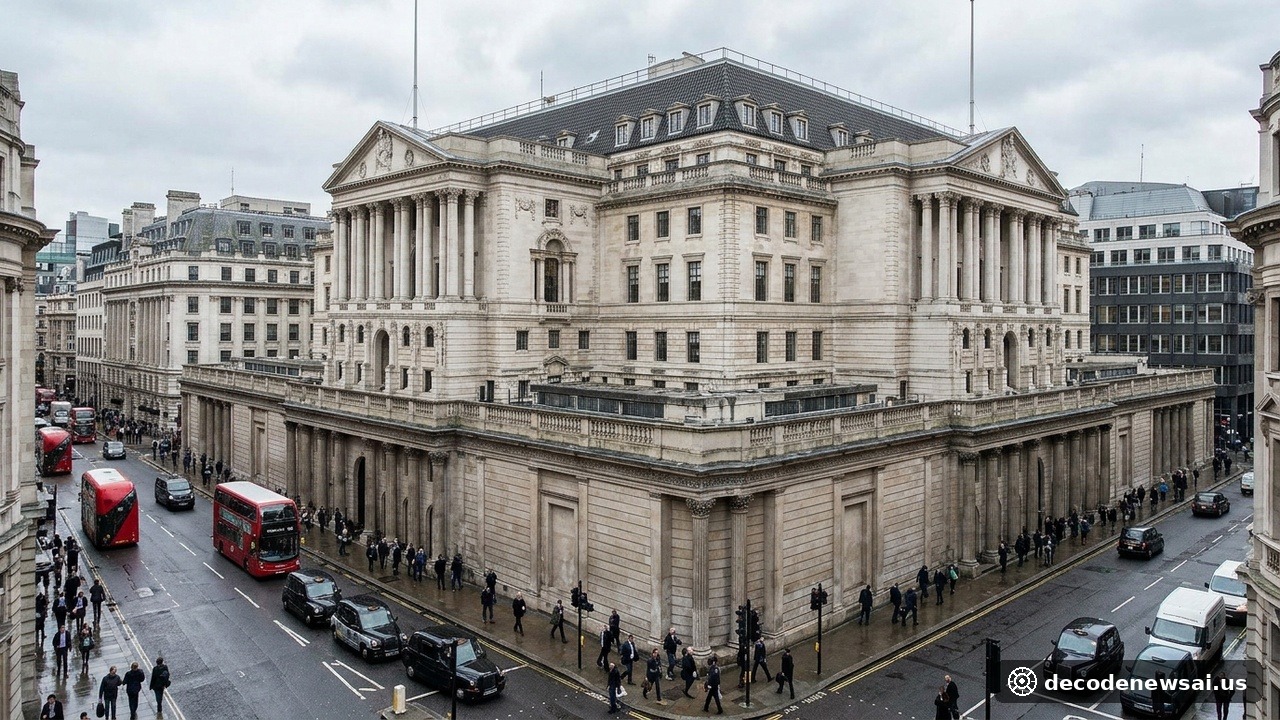
On November 5, 2026, official policy publications from the Bank of England alongside financial market coverage from The Guardian, MoneyWeek, and Morningstar confirmed that the Monetary Policy Committee (MPC) voted 8-1 to increase the official Bank Rate by 25 basis points to 4.00 percent. The decision marks the central bank’s first interest rate increase since August 2023, formally concluding a multi-year period of policy accommodation. Faced with persistent domestic services inflation, sticky wage settlements, and escalating imported energy price pressures stemming from geopolitical hostilities in the Middle East, the central bank opted for preemptive monetary tightening to anchor medium-term inflation expectations.
Monetary Policy Committee Delivers Decisive 8-1 Majority to Counter Inflation Persistence
According to formal minutes released by the Bank of England following the conclusion of the November MPC symposium, nine committee members engaged in exhaustive deliberations concerning persistent structural friction within the British macroeconomy. The final division revealed an overwhelming hawkish consensus: eight members, including Governor Andrew Bailey, voted to enact the quarter-point rate increase from 3.75 percent to 4.00 percent, with only a single external member voting to maintain borrowing costs unchanged.
The official monetary policy summary emphasized that underlying inflationary momentum necessitated immediate policy intervention. While headline Consumer Price Index (CPI) metrics had demonstrated periodic moderation over the preceding twelve months, core services inflation remained entrenched above baseline comfort thresholds, supported by private sector wage growth that consistently exceeded levels compatible with the central bank’s statutory 2.0 percent inflation target. Compounding these domestic pressures, renewed shipping disruptions and volatile crude oil benchmarks tied to the Persian Gulf crisis threatened to introduce secondary supply shocks, convincing policymakers that inaction risked allowing elevated inflation expectations to contaminate upcoming corporate price-setting cycles.
Central bank economists emphasized that service sector wage settlements had remained surprisingly decoupled from broader economic deceleration. Despite sluggish retail consumption and declining manufacturing output, employers across professional services, hospitality, and healthcare continued to grant inflation-compensating remuneration adjustments to retain specialized talent. The monetary authorities determined that failing to raise borrowing costs would validate market expectations of structural policy tolerance for elevated baseline inflation, ultimately requiring even more disruptive corrective interventions in future fiscal quarters.
Immediate Transmission Across Retail Lending Markets as Mortgage Borrowers Absorb Higher Borrowing Costs
The upward adjustment to 4.00 percent generated immediate repercussions across domestic mortgage and consumer credit markets. For millions of British households maintaining variable-rate or Bank Rate-tracker residential mortgages, the quarter-point increase immediately increased recurring debt servicing obligations.
Quantitative modeling published by independent mortgage advisory firms indicated that for a standard 25-year capital-and-interest repayment tracker mortgage of £100,000, the 0.25 percentage point rise increases monthly debt servicing costs by approximately £13.89. For interest-only borrowers holding equivalent loan facilities, monthly interest liabilities expand by £20.83 per £100,000 borrowed. While commercial retail lenders had partially discounted the rate increase into fixed-rate swap spreads, hundreds of thousands of mortgage holders scheduled to refinance expiring two- and five-year fixed products over the coming winter face substantially higher refinancing hurdles, contracting discretionary household expenditure across the retail economy.
Commercial property developers and residential homebuilders similarly expressed acute apprehension regarding the rate trajectory. Commercial real estate transactions across major metropolitan centers had only recently stabilized around anticipated yields; the unexpected resumption of monetary tightening introduces renewed asset repricing pressures. Housing industry associations warned that elevated borrowing costs will further dampen residential transaction volumes and constrain private sector housebuilding targets across regional authorities.
Balancing Stagflationary Traps as Policymakers Maintain Data-Dependent Forward Guidance
In communicating the rate decision, the Monetary Policy Committee explicitly underscored that future policy actions are not beholden to a mechanical, pre-committed hiking sequence. The statutory operational calendar confirms that the next monetary policy announcement will occur on December 17, 2026, while the subsequent comprehensive Monetary Policy Report containing full macroeconomic projections is scheduled for release on February 4, 2027.
International macroeconomic scholars and investment banking strategists across the City of London observe that raising interest rates against a backdrop of stagnant domestic gross domestic product growth highlights the central bank’s acute sensitivity to stagflation. If escalating Middle Eastern conflicts sustain elevated international energy tariffs or if domestic wage rigidity resists monetary suppression, hawkish committee members—including Deputy Governor Clare Lombardelli and Chief Economist Huw Pill, who have both signaled openness to additional near-term tightening—may command majority support for further restrictive measures, prolonging economic contraction across the United Kingdom's debt-sensitive economy.