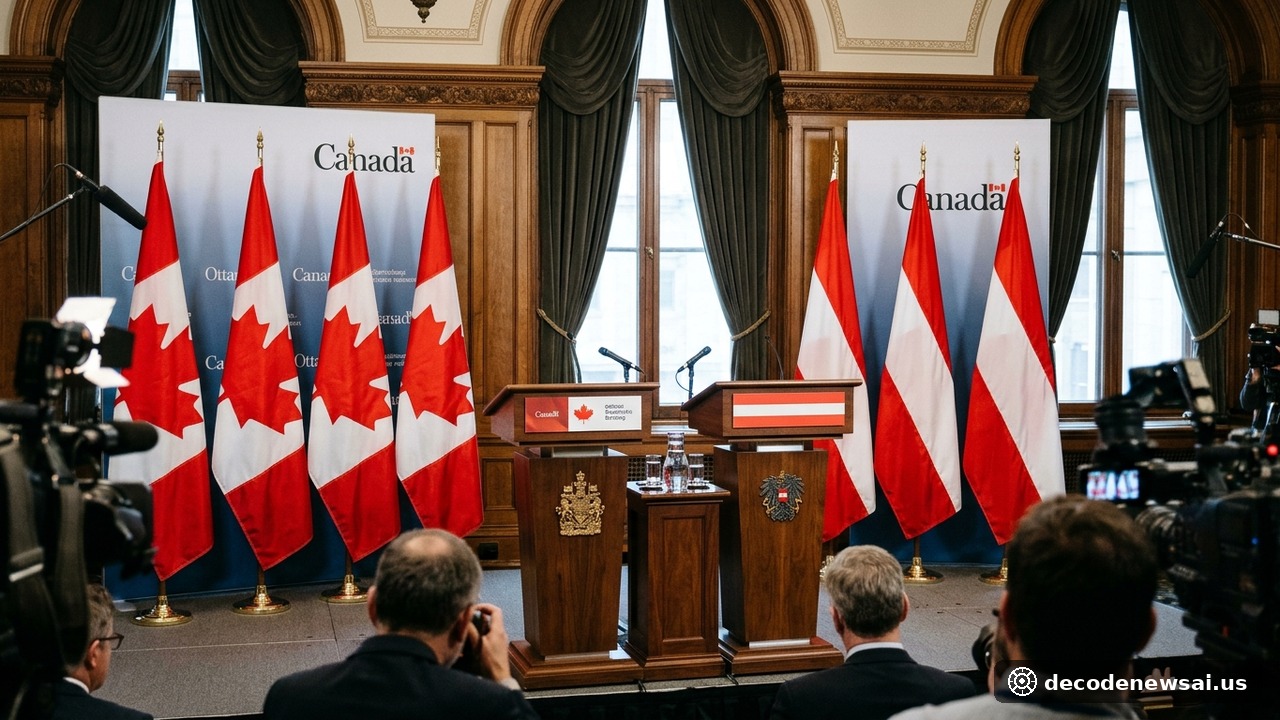
Canadian Minister of Foreign Affairs Anita Anand welcomed Austria's Federal Minister for European and International Affairs Beate Meinl-Reisinger to Ottawa on November 6, 2026, issuing a comprehensive joint statement to formally establish the inaugural Canada-Austria Political-Military Dialogue; the bilateral ministerial summit forged actionable consensus on stabilizing the Western Balkans, reinforcing North Atlantic Treaty Organization (NATO) partnership frameworks, and expanding transatlantic defense cooperation ahead of the 75th anniversary of diplomatic relations in 2027.
What Strategic Agreements Highlight the Canada-Austria Joint Declaration?
- Institutional Defense Consultation: Inauguration of Senior Official Political-Military Dialogue
- Regional Security Architecture: Joint stabilization of Western Balkans and Moldovan integrity
- Multilateral Peacekeeping Ties: Deepened collaboration across NATO Partnership and UN Missions
- Clean Industrial Supply Resiliency: Bilateral investment acceleration in critical minerals and renewables
Why Did Bilateral Discussions Center on Institutionalizing the Political-Military Dialogue?
According to official readouts released by Global Affairs Canada, the senior-level consultations held in Vienna and finalized in Ottawa represent an evolutionary pivot from ad-hoc diplomatic exchanges into formalized security coordination. Against a fractured European geopolitical landscape, Austria—navigating evolving neutral security doctrine—is actively integrating defense planning with transatlantic democracies.
Minister Anand highlighted that regularized political-military consultations establish direct communication channels between defense ministries and armed forces headquarters. The framework focuses on military supply chain interoperability, joint cyber defense infrastructure, and collaborative tactical training. Specifically, Canadian and Austrian military planners will expand cold-weather arctic operational doctrine alongside specialized alpine warfare exchanges.
How Are Ottawa and Vienna Coordinating Policy in the Western Balkans?
Security developments across the Western Balkans constituted a central regional priority during the ministerial deliberations. Given its historical geographical proximity, Austria treats the stability of Southeast Europe as a foundational national security interest, while Canada maintains operational deployments under regional peacekeeping missions and the Organization for Security and Co-operation in Europe (OSCE).
Ministers Anand and Meinl-Reisinger jointly underscored their unwavering support for the sovereignty, constitutional framework, and territorial integrity of Bosnia and Herzegovina. The joint communiqué called for accelerated European-Atlantic integration across the Western Balkan candidate nations while resolving to deploy coordinated countermeasures against foreign hybrid sabotage and disinformation campaigns targeting regional democratic institutions.
What Economic and Clean Energy Initiatives Anchor the Upcoming 75th Anniversary?
Beyond security architecture, the foreign ministers laid the groundwork for an expanded commercial partnership celebrating 75 years of diplomatic ties in 2027. Bilateral merchandise trade and high-technology joint ventures have expanded steadily under the Canada-European Union Comprehensive Economic and Trade Agreement (CETA).
Canada's abundant upstream reserves of critical energy-transition minerals, including battery-grade lithium and nickel, align directly with Austria's specialized advanced manufacturing and environmental engineering prowess. The ministers resolved to establish a bilateral executive commercial council in early 2027, prioritizing private-sector partnerships in green hydrogen infrastructure, industrial heat decarbonization, and closed-loop battery recycling to insulate bilateral trade from external geopolitical disruptions.
What Joint Operational Protocols Will Guide Future United Nations Deployments?
Defense planners in Ottawa and Vienna are establishing standardized operating procedures to coordinate prospective United Nations stabilization mandates. Drawing upon extensive peacekeeping experiences in the Middle East and Southeast Europe, both nations are harmonizing officer exchange curricula and joint logistical deployment frameworks.
The ministers reaffirmed that supporting rules-based multilateralism requires concrete institutional interoperability. By integrating Canadian strategic airlift capabilities with Austrian specialized alpine medical evacuation units, the partnership delivers agile humanitarian and stabilization assets capable of rapid deployment under international crisis management mandates, demonstrating the tangible security dividends of transatlantic bilateral cooperation.