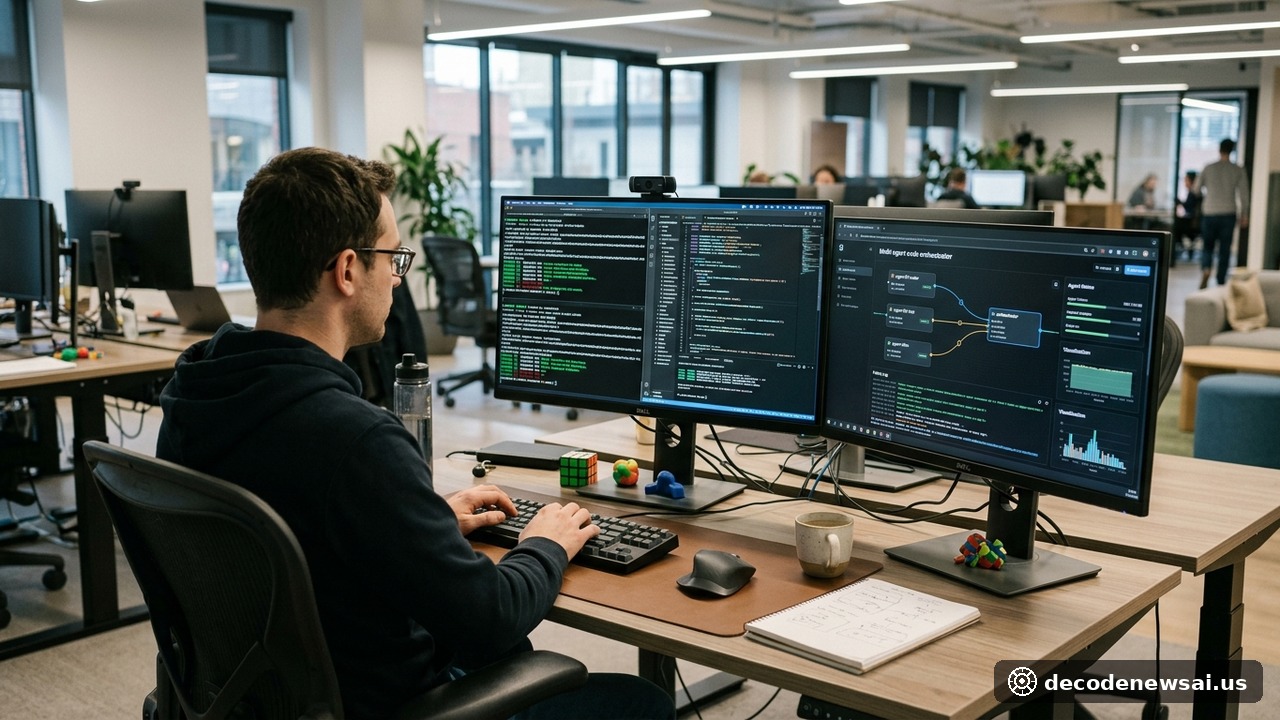
Global social media and artificial intelligence technology conglomerate Meta Platforms, Inc. (Nasdaq: META) officially announced on November 5, 2026, the successful completion of its acquisition of Conductor, an innovative AI-native coding startup specializing in multi-agent orchestration environments. Having previously secured $22 million in Series A venture financing, Conductor's proprietary platform enables software engineers to coordinate, run, and supervise multiple AI coding agents executing development tasks simultaneously in isolated virtual workspaces. By integrating Conductor's team and parallel execution technology into its core generative AI developer stack, Meta strengthens its strategic footprint across next-generation autonomous software engineering.
What Are the Core Operational Metrics and Timeline Milestones in Meta's Acquisition of Conductor?
- Conductor Prior Total Series A Venture Financing Raised: $22.0 Million USD (Backed by Prominent Tech Investors)
- Target Commercial Deployment Window for Meta Integrated Tool: First Half of 2027 (Enterprise Developer Rollout)
- Prominent Enterprise Engineering Teams Utilizing Conductor: Google, Meta, Ramp, Datadog, and Amazon Engineers
In an official corporate transition announcement published by Conductor Co-Founder and Chief Executive Officer Charlie Holtz, the startup outlined the technical rationale driving the combination: "Modern software engineering within complex enterprise monorepos has outgrown single-threaded AI code-completion copilots. Developers do not merely write isolated functions; they must simultaneously author unit tests, refactor legacy dependencies, verify architectural integrity, and resolve distributed microservice vulnerabilities. Conductor's containerized workspace isolation enables an individual engineer to operate as an engineering manager, assigning concurrent modular tasks to an array of specialized AI agents." Under the acquisition agreement, Conductor has suspended new customer registrations, with its existing cloud service scheduled to shut down on November 20 as engineering talent transfers into Meta's Generative AI organization.
How Does Containerized Parallel Multi-Agent Architecture Overcome Legacy Coding Limitations?
Traditional AI-assisted software tools operate through sequential, conversational prompting interfaces where an engineer waits for a single model to process code modifications line by line.
Conductor overcomes this throughput bottleneck through a containerized workspace orchestration mesh. The platform instantaneously provisions multiple ephemeral sandbox environments in the cloud, each complete with isolated compiler configurations, runtime libraries, and dedicated git worktrees. When an engineer initiates a large-scale feature migration, Conductor's supervisor agent decomposes the prompt into discrete work packages—such as frontend interface updates, database ORM adjustments, and end-to-end integration test suites—dispatching autonomous sub-agents to execute modifications concurrently in separate sandboxes. This parallel approach compresses complex development tasks from hours into minutes while automatically diagnosing cross-file merge conflicts prior to main branch pull requests.
Software architecture specialists noted that Conductor's local-first execution model offers unique data privacy advantages for proprietary enterprise codebases. While cloud-based copilots routinely transmit raw source code snippets across public network endpoints, Conductor allows organizations to configure on-premises model execution where sensitive intellectual property never leaves perimeter firewalls. By integrating this secure execution boundary with Meta's enterprise infrastructure, development organizations can adopt autonomous agent workflows without compromising institutional security standards.
Furthermore, developer tooling analysts highlighted that Conductor's containerized sandboxes significantly reduce onboarding latency for newly hired engineers, allowing teams to spin up fully configured cloud dev environments with pre-loaded dependencies in seconds rather than days.
What Strategic Implications Does Developer Tool Consolidation Hold for the Global Tech Ecosystem?
Meta's swift acquisition of Conductor underscores an aggressive industry-wide contest among technology hyperscalers to establish ownership over next-generation AI developer workflows.
As frontier foundational AI models approach commoditization in basic code synthesis, enterprise platform dominance hinges on controlling the workflow execution layer where software architects orchestrate real-world application lifecycles. While Microsoft continues to leverage its GitHub ecosystem, Meta is assembling an integrated developer stack pairing its open-weights Llama foundational models with Conductor's agentic execution engine. This transaction signals to the venture ecosystem that standalone AI coding utilities are rapidly being consolidated into comprehensive enterprise platforms, accelerating the advent of autonomous, multi-agent software engineering at scale.