A research team led by physics professor David Weld at the University of California, Santa Barbara has achieved an experimental breakthrough in quantum simulation. By exchanging the conventional roles of light and matter inside an optical cavity, the physicists created a matter-wave Fabry-Pérot resonator operating in the ultrastrong driving regime. The apparatus directly simulates the propagation of light in curved spacetime and reproduces horizon-like wave concentration dynamics. Published in Physical Review Letters on November 4, 2026, and featured in Physics magazine by the American Physical Society, the study establishes a versatile tabletop platform for testing relativistic wave phenomena under highly controlled laboratory conditions. Inverting Light and Matter to Overcome Relativistic Mirror Speed Limits In classical optics, a Fabry-Pérot cavity formed by a pair of facing mirrors serves as a foundational building block for lasers, spectrometers, and precision sensors. Theoretical physics models predict that if the mirrors bounding an optical cavity oscillate rapidly at relativistic velocities near the speed of light, the electromagnetic field trapped within undergoes extreme transformation. Diffuse radiation collapses exponentially into compressed, high-intensity pulses along specific spacetime trajectories that mimic light propagating near an event horizon. However, accelerating macroscopic physical mirrors to near-light speeds poses an insurmountable experimental obstacle in ordinary laboratories.
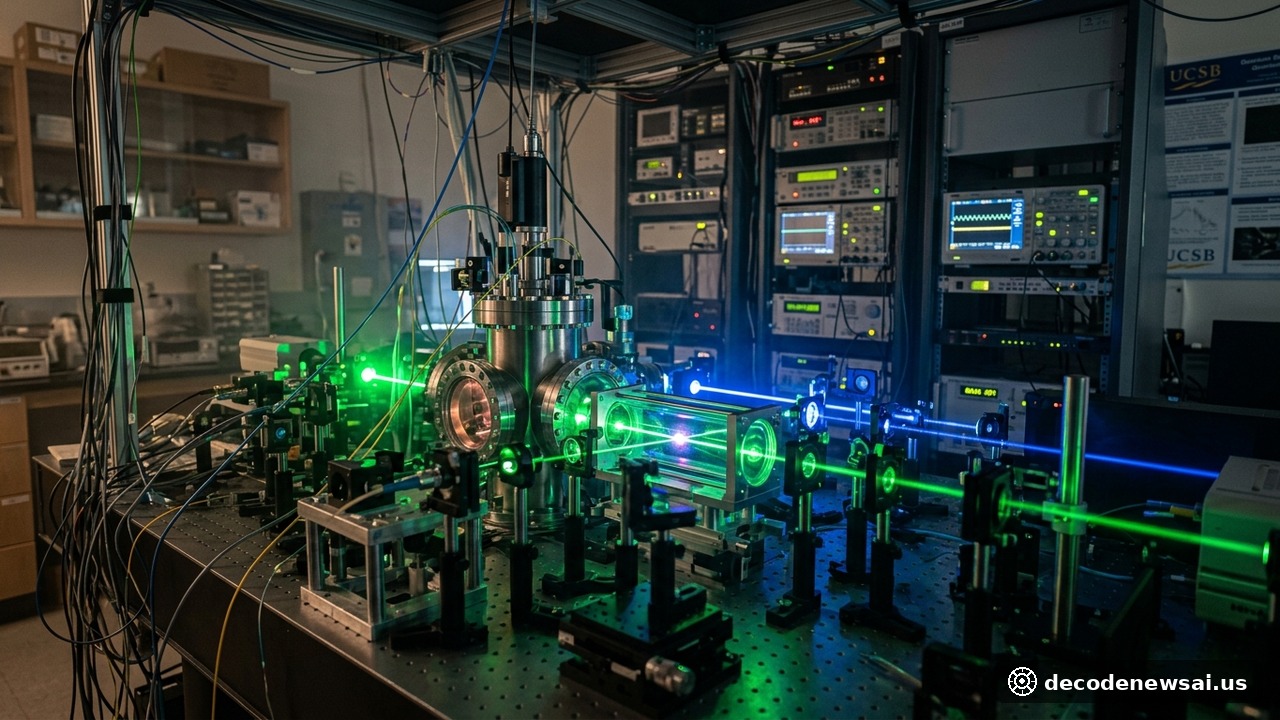
The UC Santa Barbara team circumvented this limitation by turning the familiar setup inside out. Instead of confining optical waves between physical mirrors, the physicists confined matter waves of ultracold lithium atoms between barriers formed by sheets of laser light. Four red laser beams trapped a Bose-Einstein condensate of lithium atoms within an optical lattice, endowing the matter wave with photonic-like dispersion. While photons travel at the cosmic speed of light, the ultracold lithium matter waves propagated at a manageable group velocity of less than 1 m/s. This dramatic reduction in effective wave speed allowed researchers to translate the light barriers at speeds comparable to the wave itself, granting access to the ultrastrong driving regime without requiring relativistic physical machinery. Resonant Driving at 100 Hz Focuses Matter Waves into a Solitary Moving Pulse The experimental apparatus employed an acousto-optic deflector to periodically modulate the position of one light mirror, causing the effective length of the cavity to oscillate. When the light mirrors remained stationary, the lithium matter waves spread uniformly throughout the cavity volume without exhibiting anomalous spatial localization. However, when the researchers drove the oscillating light barrier near the cavity's fundamental resonance frequency at around 100 Hz, the matter waves underwent rapid spatial compression, condensing into a single traveling pulse within a few cycles.
To track the evolution of the system, the researchers recorded stroboscopic snapshots once per modulation cycle. Over an observation window of about 70 ms, atomic pulses that initially formed at arbitrary positions consistently drifted toward a stable fixed point while moving away from an unstable fixed point. In mathematical physics, this unidirectional attraction toward a stable fixed point corresponds directly to the behavior of light falling across an event horizon into a black hole from which it cannot return. Waveform Control and Phase Shifts Reveal Time Reversal and Signal Compression The team also demonstrated versatile dynamical control over the matter-wave cavity. When the researchers excited the cavity at twice its resonant frequency, the atomic density bifurcated into two distinct pulses, each traveling toward a separate stable fixed point. In an additional test, the physicists introduced an abrupt phase shift into the mirror oscillation. This phase jump instantaneously swapped the stable and unstable fixed points, causing the matter-wave pulses to reverse their direction of travel and demonstrating time-reversal symmetry within the controlled wave dynamics.
Addressing potential technological applications, Weld noted that the dynamics observed in the experiment, along with the possibility of realizing them in a solid-state platform, points the way to new schemes for compressing and decompressing optical signals. The authors also indicated that driving the cavity with non-sinusoidal waveforms could permit laboratory investigations of other astrophysical phenomena, such as cosmic rays gaining energy when scattered by moving magnetic fields. Dominik Schneble, a cold-atom physicist at Stony Brook University who was not involved in the study, observed that the setup allows researchers to explore intriguing physics arising from oscillatory mirror motion near the effective speed of light. Analog Horizon Dynamics Distinguish Laboratory Simulations from Gravitational Black Holes The authors and independent commentators emphasized the physical interpretation and experimental boundaries of the research. The matter-wave platform provides a controlled analog that simulates relativistic wave equations and horizon boundary conditions; it does not produce gravitational collapse, mass singularity, or an astronomical black hole, nor does it detect Hawking radiation in the laboratory.
Because astronomical black holes remain inaccessible to direct experimental intervention, laboratory analog-gravity systems provide an essential testing ground where theoretical predictions can be systematically tuned, measured, and repeated. By validating relativistic wave-packet concentration in an ultrastrongly driven Fabry-Pérot geometry, the UC Santa Barbara experiment establishes an important bridge connecting quantum gases, relativistic field theory, and next-generation optical signal processing.