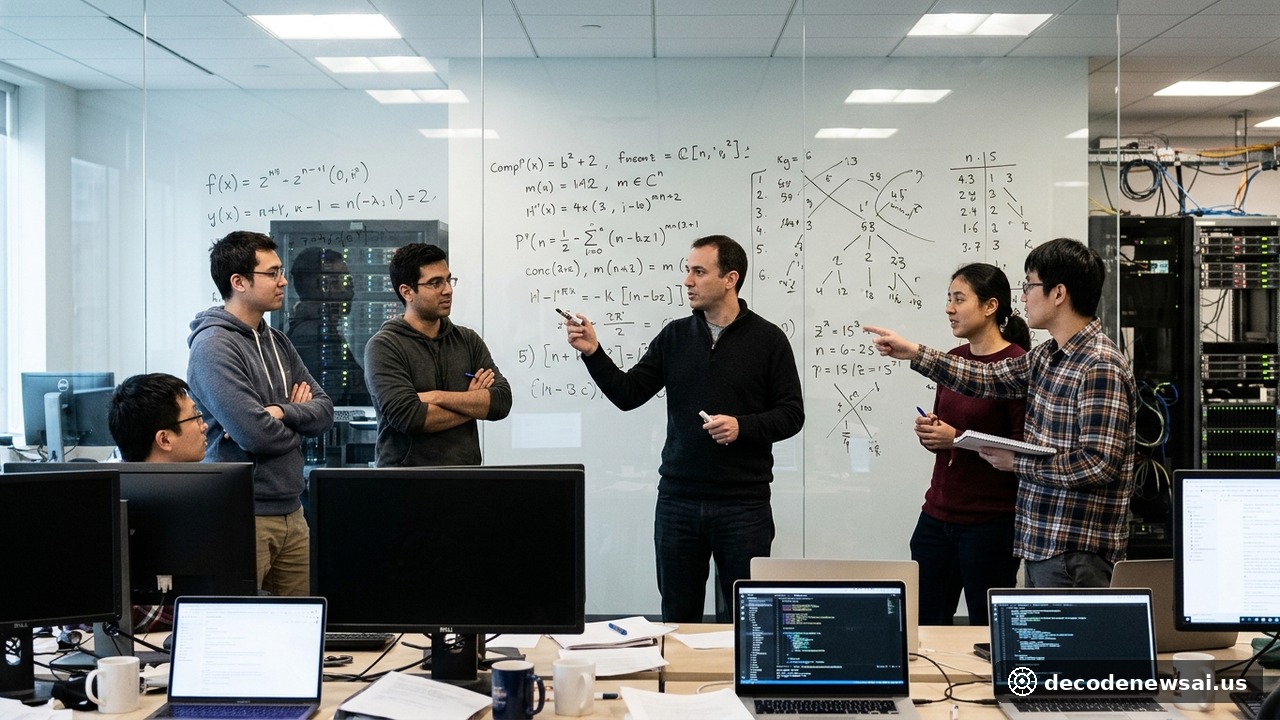
Researchers at Google DeepMind published cryptanalytic findings on November 6, 2026. The work was led by Vice President of Science Pushmeet Kohli. It shows that autonomous artificial intelligence agents found structural weaknesses in legacy 1024-bit RSA public-key encryption. The findings appear in a preprint paper titled 'Fan Factories: Multiple Number Fields in Factorization Factories and Batch NFS.'
What the DeepMind Paper Reports
DeepMind described two vulnerabilities. One method enables digital signature forgery on compromised keys. The other is an algorithmic advancement. It cuts the computational overhead of batch integer factorization for mathematically related moduli. The cost falls to approximately 1/58th of conventional baseline costs.
Background on the RSA Cryptosystem
How the Neural Agents Worked
The DeepMind engineering team ran advanced deep reinforcement learning agents. These agents identified non-obvious algebraic symmetries that have eluded human mathematicians. The team redesigned the polynomial selection phase of the Number Field Sieve (NFS). The AI agent then constructed an optimized framework dubbed Fan Factories. The system was applied across large sets of 1024-bit keys with subtle algebraic correlations. It amortizes foundational precomputations across thousands of target targets. That collapses the marginal hardware threshold to standard enterprise cloud server environments across commercial hosting providers.
What DeepMind Said About Modern Financial Networks
Where the Exposure Lies
Catastrophic vulnerabilities emerge across legacy embedded infrastructure. Hundreds of millions of industrial programmable logic controllers remain permanently operational with hardcoded 1024-bit root keys. Electrical grid sensors are in the same position. So are automotive electronic control units and municipal utility meters. Many of these operational technology assets lack over-the-air update capabilities. Malicious actors could forge authentic firmware signatures to seize industrial systems.
The Effect on National Security Assumptions
DeepMind's findings have sent seismic shockwaves through national security apparatuses. They overturn historical assumptions regarding cryptographic lifespans. For decades, international defense organizations operated under one doctrine. Asymmetric public-key systems faced obsolescence only upon the eventual arrival of fault-tolerant quantum computing clusters. DeepMind established that machine learning systems optimizing classical mathematical algorithms can achieve comparable breakthroughs on legacy cryptography.
NIST Advises a Twenty-Four-Month Window
Cybersecurity specialists at the National Institute of Standards and Technology (NIST) issued urgent advisories. These call upon enterprise operators to institute aggressive cryptographic agility audits. Organizations are advised to accelerate transitions away from classical modular arithmetic. The target is lattice-based post-quantum cryptography (PQC) standards. The advisories set a strict twenty-four-month operational window. The aim is to safeguard institutional data and sensitive industrial control infrastructure.