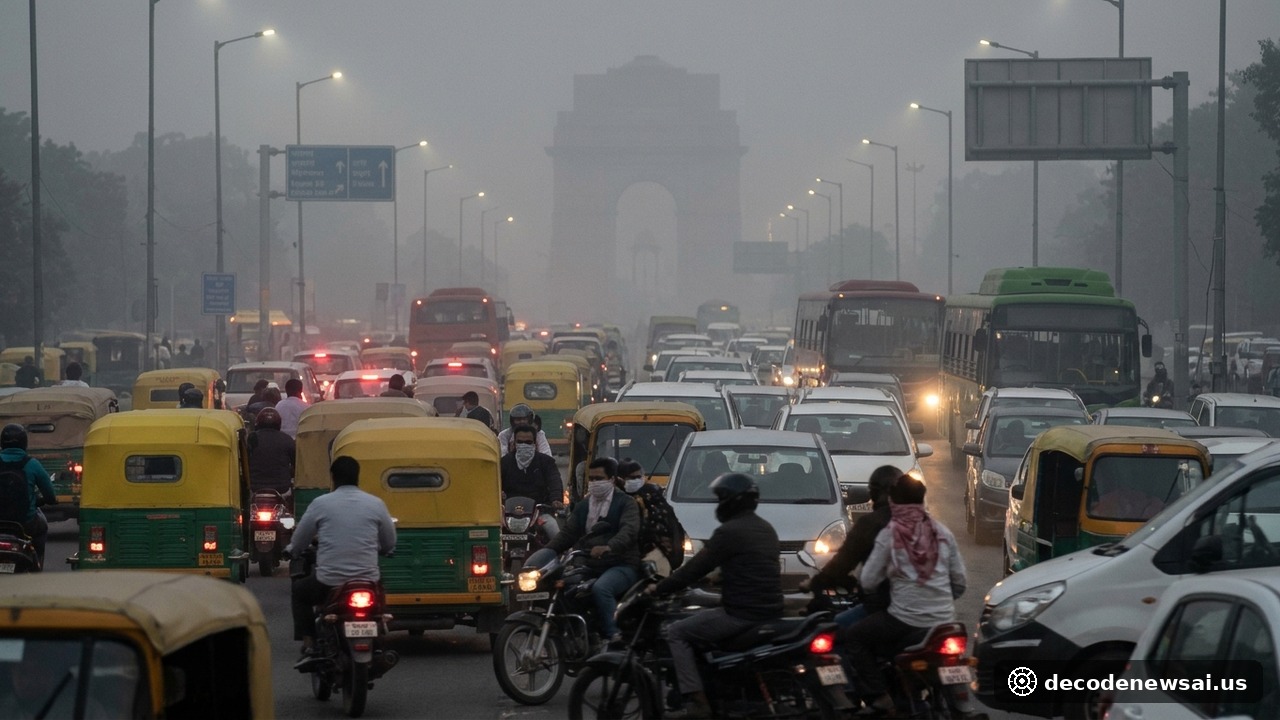
NEW DELHI - A dense layer of toxic atmospheric smog settled over India's National Capital Region on Monday, November 9, following overnight Diwali festival celebrations, pushing regional particulate pollution to hazardous thresholds. Continuous ambient air quality tracking stations administered by the Central Pollution Control Board documented Air Quality Index readings surpassing 437 across northern metropolitan districts. The severe haze reduced horizontal visibility and triggered public health alerts for millions of metropolitan residents.
GRAP Phase III activated as smog worsens
Festival pyrotechnic celebrations reached maximum intensity across residential districts on Sunday evening despite pre-existing Supreme Court judicial directives restricting consumer firecracker sales. Overnight combustion released heavy atmospheric concentrations of toxic sulfur oxides and inhalable fine particulate matter (PM2.5). Official monitoring telemetry recorded hazardous atmospheric readings across thirty-nine municipal air quality observation towers early Monday morning.
The ambient monitoring stations located at Delhi Technological University (DTU) and Burari Crossing registered the most hazardous pollution levels across the capital territory, each recording peak AQI values of 437. The city-wide composite air quality index escalated from pre-holiday baselines near 310 up to 370, entering the upper boundary of the severe category. Ground visibility at Indira Gandhi International Airport deteriorated below 500 meters, prompting minor domestic flight scheduling adjustments. Pediatric outpatient clinics reported surges in acute asthma consultations.
Shweta Narayan, a senior environmental health campaigner at the Global Climate and Health Alliance, stated during an air quality briefing: "Seasonal agricultural stubble combustion combined with festival pyrotechnics severely worsens regional air quality. Regulatory authorities must transition from reactive emergency declarations toward permanent structural emission controls." Public health advocates supported the assessment.
Stubble burning and inversions trap smog
Municipal environmental authorities immediately activated Phase III emergency protocols under the statutory Graded Response Action Plan (GRAP). The directive orders an immediate moratorium on non-essential commercial construction excavations and structural demolition works across the territory. Industrial facilities were prohibited from utilizing uncertified standalone diesel generation sets, while municipal fleets deployed over two hundred high-pressure mist spraying cannons along commercial arterial roadways.
Regional agricultural practices across the neighboring breadbasket states of Punjab and Haryana continue driving seasonal air contamination. Space-based orbital infrared thermal sensors tracked hundreds of agricultural stubble fires across agricultural fields over the preceding weekend. Seasonal meteorological atmospheric inversions characteristic of November prevent regional surface air masses from dispersing, trapping particulate smog within the Indo-Gangetic river basin.
Public health specialists across premier New Delhi medical teaching hospitals warned that exposure to elevated PM2.5 concentrations poses acute physiological risks. Prolonged inhalation of micro-particulates exacerbates ischemic heart conditions and induces chronic bronchitis among vulnerable elderly demographics. Current metropolitan pollutant measurements exceed recommended World Health Organization safety parameters by more than thirtyfold. Regional policymakers face mounting public pressure to construct coordinated cross-state clean agricultural transition pacts.
Scientists urge cross-state farm emission fixes
Atmospheric scientists at premier Indian research institutions noted that seasonal meteorology significantly amplifies surface pollution across northern river basins. During late autumn, regional cooling creates low-level temperature inversions that trap vehicular emissions, industrial exhaust, and biomass smoke near ground level. Without substantial convective air currents to disperse particulates, toxic atmospheric concentrations persist for weeks across the densely populated capital territory.
Health policy specialists urged municipal and state authorities to implement synchronized cross-border agricultural emission standards. While emergency dust suppression cannons provide localized visibility improvements along major thoroughfares, mitigating regional haze requires transitioning rural farmers away from manual field burning toward subsidized automated crop residue mulching. Environmental advocates continue lobbying for regional clean energy transit corridors to permanently replace aging diesel freight fleets.
Agricultural economists noted that regional farm cooperatives require substantial capital investment to establish modern crop residue processing facilities. Encouraging private biomass conversion companies to commercialize crop stubble into industrial packaging materials offers a viable long-term economic alternative to field burning across rural northern India.