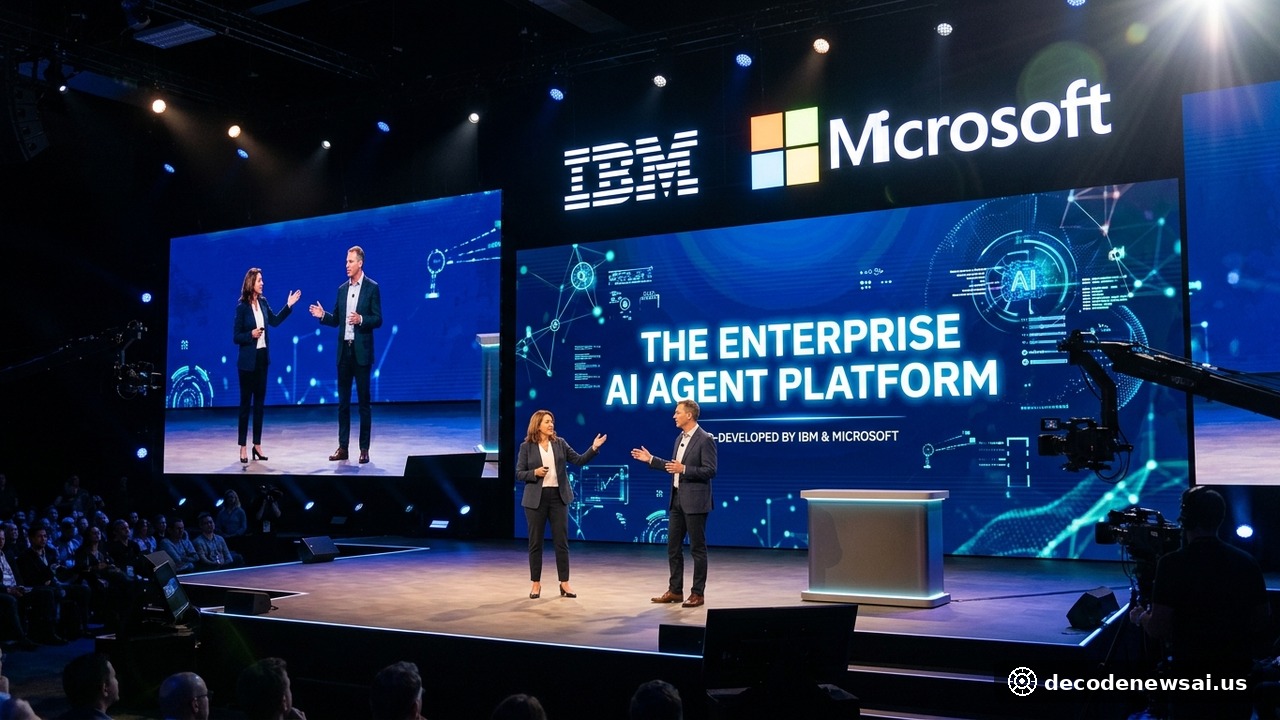
International Business Machines Corporation (IBM) and Microsoft Corporation announced a major strategic partnership expansion on November 10, 2026. The two companies unveiled a new collaborative AI agent platform. It is built for complex corporate environments. The platform combines Microsoft Azure AI infrastructure and Copilot frameworks with IBM's watsonx governance and domain-specific consulting architectures.
Enterprise Agent Platform Unites Azure Compute with watsonx Governance
The platform deploys enterprise-grade autonomous AI agents across highly regulated industries. The alliance pushes generative artificial intelligence from passive content assistance into autonomous, deterministic enterprise agent workflows. Corporate developers can build, run, and govern autonomous agents. These agents execute multi-step operational tasks across complex corporate software environments.
The solution integrates Microsoft's Azure cloud foundation and scalable OpenAI model endpoints with IBM's watsonx.governance toolsets. It creates an enterprise-ready environment. Autonomous software agents can access corporate databases safely there. Early deployment benchmarks demonstrated a 60 percent improvement in processing turnaround times. Automated agent workflows can execute complex cross-system compliance and procurement reconciliations at that speed.
The Executive Vice President and Chief Commercial Officer at Microsoft stated: "Our expanded collaboration with IBM brings together world-class cloud infrastructure and deep enterprise consulting expertise. The new AI agent platform empowers global organizations to automate mission-critical workflows securely while adhering to the highest regulatory standards."
The Platform Builds End-to-End Auditability and Governance Safeguards for Regulated Workflows
The platform addresses specific compliance mandates of banking, insurance, healthcare, and public sector organizations. It incorporates strict enterprise security and data privacy guardrails. Autonomous agents are constrained by granular role-based access policies and automated hallucination filters.
Every autonomous decision and database transaction executed by an agent generates an immutable, cryptographically signed audit log. That log is stored within the client's dedicated enterprise tenant. The architecture prevents model drift. It ensures full compliance with international regulatory frameworks, including the EU Artificial Intelligence Act and financial data protection statutes.
The Global Managing Partner for Generative AI at IBM Consulting remarked in New York: "In highly regulated commercial sectors, enterprises cannot deploy unpredictable black-box autonomous systems. Together with Microsoft, we are delivering governed, transparent AI agents designed to function as trusted digital co-workers within human-supervised operational boundaries."
The Platform Automates Complex Cross-Border Trade Finance and Supply Chain Reconciliation
The platform delivers specialized pre-configured agent templates designed for high-friction enterprise processes. In corporate banking deployments, autonomous agents can cross-reference shipping manifests, customs declarations, and international letters of credit. They complete complex trade finance audits in under 30 minutes. Traditional multi-day manual reviews take far longer.
In supply chain operations, agents continuously monitor logistics telematics to detect supplier disruptions. They automatically model alternative transportation routes and adjust inventory reorder triggers. The enterprise collaboration positions both technology leaders at the forefront of the commercial AI agent transformation.
A principal enterprise software analyst at a leading global technology advisory firm noted that the IBM-Microsoft agent partnership addresses the critical enterprise demand for governance and deterministic execution. The analyst said it sets a benchmark for enterprise AI adoption.
Strategic planning advisors and international trade specialists noted that long-term intergovernmental frameworks generate predictable operating environments across key industry sectors. By coupling transparent administrative guidelines with rigorous scientific benchmarks, regulatory bodies and enterprise leaders establish sustainable operating models capable of withstanding shifting macroeconomic dynamics. Global market participants will continue observing forthcoming implementation milestones as public agencies execute their mandated responsibilities throughout 2027. Cross-border coordination remains vital for driving sustained operational resilience and delivering measurable societal benefits worldwide.