NASA’s Swift Space Telescope Expected to Re-enter Earth’s Atmosphere on November 4
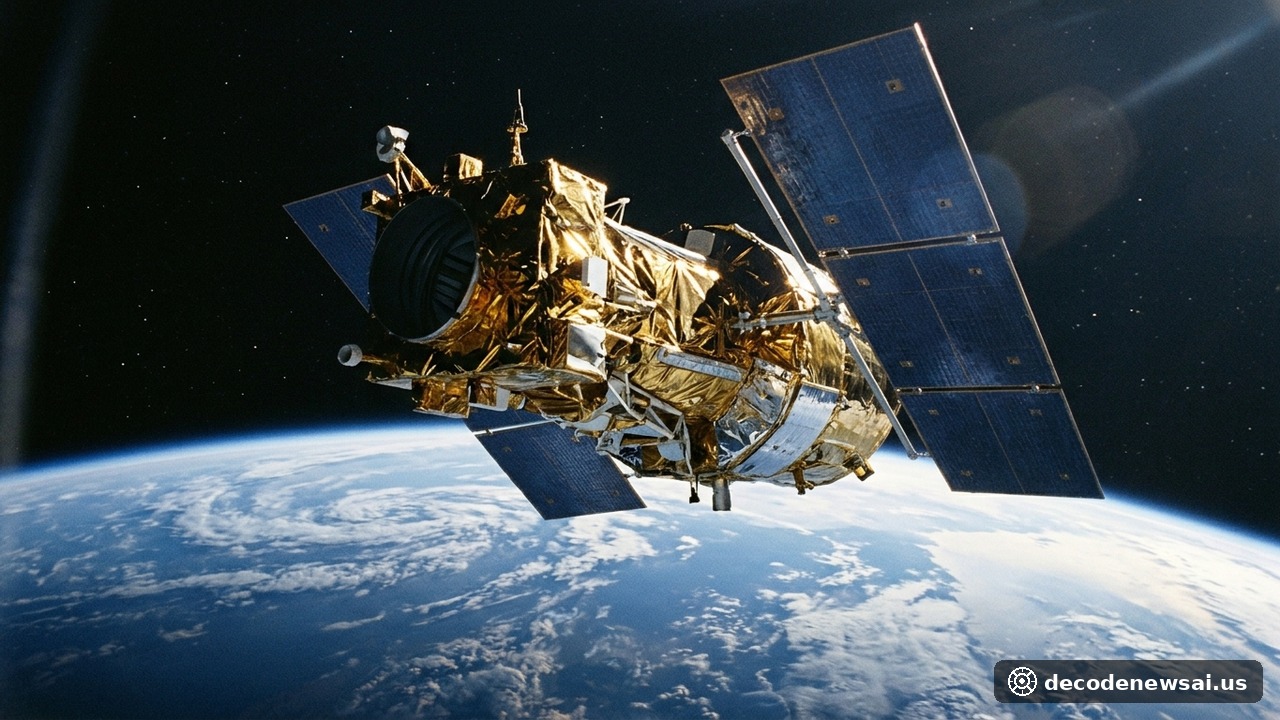
Photo: AI-generated
A nearly 22-year mission approaches its end
NASA’s Neil Gehrels Swift Observatory is expected to re-enter Earth’s atmosphere on November 4, bringing an end to nearly 22 years of observations. The spacecraft weighs about 3,200 pounds and launched in 2004 with a primary mission designed to last two years. It operated for more than ten times that planned duration. Swift was built to study gamma-ray bursts and other rapidly changing cosmic events. Its three telescopes observed the universe across different wavelengths, while its rapid pointing system allowed it to respond quickly to short-lived explosions and alert other observatories to follow-up opportunities.
Solar activity accelerated its orbital decline
NASA said increased solar activity caused Earth’s upper atmosphere to expand, increasing atmospheric drag on satellites in low Earth orbit. Swift gradually lost altitude as a result. On October 20, the observatory reached an altitude of about 171 miles, or 275 kilometers, where it could no longer maintain stable observations of its scientific targets. The spacecraft entered safe mode, and the operations team ended its science mission in preparation for re-entry. Swift does not have the propulsion capability needed to raise its orbit and avoid the descent. NASA had been monitoring the spacecraft as its orbit decayed, but the final return was expected to be uncontrolled rather than a planned landing.
A rescue attempt failed to extend the mission
NASA supported an effort by commercial space company Katalyst Space Technologies to extend Swift’s operational life. The company developed a robotic spacecraft called LINK, designed to approach Swift and help move it into a higher orbit. The rescue effort did not succeed. NASA announced on October 23 that Swift had ended science operations, then published a more specific re-entry forecast on November 2. Reuters reported that managers abandoned the effort to raise Swift’s orbit in August after the rescue mission failed. The attempt was significant as an early test of commercial in-orbit servicing technology, but it did not prevent the observatory’s eventual return to Earth.
Most of the spacecraft should burn up
NASA expects most of Swift to burn up as it travels through the atmosphere, although some dense components may survive. These could include tungsten parts and sections of the spacecraft’s mirrors. NASA estimated the risk of harm to anyone on Earth at approximately one in 2,100. Because Swift travels in a low-inclination orbit, any surviving debris is expected to fall within a broad band between 20.6 degrees south and 20.6 degrees north latitude. That region covers parts of the tropics, but it does not identify a specific impact location. The spacecraft’s eventual path through the atmosphere will determine where any fragments could reach the surface.
Re-entry forecasts remain uncertain
As of November 4, forecasts from NASA, the U.S. Space Force and other tracking organizations did not give exactly the same re-entry time. NASA’s November 2 forecast placed the expected return around 3:30 a.m. Eastern time, with an uncertainty of about 11 hours. Other tracking organizations subsequently updated their estimates using newer orbital data. Reuters also noted that forecasts differed on the precise timing. The uncertainty is normal for an uncontrolled re-entry. Solar activity, atmospheric density and the spacecraft’s changing orbit all affect the rate at which it loses altitude. A forecast window is not the same as a predicted ground impact point, and the location of any surviving debris may not become clearer until the final stages of the descent.
A lasting scientific legacy
Swift’s mission greatly exceeded its original design life. NASA said the observatory helped scientists study gamma-ray bursts, supernovas, active galaxies and other cosmic phenomena. Its ability to identify an event and rapidly redirect its telescopes made it a valuable tool for coordinating observations across the global astronomy community. The end of Swift’s operations removes a distinctive rapid-response, multiwavelength observatory from NASA’s scientific fleet. However, the mission’s extensive archive will continue to support research long after the spacecraft has left orbit. Its more than two decades of observations will remain part of the scientific legacy of a mission that far outlasted its original two-year plan.
Sources
- NASA Science: NASA’s Swift Observatory to Re-Enter Atmosphere
- Reuters: NASA's Swift satellite telescope heads for fiery re-entry 22 years after launch
- The Guardian: NASA telescope launched in 2004 to plunge back to Earth after failed rescue mission
- CBS News: An aging NASA space telescope is plunging back to Earth. Officials say the “risk of harm...is unlikely.”
- Live Science: NASA's 3,200-pound Swift telescope could fall to Earth as soon as tonight