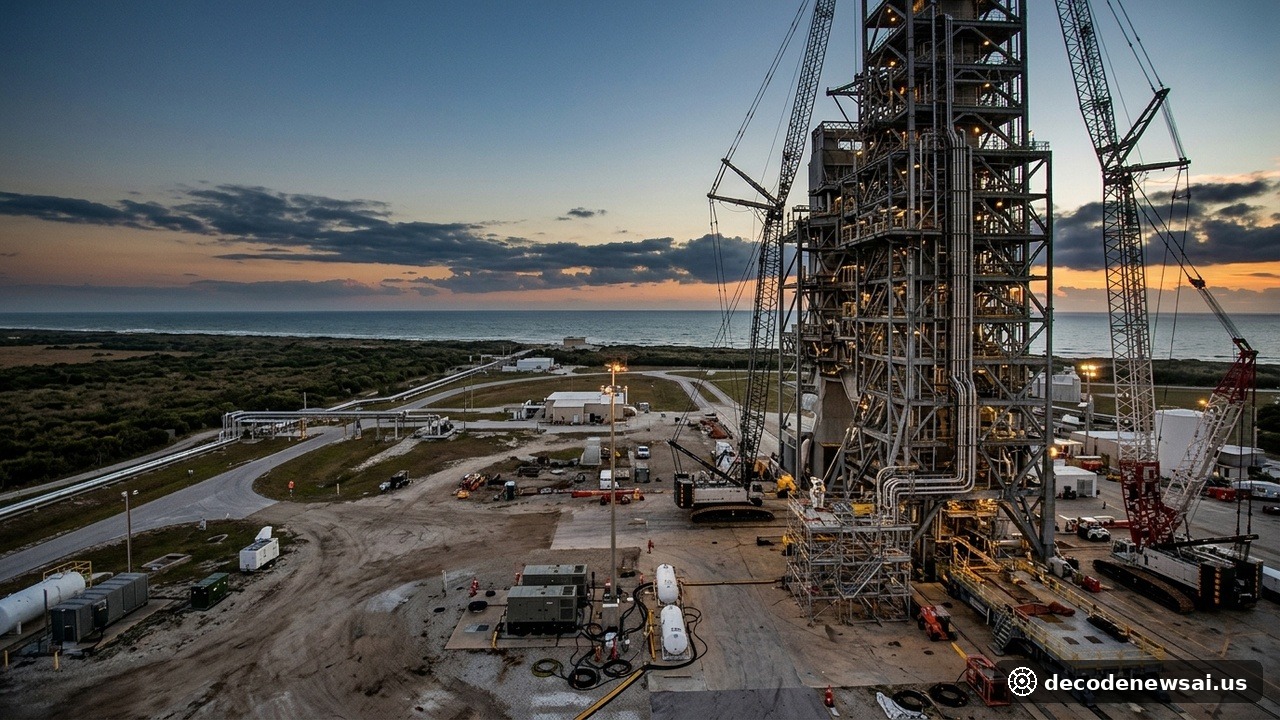
Jeff Bezos’ space company Blue Origin has pushed the next launch of its New Glenn heavy-lift rocket to January 2027. Reuters reported on Nov. 5, citing two people familiar with an email from Chief Executive Dave Limp to employees. The Financial Times first reported the delay. Blue Origin had previously aimed to return to flight before the end of 2026, but the revised target shows that rebuilding the Florida launch site after a serious May accident has taken longer than expected.
A May test accident damaged the only operational pad
The setback began on May 28, when New Glenn suffered an anomaly and exploded during a ground hot-fire test at Cape Canaveral Space Force Station. The blast damaged Launch Complex 36. Blue Origin later said the anomaly originated at the main oxygen valve on one of the rocket’s BE-4 engines. The company reported damage to key ground equipment, including a lightning tower, transporter-erector and hydraulic cylinders. Other infrastructure, including the tank farm, integration facility and water tower, remained in better condition. Because LC-36 was the only operational orbital launch site for New Glenn, the accident halted the rocket’s flight schedule.
A revised approach to rebuilding
In June, Blue Origin said it hoped to resume flights before year-end and would use a hybrid horizontal-and-vertical processing approach rather than simply recreate the previous pad setup. In August, the company also announced plans for a second launch pad at the complex to support a larger New Glenn 9x4 configuration. Those plans, however, did not remove the engineering and integration work required to return the existing pad to service. The latest delay indicates that construction, systems integration and flight-readiness work need more time. Blue Origin has not published a specific January launch date or a complete test schedule.
Commercial and NASA schedules could be affected
New Glenn is central to Blue Origin’s effort to compete in the heavy-launch market. Amazon has contracted for multiple New Glenn launches for its Leo satellite network. NASA has also awarded Blue Origin a contract worth about $3.4 billion to develop a lunar lander. A later return to flight could put pressure on satellite deployment and lunar-program schedules, but the delay alone does not establish that any NASA mission has been postponed. Amazon and NASA would need to announce changes to individual mission plans.
A longer road in the competition with SpaceX
New Glenn has completed three flights since its debut in 2025. Unlike SpaceX, which operates several launch sites and has a much higher flight cadence, Blue Origin remains more exposed to a disruption at a single facility. The Financial Times reported that Blue Origin had planned a substantially busier New Glenn schedule for 2026 and sought to expand its launch capacity. The pad delay makes those ambitions harder to achieve. January 2027 is the company’s current target for a return to flight, not a guaranteed launch date.