What Are the Core Technical Specifications and Operational Metrics of Amazon's Smart Delivery Glasses?
- Total Fleet Deployment Target by End of 2027: Over 20,000 AI Smart Wearable Eyewear Units
- Phase 1 Commercial Field Allocation in 2026: 5,000 Units (Deployed Across Major Metros)
- Estimated Productivity Gain per Delivery Stop: Approximately 4 Seconds Saved per Delivery
- Delivery Service Partners Enrolled in Pilot Program: Over 300 Independent DSP Fleet Operators
Bapu Pギリ, Vice President of Global Delivery Technology at Amazon, articulated the ergonomics driving the initiative: "Delivery associates frequently navigate multi-story apartment complexes while carrying awkward cartons, managing security gates, and dodging environmental hazards. Requiring drivers to repeatedly glance down at a bulky handheld cellular scanner disrupts workflow and introduces physical friction. By embedding turn-by-turn geospatial navigation, access code displays, and intelligent package verification directly into their natural line of sight, we return valuable seconds to every stop while dramatically improving driver safety and comfort."
How Do Heads-Up Displays and Edge Computer Vision Transform Delivery Ergonomics?
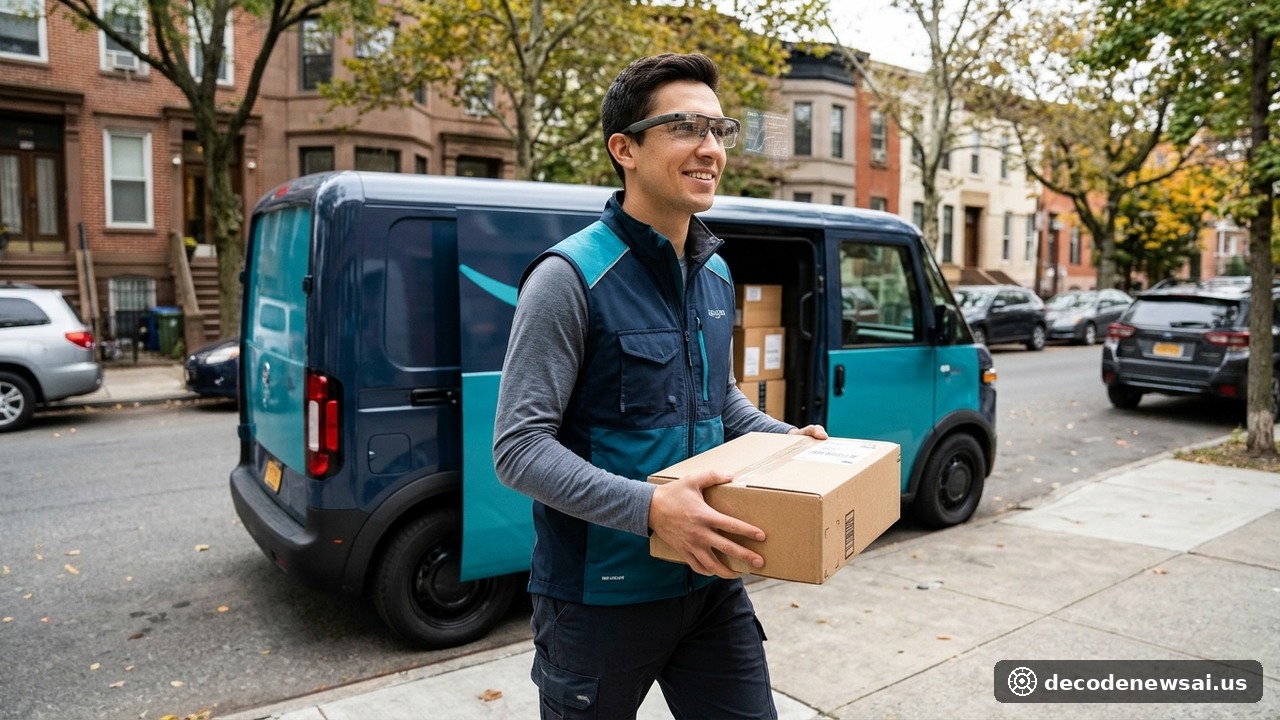
Engineered to match the form factor and lightweight balance of standard athletic eyewear, the glasses feature an ultra-bright diffractive waveguide display paired with low-power edge neural processing silicon.
The hardware automatically synchronizes with the delivery van's onboard telematics. As soon as a courier shifts into park, the display illuminates a micro-navigation pathway leading to the correct building entrance, accompanied by customer delivery instructions and door access pins. Utilizing high-speed machine vision sensors, the glasses read package shipping labels within 50 milliseconds upon sight, confirming the correct parcel via an unobtrusive bone-conduction audio chime. At the recipient's doorstep, the courier verifies package placement with a single tap on the temple frame, triggering an automatic delivery confirmation photo without requiring a handheld device.
Logistics technology evaluators noted that the hands-free ergonomic design addresses one of the most persistent physical complaints among commercial delivery drivers: repetitive strain injuries associated with holding industrial barcode scanners throughout eight-hour shifts. By transferring scanning and spatial tracking to an ultra-lightweight optical frame, couriers maintain unencumbered balance when navigating uneven walkways, ascending icy staircases, or transporting heavy parcels to residential doorsteps.
From an algorithmic perspective, the smart glasses leverage federated on-device computer vision models capable of interpreting diverse building layouts and complex exterior architectural signage without constant high-bandwidth cellular connectivity. When drivers enter apartment courtyards or subterranean parking structures where mobile coverage degrades, the device's localized spatial cache continues to render high-contrast directional cues, guaranteeing seamless operational continuity across difficult urban topography.
What Are the Broader Industry Ramifications for Global Autonomous Logistics?
Amazon's systematic deployment of wearable spatial computing highlights how enterprise AI applications are revolutionizing field service productivity.
When applied across Amazon's annual delivery volume exceeding tens of billions of packages worldwide, a four-second efficiency dividend per stop aggregates into millions of driver hours saved and hundreds of millions of dollars in recurring operating expense reductions. As competitors like FedEx and DHL evaluate comparable augmented reality solutions, wearable enterprise computer vision is rapidly shedding its experimental status, establishing itself as an indispensable linchpin of modern high-velocity global supply chains.