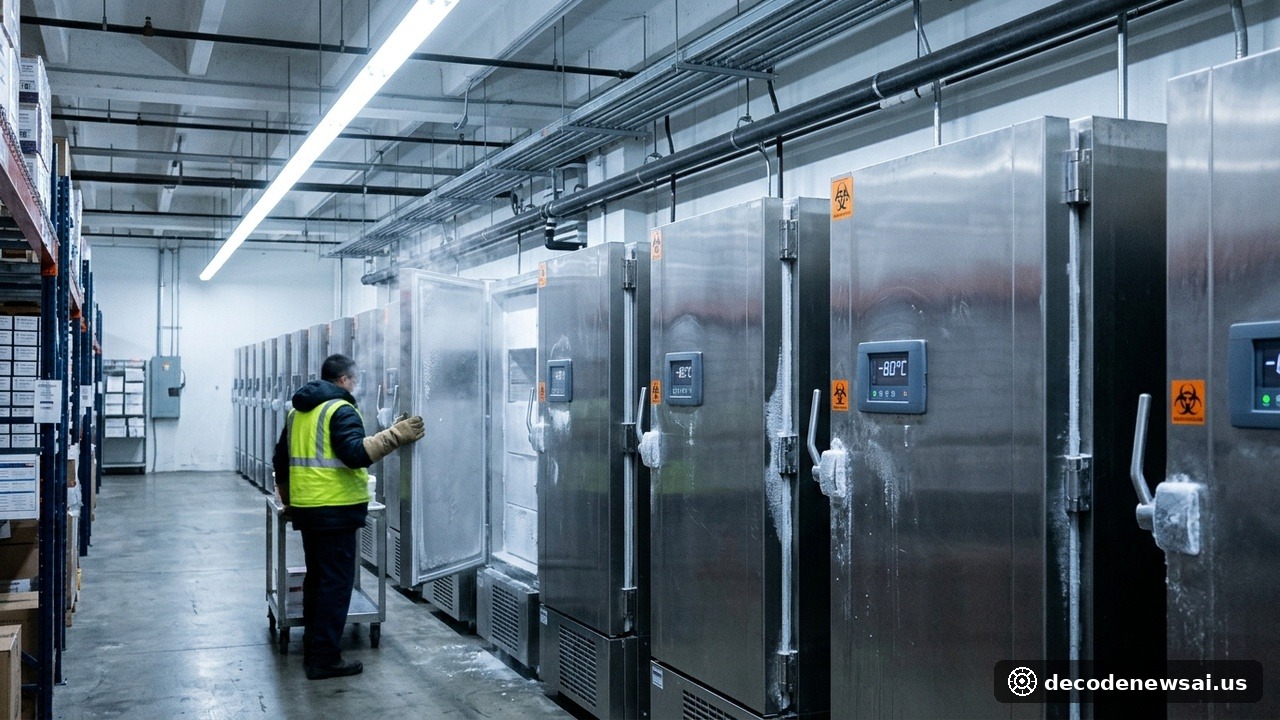
The United Kingdom's National Cyber Security Centre (NCSC) alongside Danish industrial cybersecurity leader Secomea issued an urgent high-level operational technology (OT) alert across European food logistics and critical national infrastructure networks on November 5, 2026, confirming that coordinated cyberattacks targeting refrigeration programmable logic controllers (PLCs) have expanded beyond France into supermarket cold-storage chains across six European nations. Official incident reports confirmed that vulnerable operational technology has been directly exploited at two major food manufacturing facilities in the UK, prompting GCHQ incident response specialists to work continuously overnight to assist commercial operators in severing unauthorized external cellular bridge connections and preventing catastrophic inventory spoilage across regional supply chains.
What Are the Quantifiable Impact Metrics and Technical Vulnerabilities in the Cold-Chain Attacks?
- European Sovereign Nations Impacted by Targeted Attacks: 6 Nations (Including France, Sweden, and Belgium)
- Confirmed Physical Commercial Facilities Infiltrated in UK: 2 Food Distribution Hubs (Confirmed by NCSC CEO)
- Exposed Industrial Cold-Storage Internet Gateways Identified: Over 100 Multinational Commercial Distribution Hubs
- Expert Warning Window for AI-Accelerated Physical Attacks: Within Next 2 Months (Advanced from Two-Year Horizon)
NCSC Chief Executive Officer Richard Horne confirmed in formal briefings that hostile threat actors systematically breached legacy remote access bridges, stating: "Vulnerable technology has been exploited in two instances in the UK, and GCHQ is actively alerting organizations across the food supply chain facing similar exposure." Intelligence agencies confirmed that pro-Russian advanced persistent threat (APT) collectives claimed responsibility for the campaign. Rather than executing standard data exfiltration or deploying software encryption payloads for monetary extortion, the intruders specifically altered temperature thresholds on industrial variable-frequency compressors, remotely disabling cooling loops and raising ambient warehouse temperatures to destroy perishable agricultural products and critical blood plasma inventories.
The campaign exposed deep vulnerabilities in distributed operational technology networks, demonstrating that physical disruption of essential consumer commodities has emerged as a primary vector of hybrid asymmetric warfare.
Why Did Legacy Enterprise Security Firewalls Fail Against Industrial Operational Technology?
Michael Ferdinandsen, Chief Executive Officer of Danish operational technology security provider Secomea, underscored in a technical post-mortem that corporate defensive postures suffer from structural blind spots.
While multinational retailers invest millions securing corporate information technology (IT) environments against phishing and data theft, edge operational technology (OT) controlling industrial cooling, HVAC, and refrigeration units is frequently maintained by external third-party contractors via unmanaged cellular modems lacking multi-factor authentication (MFA). Utilizing automated scanning engines augmented by machine learning models, attackers rapidly identify exposed industrial modems, exploit unpatched supervisory control and data acquisition (SCADA) firmware, and execute unauthorized hardware commands completely undetected by centralized corporate antivirus systems.
Industrial automation engineers pointed out that the convergence of legacy fieldbus protocols with modern cloud analytics has dramatically expanded the attack surface of food logistics hubs. Many automated distribution warehouses operate programmable logic controllers that were designed decades ago without built-in cryptographic authentication or session encryption. When these systems are connected to remote energy optimization dashboards, they become accessible to automated vulnerability scanning tools deployed by hostile actors.
In response to the escalating threat, cybersecurity agencies across the European Union are collaborating with the European Union Agency for Cybersecurity (ENISA) to establish mandatory security baselines for all connected cooling equipment. Facilities failing to demonstrate compliant network segmentation by early 2027 may face regulatory sanctions under updated network and information security directives.
What Strategic Repercussions Does This Crisis Pose for Critical National Infrastructure Security?
The systematic weaponization of European commercial refrigeration infrastructure marks an alarming escalation in hybrid cyber warfare, shifting threats from digital extortion to kinetic disruption of physical food security.
Prominent international security analyst Will Geddes cautioned that the deployment of artificial intelligence capabilities across automated exploit generation has compressed the threat horizon dramatically, warning that critical national infrastructure (CNI) attacks on municipal water supplies, regional power substations, and refrigerated transport grids are imminent within the next two months rather than years. In response, British and European defense ministries are instructing vital supply chain operators to mandate physical, air-gapped manual override switches, forcing industrial automation vendors to implement zero-trust cryptographic architectures across all edge infrastructure.