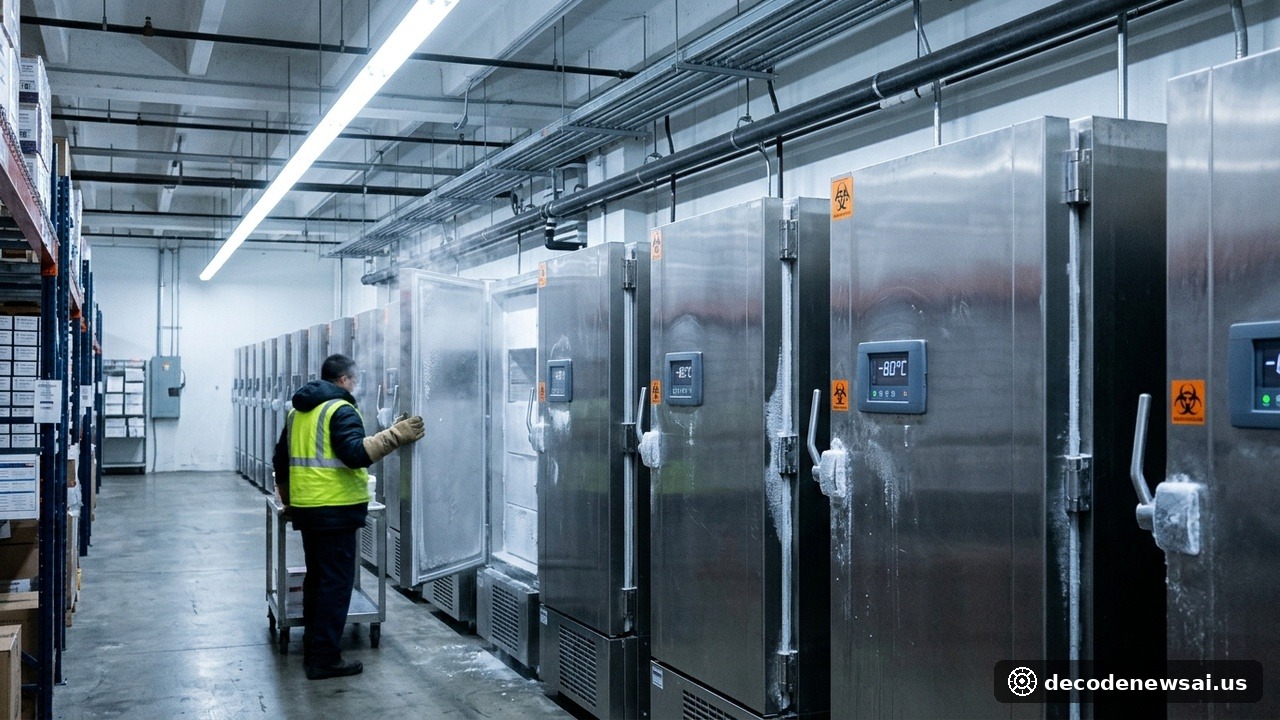
On November 4, 2026, premier international news agencies and cybersecurity intelligence organizations including The Guardian, CBS News, BleepingComputer, and The Record reported that European critical civilian infrastructure suffered an escalating wave of destructive operational technology (OT) cyber intrusions. France’s national blood transfusion service, the Établissement Français du Sang (EFS), formally confirmed that unidentified threat actors breached a third-party refrigeration equipment supplier, maliciously altering temperature and automated defrost thresholds across three central plasma cold-storage facilities. The alarming incident marks a direct escalation from previous cyber incidents that warmed commercial supermarket freezers across more than ten European nations, moving physical disruption directly into healthcare critical infrastructure and posing systemic risks to public health stability across the continent.
Malicious Defrost Manipulation Averted by Rapid Fail-Safe Intervention with Zero Blood Loss
According to official briefings released by the EFS, the cyber incident was detected on November 2, when specialized temperature monitoring sensors signaled abnormal environmental configurations. Rather than attempting to penetrate central patient databases or corporate administrative networks, the hackers targeted the operational management portal of third-party refrigeration service contractor Coolworld. Exploiting exposed credentials on interconnected industrial sensor gateways, the intruders remotely manipulated environmental parameters, forcing temperature thresholds in several plasma cold rooms to extreme high-heat levels, with digital setpoints pushed to as high as 110 degrees Celsius (230 degrees Fahrenheit). The deliberate heating was timed to coincide with low-staffing holiday periods across French regional facilities, aiming to maximize mechanical destruction before operators could react.
The apparent attempt to spoil life-saving plasma supplies intended for emergency clinical transfusions and vital plasma-derived medication fractionation was successfully thwarted by automated safeguards and on-site engineering crews. Physical threshold alarms sounded immediately within the affected storage complexes, prompting facility managers to sever external telemetry connections and transition cooling compressors to localized, isolated manual overrides. EFS leadership issued public confirmations affirming that rapid operational containment prevented any biological degradation or spoilage, ensuring that all stored blood, platelet, and plasma supplies remained fully preserved and that clinical deliveries to hospitals nationwide continued uninterrupted. Technical teams worked around the clock to audit every thermal sensor before reconnecting any telemetry interfaces, verifying that backup power generators and secondary chilling circuits performed flawlessly under emergency conditions.
Russian-Linked Infrastructure Exploits Factory Default Passwords Across Danfoss Sensors
Threat intelligence firms including Lupovis and Help Net Security published technical teardowns detailing the coordinated attack vectors deployed across the continent. Cybersecurity telemetry revealed that beginning in late October 2026, malicious authentication scans originating from bulletproof hosting autonomous systems (ASNs) historically utilized by Russian-aligned advanced persistent threat (APT) groups systematically probed Danfoss AK-SM refrigeration controllers exposed to the public internet. Attackers exploited publicly documented factory-default administrative credentials that regional installation contractors had failed to replace, granting the actors unhindered access to industrial programmable logic controllers. Researchers noted that the adversaries spent days mapping device topologies before deploying automated execution scripts designed to overwrite thermal schedules simultaneously across international retail networks.
Prior to targeting the French blood agency, the coordinated campaign inflicted extensive physical and financial havoc across European retail grocery supply chains. Supermarket conglomerates throughout Belgium, Luxembourg, the Netherlands, Sweden, Finland, Estonia, Ireland, and Germany reported widespread overnight warming incidents. Intruders remotely triggered forced heating cycles that pushed grocery chillers above 50 degrees Celsius (122 degrees Fahrenheit), destroying massive inventories of perishable meats, dairy products, and frozen goods. The coordinated assault followed an earlier October breach that struck up to 700 French supermarkets, forcing operators to condemn tens of millions of euros worth of spoiled retail provisions, severely rattling consumer sentiment regarding retail food safety. Supermarket operators instituted emergency round-the-clock physical security patrols around mechanical rooms to supplement vulnerable automated monitoring software.
Urgent Awakening Over Operational Technology Insecurities Across Critical Infrastructure
France’s national cybersecurity agency, ANSSI, in close coordination with the Ministry of Health, initiated a comprehensive national-security investigation to isolate entry vectors and trace the laundering of command-and-control traffic. Simultaneously, across the Atlantic, the United States Cybersecurity and Infrastructure Security Agency (CISA) issued urgent joint security advisories cautioning domestic healthcare providers and commercial food distribution networks against active, ongoing cyber threats targeting internet-facing refrigeration and environmental monitoring architectures. Western intelligence agencies coordinated threat intelligence sharing to assist multinational retailers in auditing remote terminal units and identifying shadow industrial controllers operating on unsegmented corporate networks.
Industrial cybersecurity strategists emphasize that the penetration of public healthcare cold storage demonstrates a perilous paradigm shift in cyber-physical aggression, transitioning from digital extortion toward kinetic sabotage of essential life-support networks. Because distributed operational technologies managing cooling loops, municipal water filtration, and building climate automation are frequently maintained by external third-party vendors without multi-factor authentication or network segmentation, they present highly vulnerable asymmetric targets. Experts warn that unless sovereign regulators enforce mandatory zero-trust air gaps, credential rotation mandates, and continuous telemetry monitoring across civilian operational technology footprints, modern societies remain dangerously exposed to hostile infrastructure interdiction designed to destabilize civil institutions during periods of acute geopolitical strain.