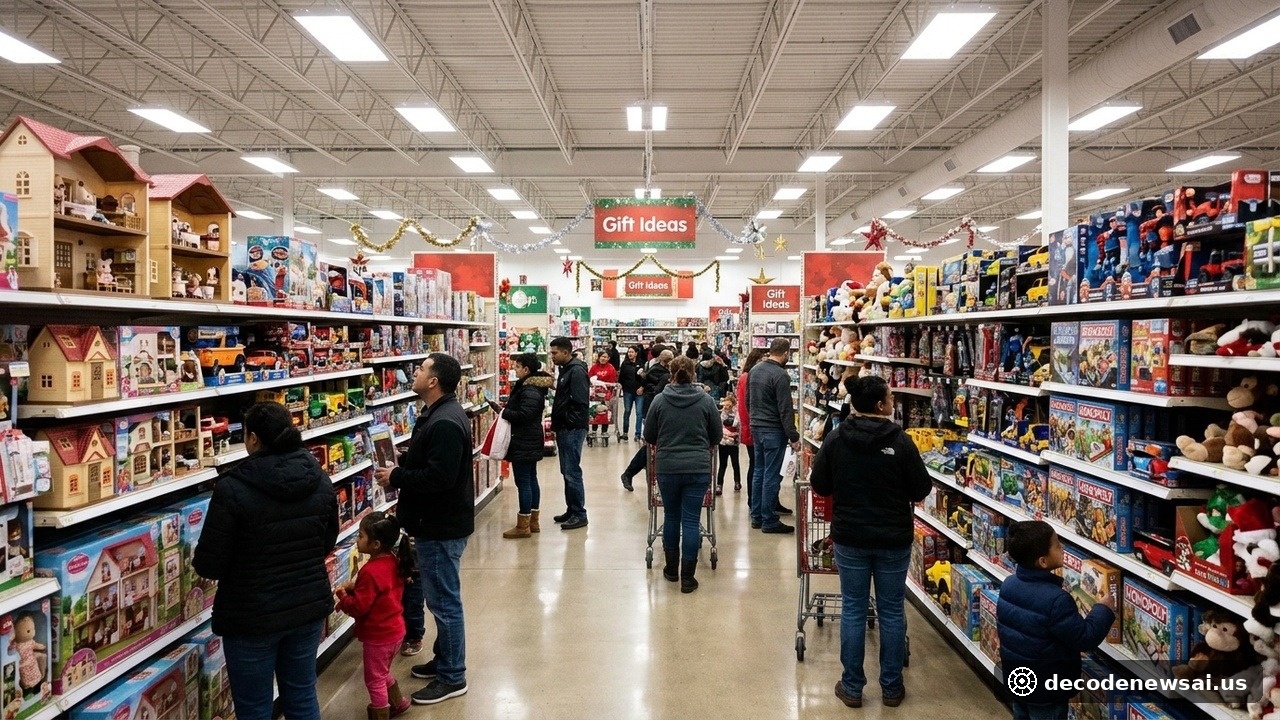
Mattel lowered its full-year 2026 sales and earnings outlook on November 5, saying consumer demand weakened toward the end of the third quarter and that the slowdown continued into the fourth. The toy maker reported quarterly revenue growth, and adjusted earnings exceeded analyst expectations, but sales missed forecasts and performance varied sharply across its major brands. The revised outlook puts new Chief Executive Roger Lynch under pressure just as the company enters the holiday shopping season, a critical period for toy sales.
The company now expects constant-currency net sales growth of 1% to 4% for 2026, down from its previous range of 3% to 6%. It also reduced its adjusted earnings-per-share forecast to $1.05 to $1.20, from $1.27 to $1.39. Mattel said the change reflected softer-than-expected point-of-sale trends that emerged late in the third quarter and continued into the fourth quarter across its major markets.
Full-year guidance falls as consumer demand softens
The revised forecast marks a more cautious view of the business heading into the most important selling period of the year. Mattel expects adjusted operating income of $500 million to $570 million and an adjusted gross margin of roughly 48% for the full year. The company said its updated outlook reflects the demand trends it is seeing now, rather than the assumptions behind its earlier forecast.
Management said the slowdown was broad across its major markets. It did not describe the weakness as a problem isolated to one country or product category. The company also said it had inventory and supply-chain capacity to serve demand within the revised sales range. That assurance reduces the risk that the lower forecast is being driven by an inability to supply products, but it does not resolve the question of whether consumers will buy enough toys during the holiday season.
The fourth quarter is particularly important for toy companies because holiday purchases can account for a significant portion of annual sales. Mattel's lowered guidance therefore reflects more than a single disappointing quarter: it indicates that management has seen weaker retail demand continuing into the period when sales would normally be expected to accelerate.
Quarterly profit beats estimates, but revenue misses
Mattel reported third-quarter net sales of $1.807 billion, up 4% from a year earlier. The result was below analysts' expectation of about $1.84 billion. Adjusted earnings were $1.30 per share, compared with $0.91 a year earlier and above the analyst consensus of $0.94. Net income increased to $353.6 million from $278.4 million.
Adjusted gross margin rose to 55%, an increase of 4.8 percentage points from the prior-year quarter. Mattel attributed much of the improvement to $88 million in tariff refunds received during the period. Inflation and higher royalty costs offset some of the benefits from cost savings and foreign-exchange movements.
The tariff refunds are important when assessing the quality of the quarter. They boosted reported profitability, but they do not necessarily indicate that the underlying economics of Mattel's brands improved by the same amount. The company said its revised full-year guidance excludes tariff-refund benefits already recognized during the year as well as any additional refunds that may be received during the rest of 2026. Investors therefore need to separate the one-time support from recurring product sales and operating performance.
The results also showed why headline revenue growth does not tell the whole story. Sales increased, but the company missed revenue expectations and said retail trends had softened. Adjusted earnings beat estimates, yet the outlook for the full year moved lower. That combination suggests that Mattel's immediate challenge is not simply controlling costs; it is restoring more consistent consumer demand across its portfolio.
Hot Wheels holds up while Barbie and Fisher-Price struggle
Mattel's brand results were uneven. Gross billings in the vehicles category increased 9%, with Hot Wheels gross billings up 7%. The dolls category rose 4%, but growth from partner brands, including the addition of KPop Demon Hunters products, largely offset a decline in Barbie. Gross billings in the infant, toddler and preschool category fell 16%, primarily because of weakness at Fisher-Price.
The contrast is significant for a company whose strategy depends on turning well-known intellectual property into products, entertainment and licensing opportunities. Hot Wheels has been a relative bright spot, while Barbie and Fisher-Price need stronger execution. Mattel has been trying to extend its brands beyond traditional toys, but that strategy still depends on products and content generating consumer interest at retail.
On the earnings call, Lynch said Mattel could apply lessons from Hot Wheels to other parts of its portfolio. He pointed to clearer audience segmentation and the brand's expansion into car culture and lifestyle, including efforts to reach adult fans and collectors. He described Barbie's current performance as below where it needs to be and said the company must execute more consistently with products, content and cultural moments.
Lynch did not provide a detailed 2027 forecast. Mattel typically gives its next-year outlook with its fourth-quarter results, expected in February 2027. Until then, investors will be looking for signs that the company can improve the performance of its major brands without weakening investment in product development and marketing.
New leadership faces activist pressure and a holiday test
Lynch took over as chief executive earlier in the week after longtime CEO Ynon Kreiz left in October. Mattel also announced that Steve Totzke would return as president and chief operating officer, effective November 11. Totzke previously served as president and chief commercial officer and continued advising the company after stepping away from that operating role.
The leadership changes come as some shareholders have urged Mattel to consider strategic alternatives, including a possible sale. Activist investors have criticized the company's performance and called for a sharper response. The company, for its part, has emphasized an intellectual-property strategy intended to expand brands such as Barbie, Hot Wheels and UNO through entertainment, licensing and consumer products.
That strategy could create growth beyond the traditional toy aisle, but it does not remove the need for strong demand for the core products. The third-quarter results show a portfolio in which some brands are growing while others remain under pressure. A stronger entertainment or licensing business may take time to translate into consistent retail sales.
The immediate test is the holiday quarter. If demand stabilizes, Mattel may be able to meet its reduced guidance and give Lynch more room to reshape the business. If the slowdown continues, the company could face another round of pressure on its forecasts, brand strategy and leadership. Tariff refunds helped margins in the latest quarter, but sustained improvement will depend more directly on consumer purchases, product execution and the ability to turn brand recognition into repeatable sales.