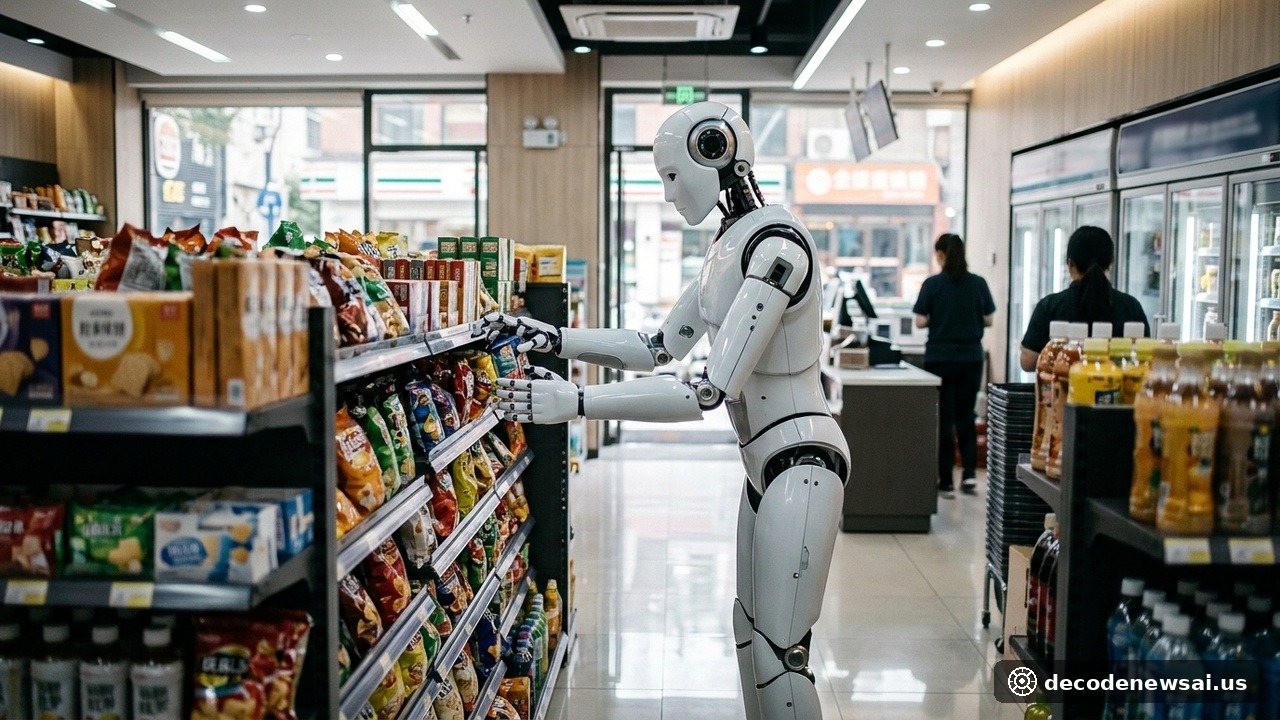
Between November 2 and November 3, 2026, Chinese robotics manufacturer AgiBot deployed six of its G2 humanoid robots for an unprecedented 24-hour operational trial at a commercial convenience store in the Xuhui district of Shanghai. Billed publicly as "Robots Never Clock Out," the continuous livestreamed demonstration challenged the bipedal machines to perform front-line convenience retail tasks alongside human employees, navigating active store environments populated by real customers. The trial attracted more than 2 million online viewers across digital streaming platforms, concluding with official performance evaluations that saw four robots pass their workplace probation while two failed to meet required operational standards. The ambitious showcase provided millions of curious viewers worldwide with an unvarnished look at the practical realities, operational limitations, and societal reactions surrounding commercial automation in a modern urban metropolis.
Sustaining Continuous 24-Hour Operations Across 1,730 Retail Tasks
According to reports published by Xinhua and Pandaily, the trial began at 10:00 a.m. on November 2 and concluded at 10:00 a.m. on November 3. The operational shift exposed the robotic workforce to a full diurnal retail cycle, encompassing high-density lunch rushes, afternoon lulls, evening shopping crowds, overnight maintenance periods, and early morning breakfast rushes. Operating under the centralized orchestration of AgiBot's Genie Master embodied artificial intelligence platform, the six humanoid robots collectively recorded and completed 1,730 discrete operational tasks over the course of the 24-hour shift.
Detailed performance logs released following the trial indicate significant multi-task productivity across core retail categories. Over the 24-hour period, the robot fleet delivered 683 customer greetings at store entrance zones, conducted 369 merchandise retrieval and restocking actions across narrow store aisles, and prepared 147 freshly ground coffee beverages for patrons. The humanoid workers navigated aisles, responded to customer inquiries regarding product locations, and assisted human coworkers with routine shelf replenishment, providing tangible evidence regarding the technical feasibility of deploying embodied AI systems within active consumer spaces.
The demonstration highlighted remarkable advancements in multi-agent fleet management and dynamic spatial mapping within confined indoor commercial layouts. Store managers noted that during peak daytime intervals, coordinated routing protocols enabled the machines to share narrow physical passageways with human shoppers without causing dangerous gridlock or physical collisions, demonstrating the emerging viability of synchronized cooperative automation in retail spaces. Engineers utilized real-time point-cloud sensors, tactile feedback systems, and multimodal vision models to adjust navigation trajectories dynamically as foot traffic fluctuated throughout the day and evening.
Two Humanoid Workers Fail Probation After Navigational Lapses
Despite recording over a thousand completed assignments, the formal workplace assessment conducted at the conclusion of the 24-hour shift revealed significant operational limitations. Of the six deployed AgiBot G2 units, four successfully passed their probationary review, while two were formally designated as having failed their evaluations due to task breakdowns and navigational errors encountered under real-world operating conditions.
The two machines that failed their performance audit included a unit assigned to store cleanliness and a unit tasked with inventory monitoring and shelf patrol. During peak evening operations, the sanitation robot encountered an overfilled trash receptacle, which triggered a perceptual error that caused the machine to deviate from its assigned route and freeze in place until operators intervened. Meanwhile, the shelf inspection unit struggled to maintain sensor tracking amidst dense crowds of moving customers, resulting in delayed inventory logging and missed stock notifications. The public failure of the two units quickly went viral on social media, prompting humorous commentary among netizens who noted that even advanced humanoid robots are not immune to the pressures of workplace probation, performance reviews, and dismissal in competitive economic environments.
Observers remarked that seeing high-tech robots struggle with basic workplace unpredictability humanized the technological transition, highlighting the vast gap between scripted laboratory demonstrations and messy retail environments.
Real-World Retail Complexities Highlight Embodied AI Engineering Hurdles
Industry analysts and robotics researchers noted that while the Shanghai experiment served as a compelling public demonstration, it underscored the substantial gap separating controlled laboratory benchmarks from messy commercial deployments. Unlike factory assembly lines or automated fulfillment warehouses where physical variables and lighting conditions are strictly controlled, retail convenience stores present continuous physical unpredictability, ranging from wandering children and irregular floor clutter to misplaced merchandise and sudden liquid spills.
Technology commentators also emphasized that public livestream broadcasts do not fully clarify whether the robotic clerks operated with absolute continuous autonomy or relied on battery swapping breaks, periodic hardware recalibrations, or human teleoperation intervention during moments of operational stalling. The necessity of physical maintenance and power management remains a central consideration for store proprietors evaluating the true return on investment for robotic workers. As robotics enterprises accelerate efforts to commercialize service humanoids across hospitality, logistics, and retail, the 24-hour Shanghai convenience store trial provides invaluable field data regarding the sensory, algorithmic, and mechanical hurdles that humanoid machines must overcome before achieving permanent commercial viability in customer-facing environments worldwide. The experiment marks a pivotal first step toward understanding how embodied synthetic workers will interact with human societies.